In this guide
Open Settings, Accessibility, Colour and motion, Colour correction and turn on Use colour correction. Pick Red-green green weak, Red-green red weak, Blue-yellow or Greyscale. Intensity sets the strength, except for Greyscale. A shortcut is on the same page.
- Device
- Android
- Shown on
- Google Pixel 10a, Android 17 (build CP3A.261005.005)
- App
- Settings
- Path
- Settings › Accessibility › Colour and motion › Colour correction: Use colour correction
- Real screenshots
- 8 of 8 steps
- What we did
- Looked at each screen; changed nothing
- Checked
- October 2026
- Sources
- 2 official, linked below
Step by step
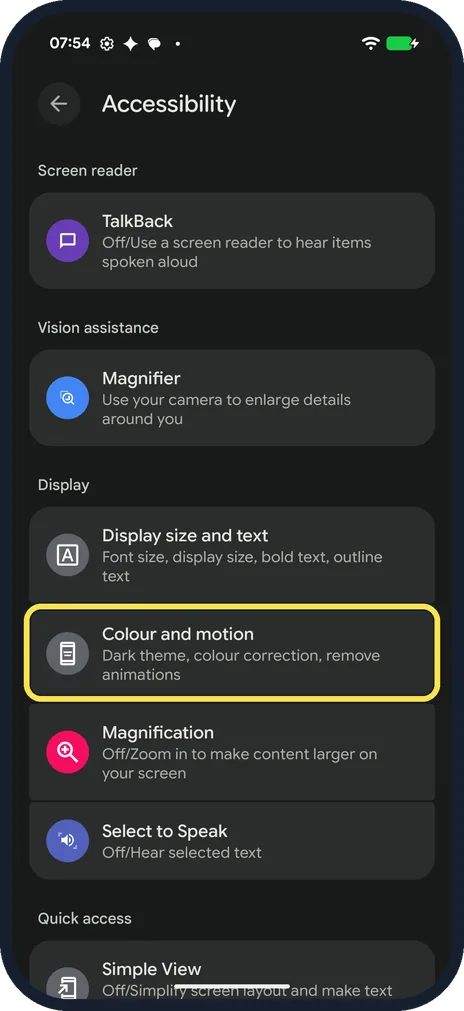
Open Colour and motion
Open Settings and tap Accessibility. Under Display, tap Colour and motion: Dark theme, colour correction, remove animations.
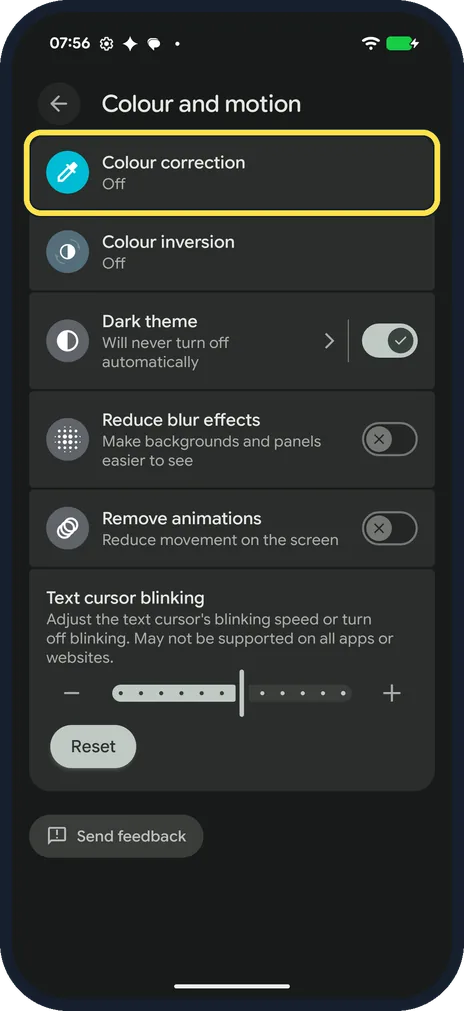
Tap Colour correction
Colour correction is the first row. Ours said Off.
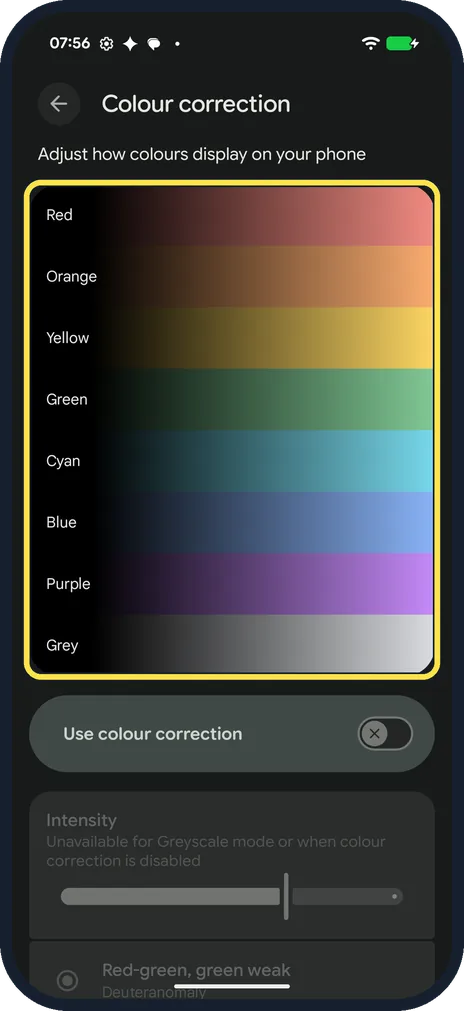
Use the colour strip
The page opens with a strip of Red, Orange, Yellow, Green, Cyan, Blue, Purple and Grey. Watch it to see what each choice does.
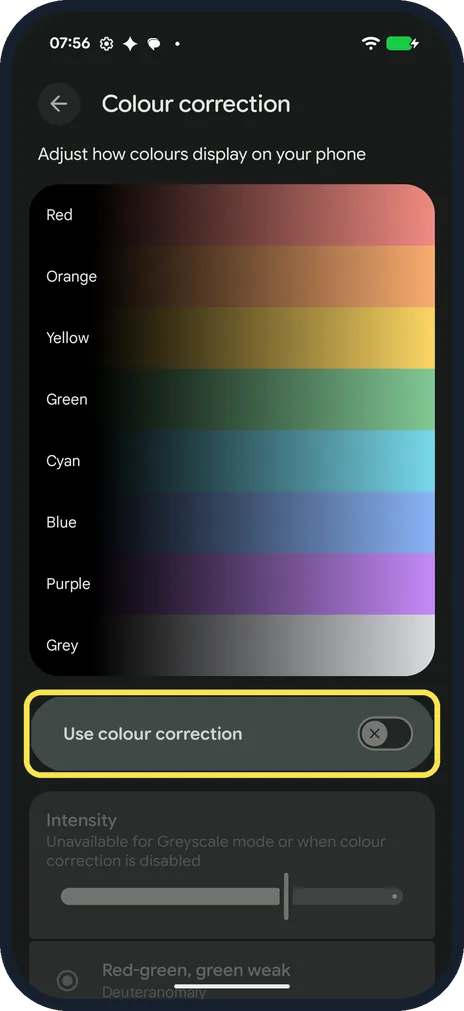
Turn on Use colour correction
Turn on Use colour correction under the strip. Ours was off.
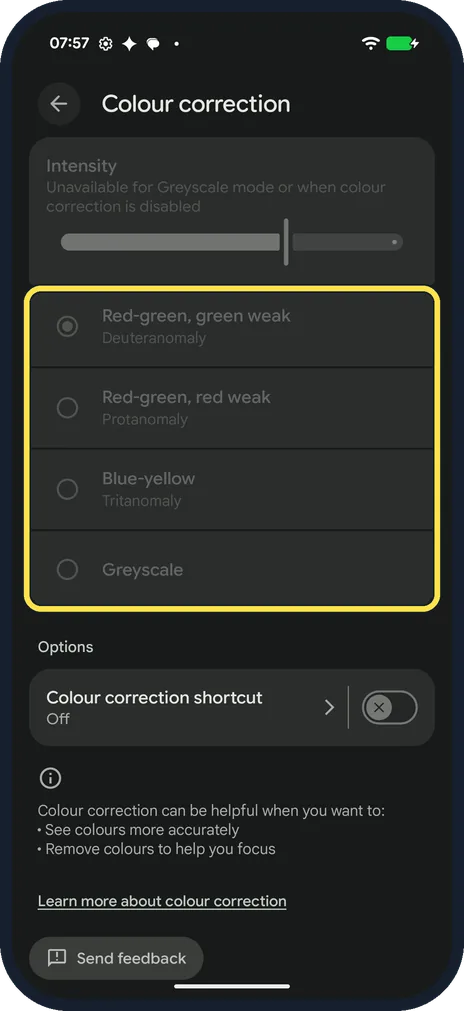
Pick a mode
The choices are Red-green, green weak (Deuteranomaly), Red-green, red weak (Protanomaly), Blue-yellow (Tritanomaly) and Greyscale. Ours had Deuteranomaly selected, greyed out while the switch was off.
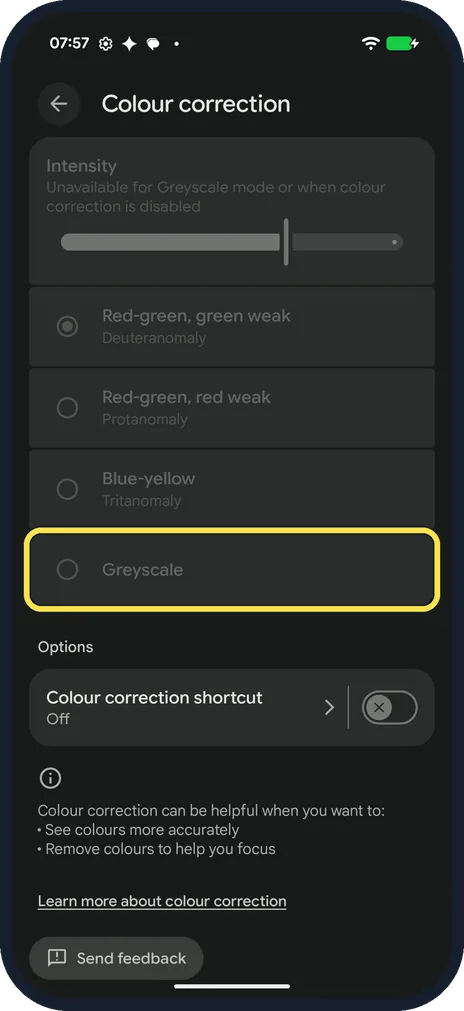
Or pick Greyscale
Greyscale is the last choice and makes the screen black and white. The page says colour correction can help you see colours more accurately or remove colours to help you focus.
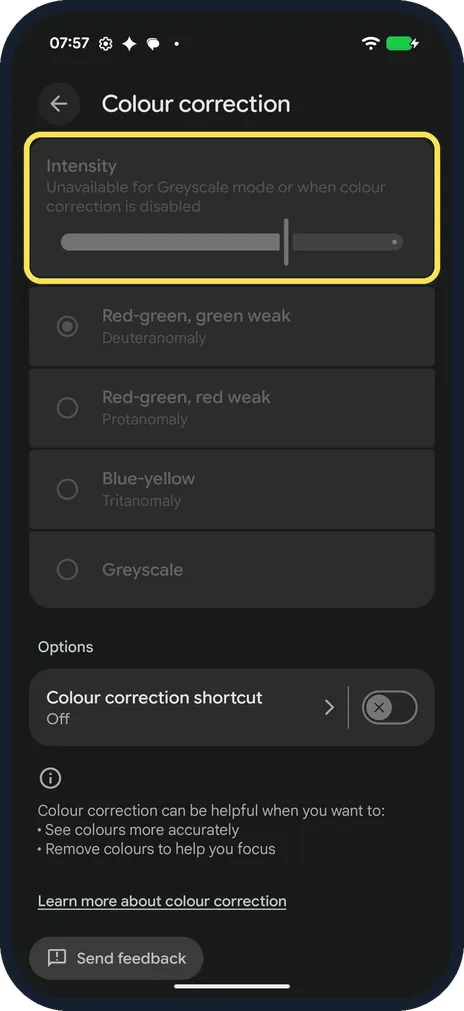
Set the intensity
Intensity sets how strong the correction is. Ours said Unavailable for Greyscale mode or when colour correction is disabled.
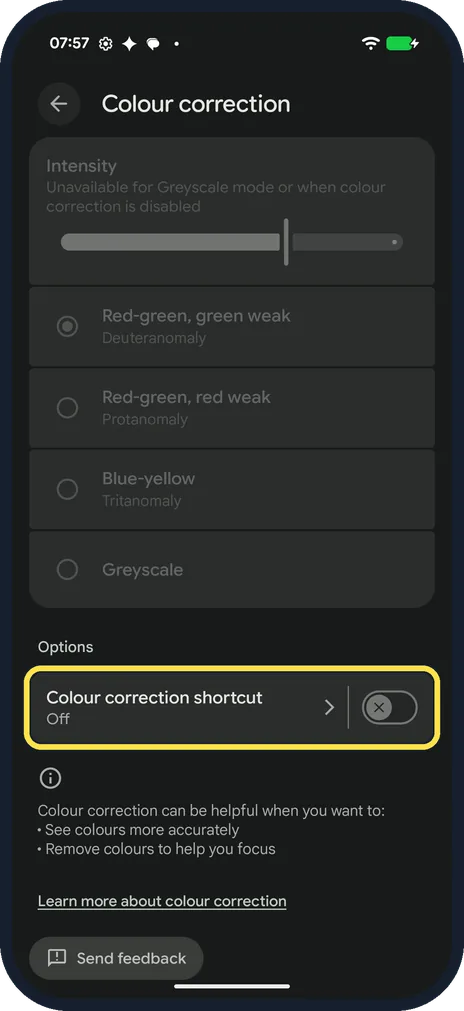
Add a shortcut
Under Options, Colour correction shortcut lets you turn it on and off quickly. Ours was Off.
If you do not see this option
- No Colour correction on your phone? Google says this feature isn't available on all devices. It was on our Pixel 10a with Android 17. Source: Change text and display settings
- Older Android version? Google says some of these display steps work only on Android 13 and up. Source: Change text and display settings
- Want greyscale only at night? Google says Bedtime mode in Digital Wellbeing has a Grayscale screen option that changes the screen to black and white at bedtime. Source: Manage how you spend time on your Android phone with Digital Wellbeing
If this does not work
- Can't pick a mode? On ours, the modes and Intensity were greyed out while Use colour correction was off. Turn the switch on first.
- Intensity slider greyed out? The page says Intensity is unavailable for Greyscale mode. Pick one of the other three modes to set it.
- Colours look odd but correction is off? Check Colour inversion and Dark theme on the Colour and motion page. On ours inversion was off and Dark theme on. See how to use dark theme on a Google Pixel.
About this guide
Colour correction helps if you have trouble telling some colours apart. Greyscale turns the screen black and white, which some people use to stay focused.
The screenshots are from our Google Pixel 10a with Android 17 (build CP3A.261005.005), in Dark mode. Colour correction was off. We only looked and changed nothing.
Good to know
For a warmer screen at night instead, see how to use Night Light on a Google Pixel.
In short: Settings, Accessibility, Colour and motion, Colour correction: Use colour correction, pick a mode or Greyscale, Intensity.
- Google Android Accessibility Help: Change text and display settings
- Google Android Help: Manage how you spend time on your Android phone with Digital Wellbeing
Links checked in October 2026. Menus and features can change after software updates. These steps match the version named at the top.
Did this guide work for you?
Sorry about that. What happened?