In this guide
Go to Settings, Display & brightness, Refresh rate. Default (recommended) was ticked on our Redmi and changes the rate by itself, up to 120 Hz. Custom (Prefer selected refresh rate) lets you choose a rate yourself. A higher rate looks smoother but uses more power.
- Device
- Android
- Shown on
- Xiaomi Redmi Note 15 Pro 5G (25080RABDG), HyperOS 3.0.308.0, Android 16
- App
- Settings
- Path
- Settings › Display & brightness › Refresh rate
- Real screenshots
- 7 of 7 steps
- Checked
- October 2026
- Sources
- 4 official, linked below
Step by step
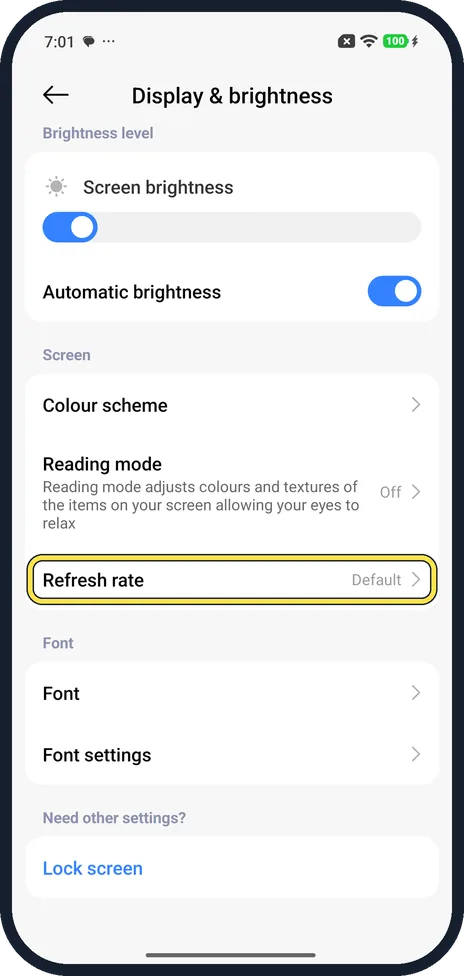
Open Refresh rate
Open Settings, tap Display & brightness and scroll to Screen. Refresh rate showed Default on ours. Tap it.
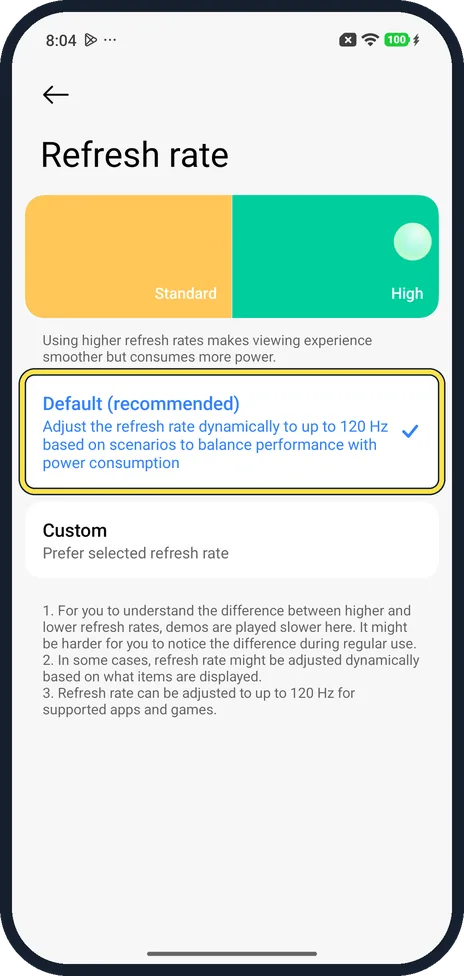
Keep Default for up to 120 Hz
Default (recommended) was ticked. Its note says it adjusts the refresh rate dynamically to up to 120 Hz, to balance performance with power use. So you already get 120 Hz where the phone thinks it helps.
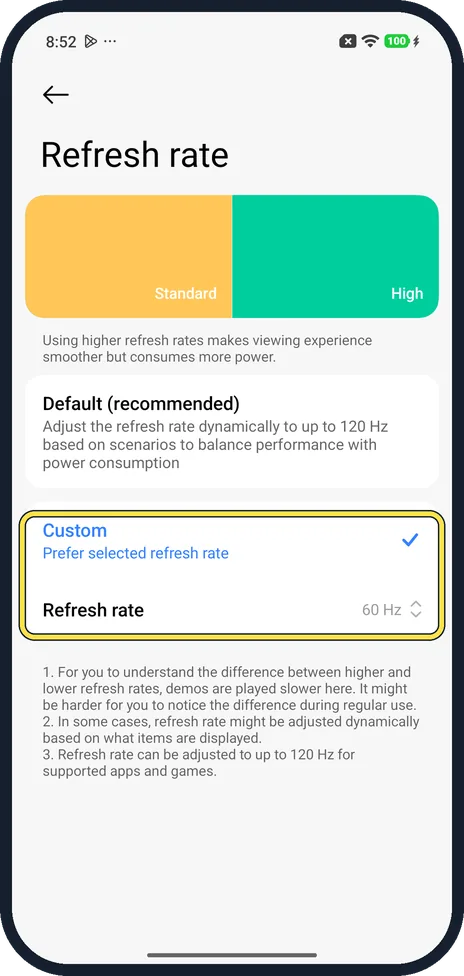
Or tap Custom
Custom says Prefer selected refresh rate. Tapping it ticked it and added a Refresh rate row, set to 60 Hz on ours.
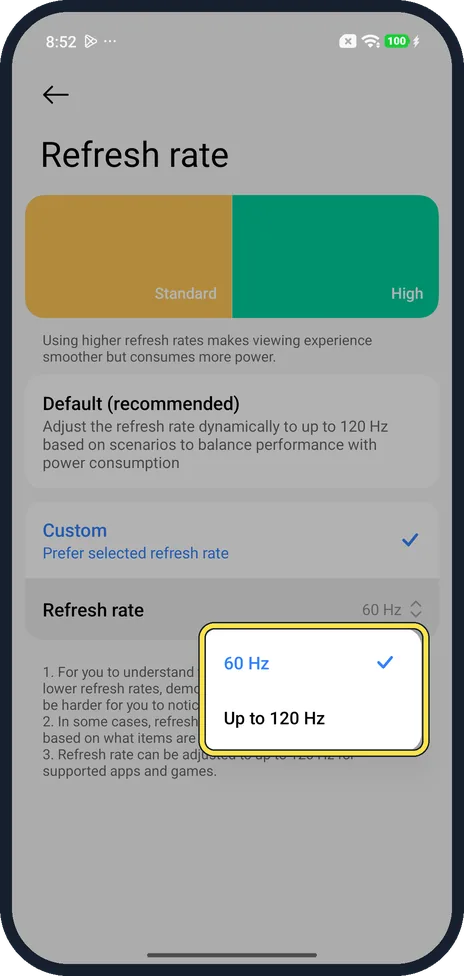
Pick the rate
Tap Refresh rate. The choices were 60 Hz and Up to 120 Hz, with 60 Hz ticked.
Check the result
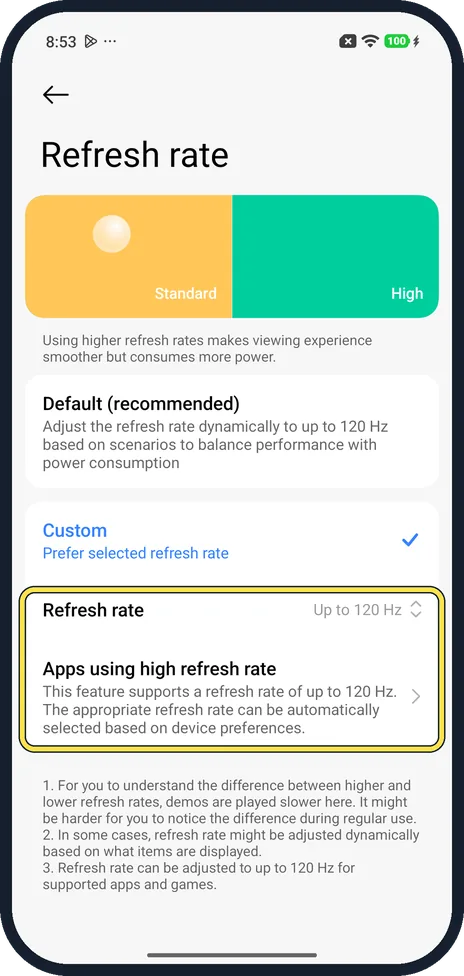
We picked Up to 120 Hz. The row then read Up to 120 Hz, and a new row appeared: Apps using high refresh rate. Afterwards we set it back to Default (recommended).
Compare Standard and High
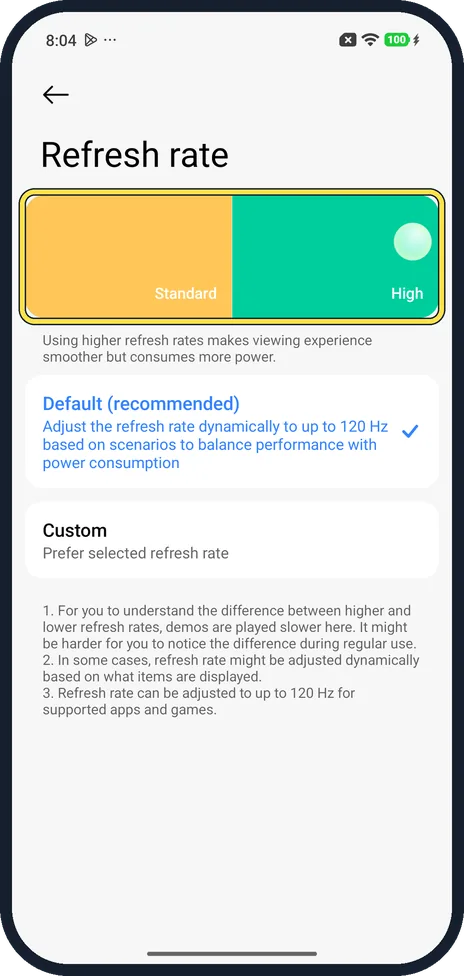
The coloured card at the top is a demo of Standard and High. Below it: Using higher refresh rates makes viewing experience smoother but consumes more power.
Read the notes
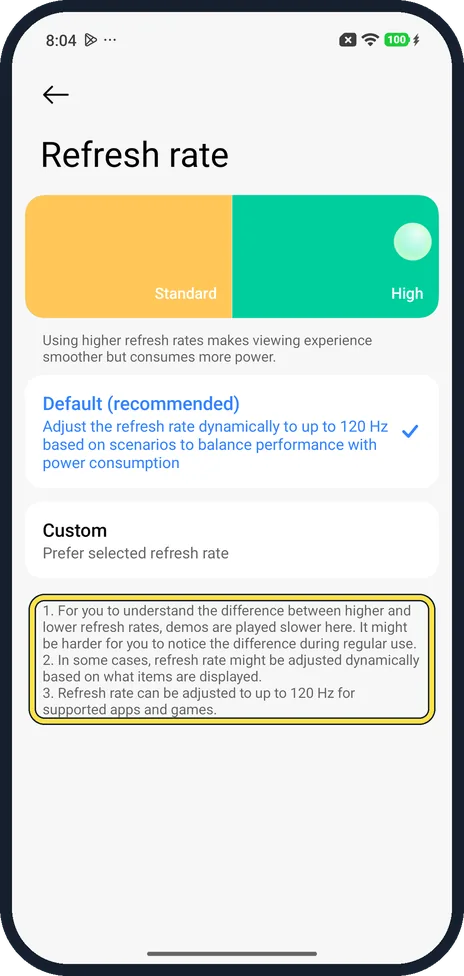
The notes say the demos are played slower so you can see the difference, the rate may change with what is on screen, and up to 120 Hz works in supported apps and games.
If you do not see this option
- No 120 Hz? Not every model goes that high. Xiaomi says the REDMI 13C 5G has a maximum of 90 Hz, and its Custom choice offers 60 Hz or 90 Hz. Our Redmi Note 15 Pro 5G says up to 120 Hz. Source: How to adjust the refresh rate on the REDMI 13C 5G?
- No Display & brightness? On older software the menu is called Display. Xiaomi's page for the REDMI Note 11 Pro+ 5G gives Settings, Display, Refresh rate. Source: How to adjust the refresh rate on the REDMI Note 11 Pro+ 5G?
If this does not work
- Scrolling still feels choppy? Xiaomi's tip for the REDMI Note 14 Pro+ 5G: open Refresh rate, tap Custom, then Refresh rate, and choose 120Hz. It also suggests closing apps you are not using. Source: Why is the display of the REDMI Note 14 Pro+ 5G stuck and not smooth?
- An app does not look smoother? The notes on our phone say up to 120 Hz is for supported apps and games, and the rate may change with what is on screen.
- Battery runs down faster? The page says higher rates use more power. Go back to Default, or check battery mode and battery use.
About this guide
The refresh rate is how many times a second the screen redraws. A higher rate makes scrolling look smoother.
The screenshots are from our Redmi Note 15 Pro 5G with Xiaomi HyperOS 3.0.308.0 and Android 16, in Light mode. Default was ticked on ours. We only opened these screens and changed nothing.
Good to know
Change the screen colours next: how to change the colour scheme.
In short: Settings, Display & brightness, Refresh rate. Default goes up to 120 Hz; Custom to choose.
- Xiaomi: Generic User Guide for HyperOS 3.0
- Xiaomi Support: How to adjust the refresh rate on the REDMI 13C 5G?
- Xiaomi Support: How to adjust the refresh rate on the REDMI Note 11 Pro+ 5G?
- Xiaomi Support: Why is the display of the REDMI Note 14 Pro+ 5G stuck and not smooth?
Links checked in October 2026. Menus and features can change after software updates. These steps match the version named at the top.
Did this guide work for you?
Sorry about that. What happened?