In this guide
Open Settings, Display and touch and tap Brightness level, the first row. A slider opens over the top of the page; drag it. Adaptive brightness, the next row, changes the brightness to the light around you. Its page has the Use adaptive brightness switch, on on ours.
- Device
- Android
- Shown on
- Google Pixel 10a, Android 17 (build CP3A.261005.005)
- App
- Settings
- Real screenshots
- 6 of 6 steps
- What we did
- Looked at each screen; changed nothing
- Checked
- October 2026
- Sources
- 2 official, linked below
Step by step
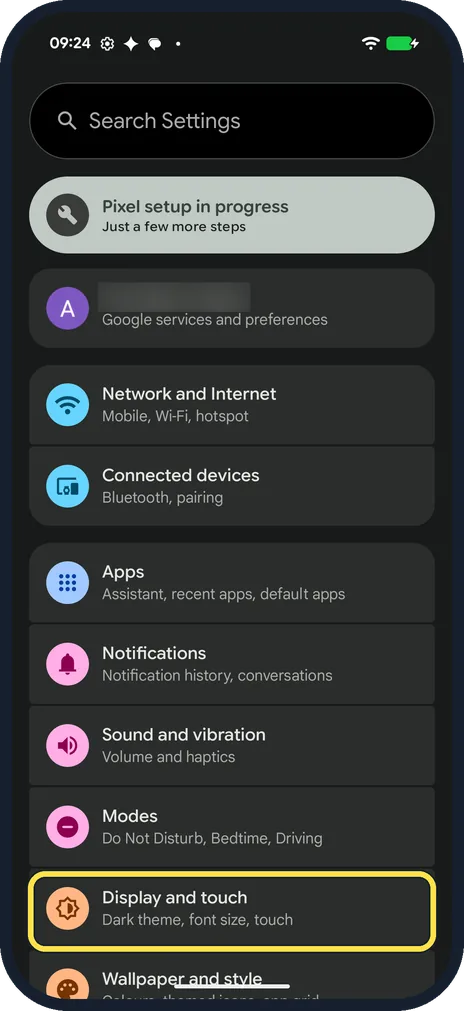
Open Display and touch
Open Settings and tap Display and touch (Dark theme, font size, touch).
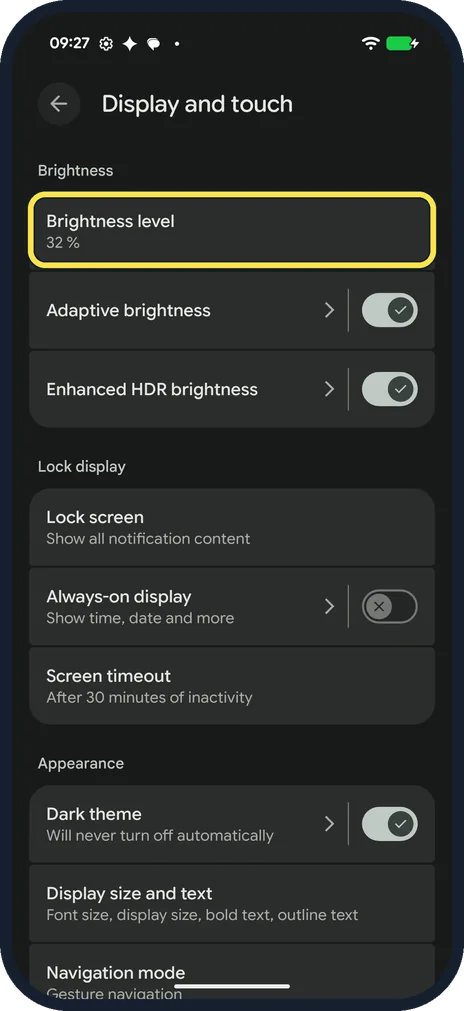
Tap Brightness level
The page opens with Brightness at the top. Brightness level is the first row; ours said 32 %. Tap it.
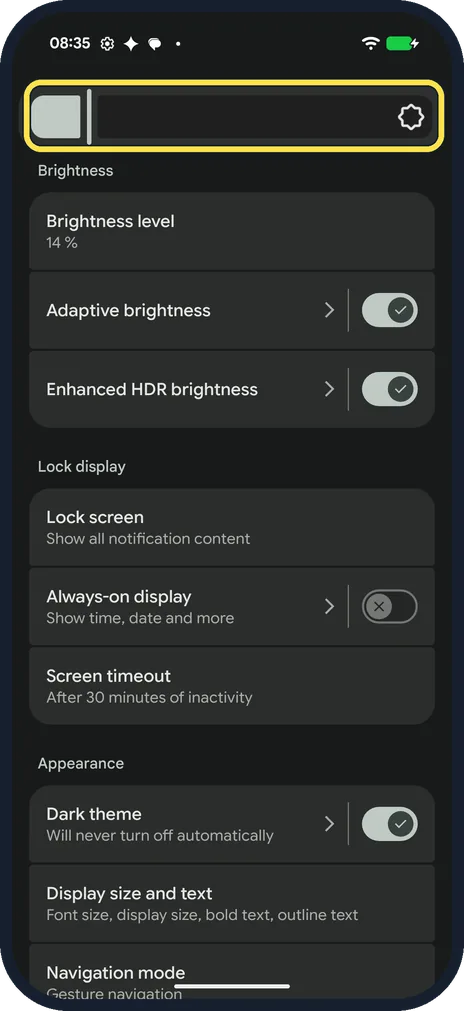
Drag the slider
A slider opens across the top of the page, over the title. Drag it right for a brighter screen, left for a dimmer one.
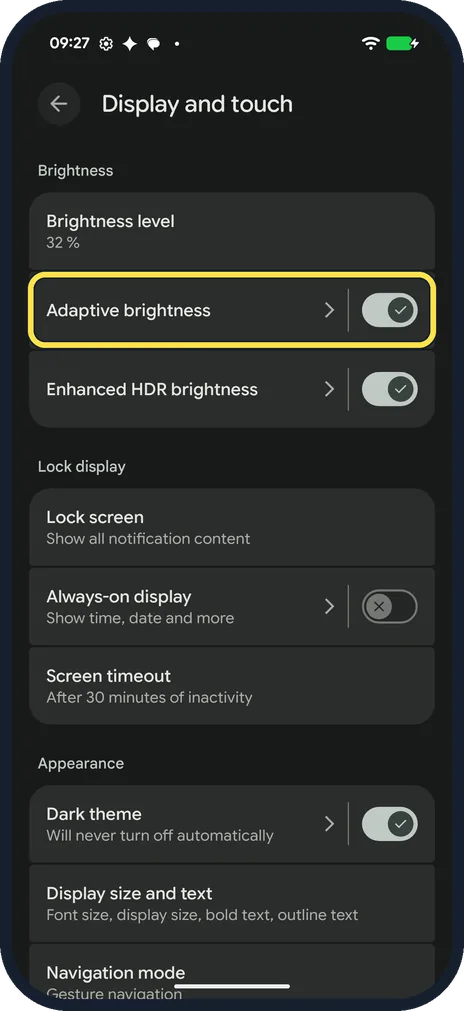
Open Adaptive brightness
Adaptive brightness is the next row. The switch on the row turns it on or off; tap the words to open its page. Ours was on.
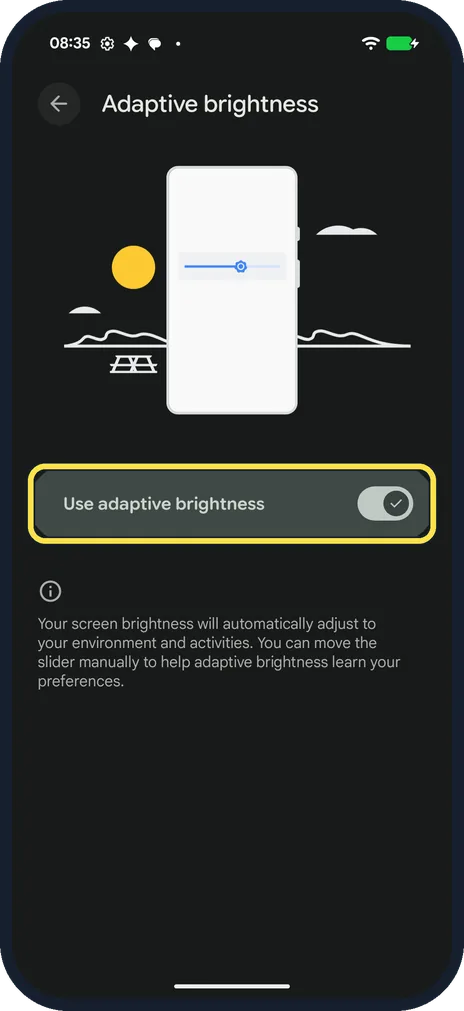
Use adaptive brightness
Turn Use adaptive brightness on or off. It stayed on on ours. The note says your screen brightness will adjust to your environment and activities, and you can move the slider manually to help adaptive brightness learn your preferences.
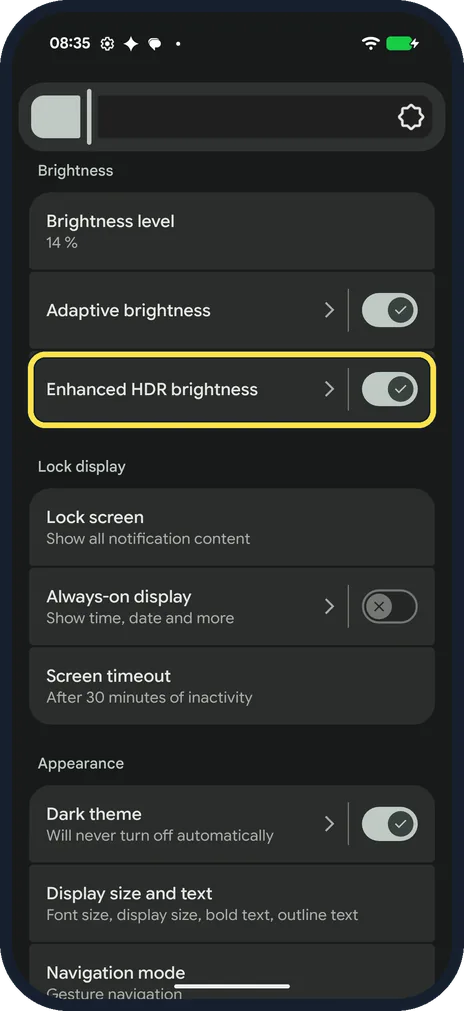
Enhanced HDR brightness
Back on Display and touch, Enhanced HDR brightness, below Adaptive brightness, was also on, with its own switch. We didn't open it.
If you do not see this option
- Want it darker than the lowest setting? Google says Extra dim dims the screen beyond the minimum. On Pixel 10 and later it is part of the brightness slider in Quick Settings; on Pixel 9 and earlier it is a switch under Settings, Accessibility. Source: Change text and display settings
- Brighter than the slider allows in sunlight? Google says that on Pixel 4 and later, adaptive brightness can briefly go above the normal maximum in very bright light, such as direct sunlight. Source: Manage screen & display settings on a Pixel phone
- Quicker way? Google says Quick Settings, from the top of any screen, has your most-used settings, and that on Pixel 10 and later the brightness slider is in the Quick Settings menu. Source: Manage screen & display settings on a Pixel phone · Source: Change text and display settings
If this does not work
- Brightness keeps changing by itself? That is adaptive brightness. Google says it is on by default and learns your preferences over time. On ours Brightness level read 14 % in one shot and 32 % in a later one. Move the slider to teach it, or turn Use adaptive brightness off. Source: Manage screen & display settings on a Pixel phone
- Screen too dark to read outdoors? Turn adaptive brightness on so it can raise the screen in bright light, or drag the slider right. Source: Manage screen & display settings on a Pixel phone
- Battery running down fast? A bright screen uses more power. See Pixel battery draining fast? What to check.
About this guide
Brightness is a slider. Adaptive brightness moves it for you as the light changes.
The screenshots are from our Google Pixel 10a with Android 17 (build CP3A.261005.005), in Dark mode. Adaptive brightness was on. We only looked and changed nothing.
Good to know
A warmer screen at night: how to use Night Light on a Google Pixel.
A darker look everywhere: how to use dark theme on a Google Pixel.
In short: Settings, Display and touch: Brightness level (slider), Adaptive brightness, Use adaptive brightness.
- Pixel Phone Help: Manage screen & display settings on a Pixel phone
- Google Android Accessibility Help: Change text and display settings
Links checked in October 2026. Menus and features can change after software updates. These steps match the version named at the top.
Did this guide work for you?
Sorry about that. What happened?