Written division in German school: how your child does it vs how you learned it
German schools write division on one line, 984 : 8 = 123, with the working under the first number and the remainder as "Rest". The steps match the UK and US method; only the layout and the words change. Some states now teach a half-written method first.
By Abu Bakar SaadatPublished 27 October 20264 min readPublisher: Saadat Rafiq
 Illustration
At a glance
- German name
- schriftliche Division (schriftliches Dividieren)
- Usually taught
- Class 4 in Germany; Year 5 (short) and Year 6 (long) in England; grade 6 standard algorithm in US Common Core
- German layout
- 984 : 8 = 123 on squared paper
- Remainder
- Germany: Rest 3 · UK: r 3, a fraction or a decimal
- Check
- Umkehraufgabe: 123 · 8 = 984
- Sources
- Mahiko and PIKAS (DZLM), Lower Saxony ministry, News4teachers, GOV.UK, Common Core, read 27 October 2026
- Checked
- October 2026
If you went to school in the UK, the US, Pakistan or India, your child's German maths homework can look strange. The maths is the same. What changes is where the numbers go on the page and the words the teacher uses. This guide shows the German way next to the British and American way, so you can help without teaching a second method.
The same sum, two layouts
| Germany | UK and US | |
|---|---|---|
| How it's written | On one line: 984 : 8 = 123 | 984 under a bracket, 8 outside it on the left |
| Where the answer goes | To the right, after the equals sign | On top, above the bracket |
| Where the working goes | Underneath 984, one digit per box | Underneath 984, inside the bracket |
| Remainder | "Rest", for example 322 Rest 3 | "r 3", or as a fraction or decimal (UK Year 6) |
| Division sign | A colon ( : ) | ÷, or the bracket itself |
9 8 4 : 8 = 1 2 3
8
1 8
1 6
  2 4
  2 4
0 1 2 3
┌──────
8 │ 9 8 4
8
1 8
1 6
2 4
2 4
0The German layout above follows the parent guide from Mahiko, a maths project of the German Centre for Teacher Education in Mathematics (DZLM). Children write it on squared paper (Karopapier), one digit per box.
Step 1: start with the biggest place value
Your child starts at the left. Mahiko suggests saying it out loud, in the words the class uses: "Ich beginne mit der größten Stelle. 8 passt 1-mal in die 9. Schreibe 1." (I start with the biggest place. 8 goes into 9 once. Write 1.) The 1 goes after the equals sign.
Step 2: multiply, then subtract
"1 · 8 = 8, schreibe 8. 9 – 8 = 1, schreibe 1." The 8 goes under the 9, and the 1 under that. In Germany a dot ( · ) means "times".
Step 3: bring down the next digit and repeat
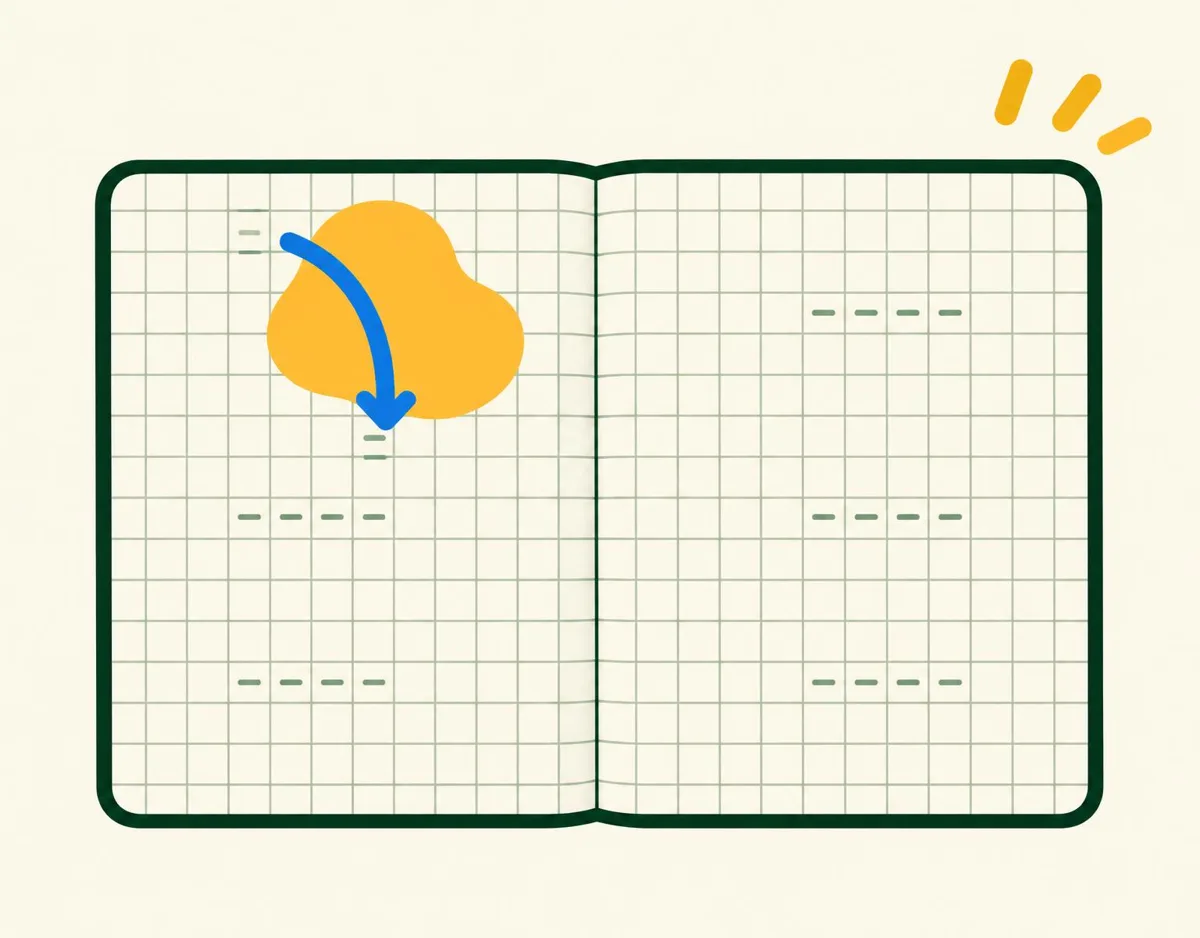
"8 Zehner dazu. 8 passt 2-mal in die 18. Schreibe 2." Then multiply and subtract again: 2 · 8 = 16, 18 – 16 = 2. Bring down the 4: 8 goes into 24 three times, 3 · 8 = 24, 24 – 24 = 0. The answer is 123.
With a remainder: "Rest"
2 2 5 7 : 7 = 3 2 2 Rest 3
2 1
  1 5
  1 4
    1 7
    1 4
      3
When the first digit is too small, your child takes two digits at once. Mahiko's wording: "7 passt 0-mal in die 2, also nehme ich die Hunderter dazu. 7 passt 3-mal in die 22." At the end, "3 bleiben übrig. Schreibe Rest 3." In England, Year 6 children also learn to write the remainder as a fraction or a decimal (GOV.UK). In German primary school it stays as "Rest".
Step 4: check with the reverse sum (Umkehraufgabe)
German teachers ask for an Umkehraufgabe: multiply the answer back. 123 · 8 = 984, so it's right. With a remainder, add it at the end: 322 · 7 = 2254, plus 3 = 2257. PIKAS lists this check, and a quick estimate (Überschlag), as things your child should be able to do.
If your child's school doesn't teach it yet
Not every state does the full method in primary school. Lower Saxony's ministry says written division is not abolished, but in primary school it is now prepared in partial steps, with half-written division (halbschriftliches Dividieren) at the centre, and learned fully at secondary school. News4teachers reported in January 2026 that the first children taught this way reach class 4 in 2028/29 at the earliest. Saxony's ministry said on 12 January 2026 that it is keeping written division in primary school: its 2025 curriculum covers it in class 4, at the level of "Einblick gewinnen" (getting a first insight).
Half-written division splits the big number into easy parts, then adds the answers:
984 : 8
800 : 8 = 100
160 : 8 =  20
 24 : 8 =   3
984 : 8 = 123
If this is what your child brings home, don't jump ahead to the written method. Ask the teacher which way they use.
If this doesn't work
- A zero goes missing: PIKAS names place value and zeros as typical mistakes. If the number brought down is too small, your child must write a 0 in the answer before going on. For example, 816 : 8 = 102, not 12.
- Times tables slow everything down: Mahiko suggests writing a list of multiples first (0 · 7 = 0, 1 · 7 = 7, 2 · 7 = 14 and so on). If your child still struggles often, go back to the times tables (das 1·1) before more division.
- The answer and the check don't match: Mahiko suggests asking "Why doesn't the same thing come out?" and letting your child find the step that went wrong.
- Your child is confused by your method: stop showing the bracket layout. Two layouts at once is harder than either one.
Questions readers ask
In which class do German children learn written division?
Usually at the end of primary school, in class 4, as the Philologenverband points out. It depends on the state: Saxony keeps it in class 4, and Lower Saxony is moving the full method to secondary school.
Why does my child write the answer after the equals sign?
Because in Germany the sum is written on one line, 984 : 8 = 123, on squared paper, one digit per box. The working goes underneath the number being divided, not under a bracket.
How does my child write a remainder in German?
With the word Rest after the answer, for example 2257 : 7 = 322 Rest 3. Mahiko's parent material uses this wording: "Schreibe Rest 3".
Is the German answer different from the UK or US answer?
No. The numbers are the same in every country. Only the layout and the way you talk through the steps are different.
Should I teach my child the method I learned?
Not while they are learning it at school. Use the school's layout and its words, and use your own method only to check the answer.
Sources
We base our articles on the makers' official documentation.
- Mahiko (DZLM): Schriftlich dividieren, parent guide (German, Feb 2022, PDF)
- PIKAS (DZLM): Schriftliche Division, Klasse 4 (German, Nov 2022, PDF)
- Niedersächsisches Kultusministerium: Niedersachsen schafft die schriftliche Division nicht ab (German)
- News4teachers: Philologen warnen davor, die schriftliche Division aus dem Grundschul-Lehrplan zu streichen (German, 14 Jan 2026)
- Sächsisches Kultusministerium: Sachsen hält an schriftlicher Division in Grundschulen fest (German, 12 Jan 2026, PDF)
- GOV.UK: National curriculum in England, mathematics programmes of study
- Common Core State Standards: Grade 6 The Number System (6.NS.B.2)