How to trim your dog's nails
Researched by Abu Bakar Saadat7 min read
Last updated: 15 November 2026References
On this page 10 sections
In short
Use dog nail clippers, take small cuts from the tip and stop a few millimetres before the pink quick. On black nails, take tiny slices and stop when a grey to pink oval shows. Keep styptic powder or cornflour ready in case a nail bleeds.
At a glance
- You need
- Dog nail clippers, styptic powder or cornflour, treats, a non-slip mat
- Stop
- A few mm before the quick (PDSA); best not within 2 mm (WSU)
- Advice from
- PDSA, Dogs Trust and Washington State University vet hospital, read 28 October 2026
- Checked
- November 2026
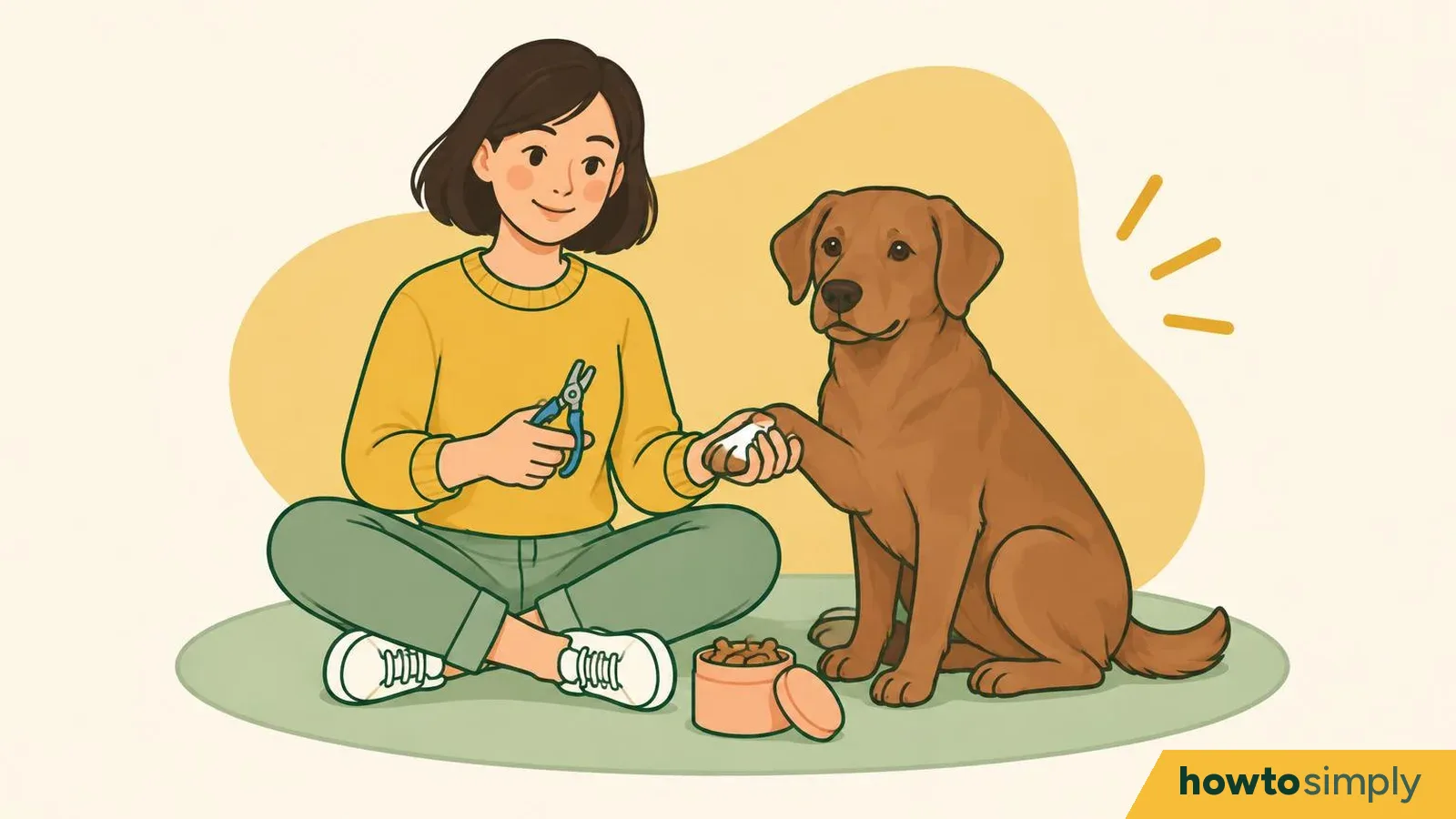
Kneeling on the ground with a paw in one hand and the clippers in the other, you're probably feeling just as anxious as your dog, especially when the nails are dark. Feeling cautious is a good thing. Making small cuts lowers the chance of cutting into the quick (WSU), and this page will show you where to stop.
Running along the centre of each nail is the quick, which holds nerves and blood vessels. Cutting into it causes your dog pain and makes the nail bleed. This means each of the steps below is designed to find where the quick ends and keep it from being damaged. WSU recommends learning to clip your dog's nails from a vet or a veterinary technician before you begin.
If your dog is nervous, start with step 1 below. If the nails are very long, the "Long and overgrown" box under Where to stop describes how to shorten them a little at a time.
Where to stop: which nails does your dog have?
Light or clear nails
Find the quick: it looks like a pink or red area inside the nail.
Cut: stop a few millimetres short of it. WSU's veterinary hospital advises not cutting within 2 mm of it.
Black or dark nails
Find the quick: it's hidden inside the dark nail. Shine a torch through the nail, or use a similar light-coloured nail as a guide.
Cut: take several small slices. Stop once a grey to pink oval shows on the cut end.
All dark, and you're unsure
Find the quick: get your vet to point out the safe place to cut.
Cut: snip off only the sharp tip.
Long and overgrown
Find the quick: it has probably grown longer as well.
Cut: take off a little, then give the quick about a week to move back before the next trim.
How to trim the nails
Get your dog used to the clippers first.
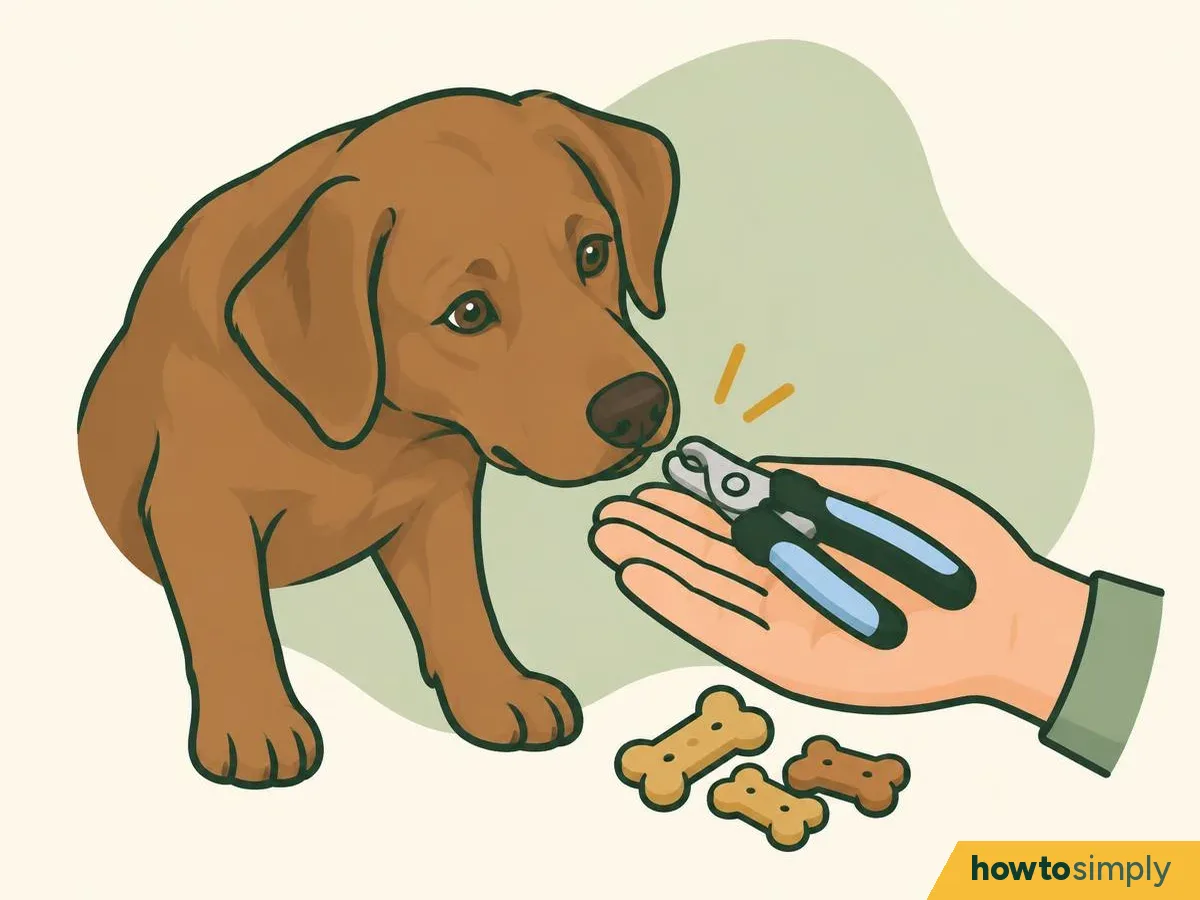
Illustration It can take a couple of weeks, or longer, before the first real trim, and that's normal. Dogs Trust suggests repeating each stage a few times a day over a few days running before going on to the next one (Dogs Trust):
- Clippers on the floor. Lay them down and scatter treats around them, so seeing them starts to mean something good.
- Sniff and touch. Rest a hand on one paw and let your dog have a good sniff of the clippers. Reward them with a treat and some praise right away.
- Nails. When touching the feet is no problem, touch the nails too, with a treat each time.
- The squeeze. Squeeze the clippers close to the nails so your dog hears the sound, then give a treat.
- The snap. Cut a piece of dried pasta, such as macaroni, next to the paw. It sounds just like a real cut, and it shows you how gently to press.
- One tip. Trim just the very end of one nail and reward. Over the next sessions, add one nail at a time.
Use the same towel or bath mat every time: it becomes a signal of what is about to happen. A lick mat or yummy treats teach your dog that having its paws touched is something nice (Dogs Trust).
Before you move on: your dog stays happy at each stage. If it looks worried, go back to a stage it was happy with.
Source
Dogs Trust
Hold one toe at a time, firmly but gently.
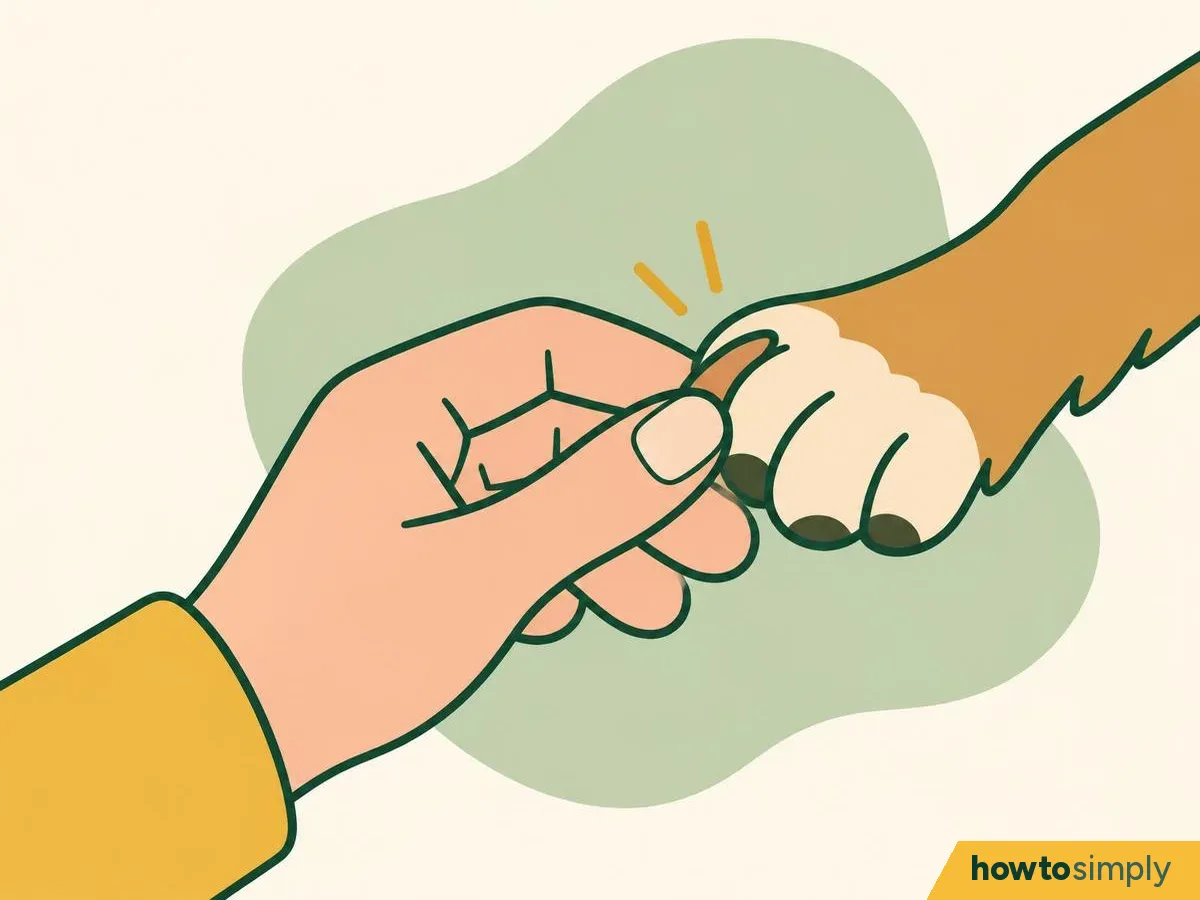
Illustration Start when your dog is relaxed. Hold the paw in a position that's comfortable for your dog and lets you see the nail, and hold one toe at a time between your thumb and forefinger.
You should see: the whole nail, clear of fur. Trim fur away if it hides the nails.
Source
PDSA, WSU, Dogs Trust
Careful: before you cut, squeeze the clippers gently on the spot. If your dog flinches, seems worried or yelps, you've found the quick, so don't cut there.
Cut a small piece from the tip, from underneath.
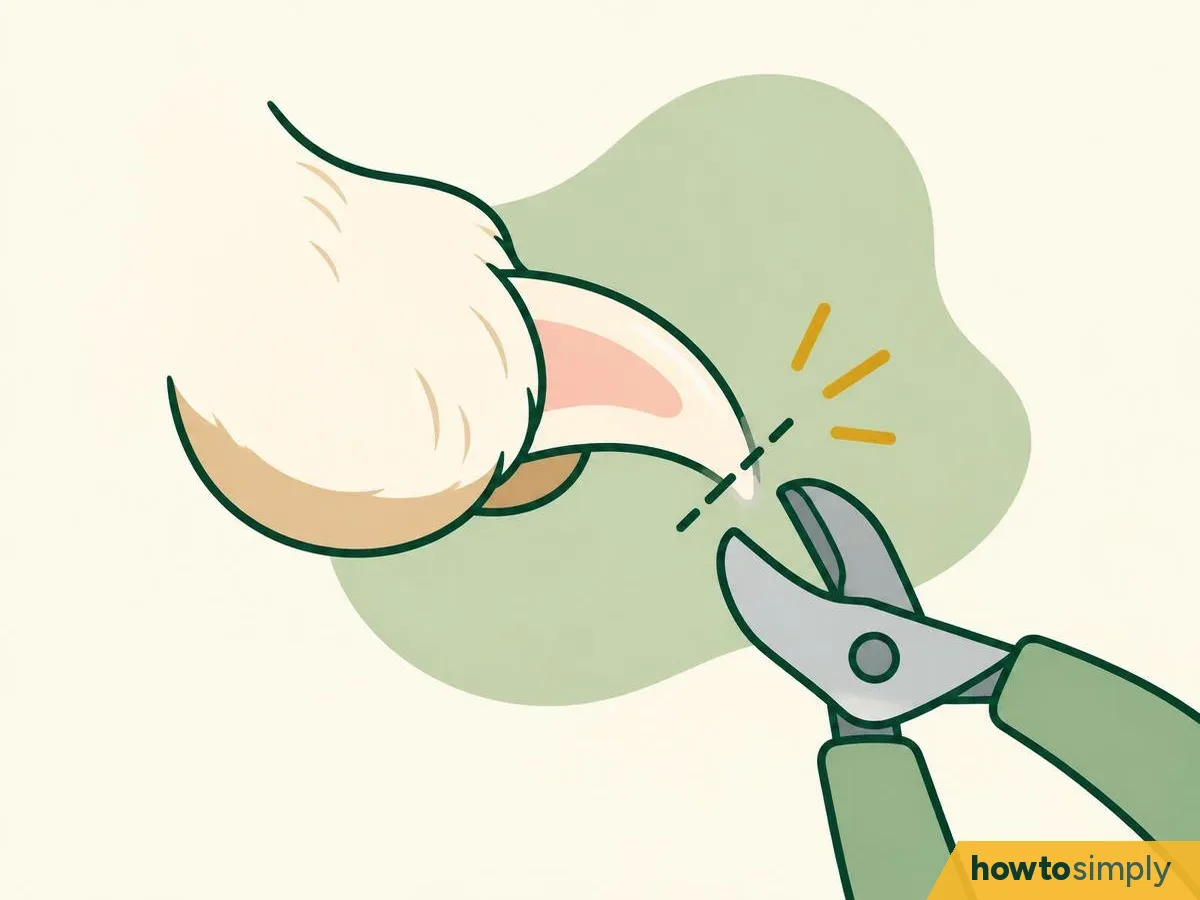
Illustration: the cut line sits well before the pink quick 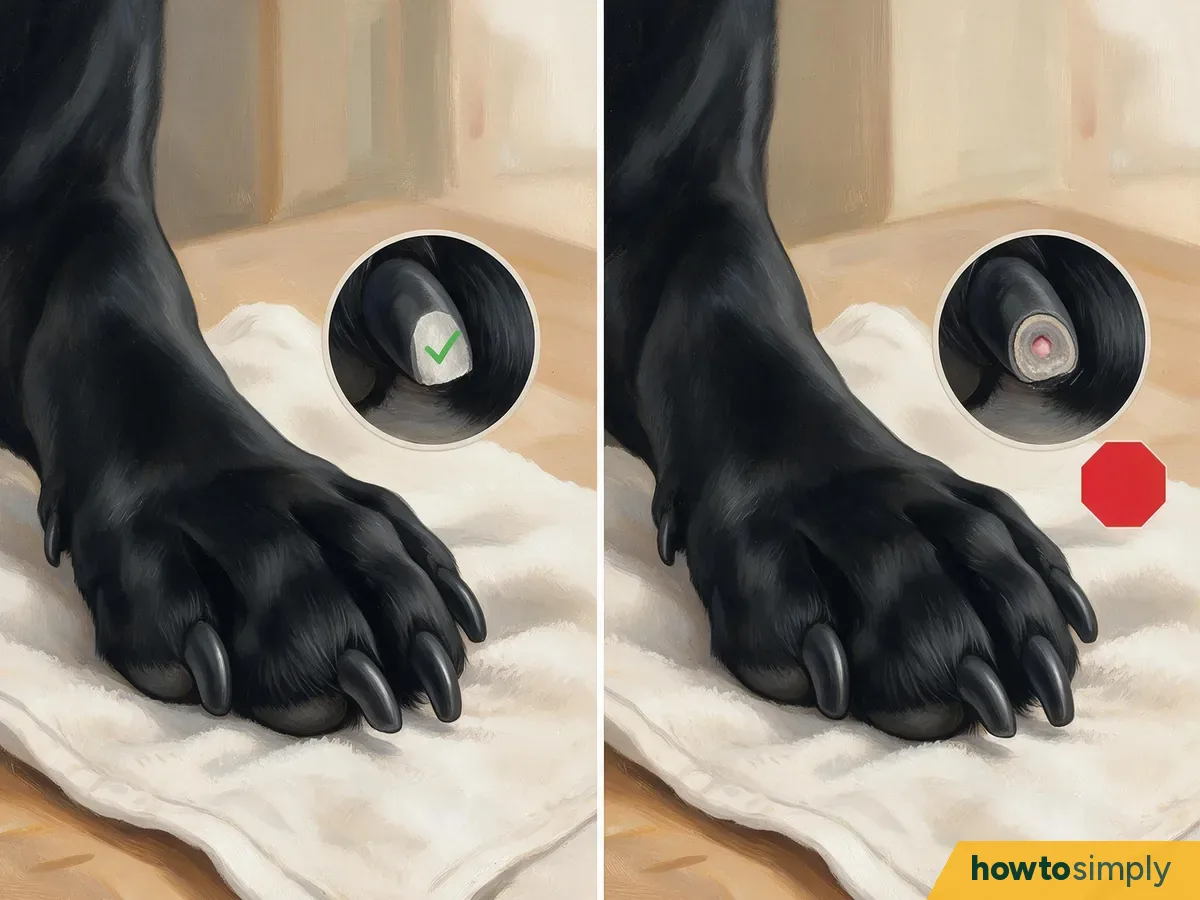
Illustration: on a dark nail, stop as soon as a grey to pink oval appears on the cut surface Clip at roughly 45 degrees, keeping the blade that cuts towards you, not the dog. Take one small cut, look at the cut surface, and decide whether to take another. It takes longer, but taking off a little at a time makes it less likely you'll nick the quick (WSU).
Check each nail on its own: the second and fifth toes often need less taken off than the third and fourth.
You should see: on a light nail, the pink quick still a few millimetres beyond your cut. On a dark nail, stop as soon as a grey to pink oval appears on the cut surface.
Source
Dogs Trust, WSU, PDSA
Don't forget the dewclaws.
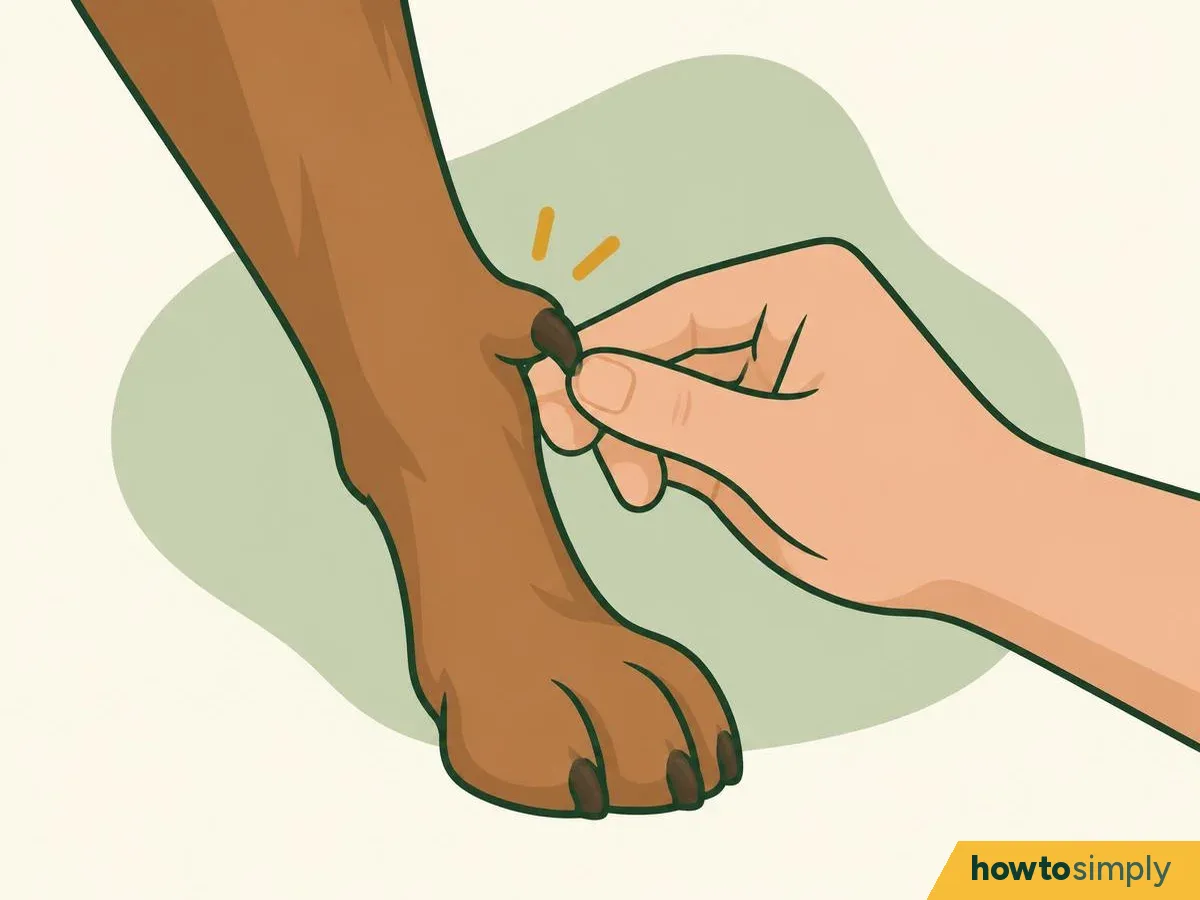
Illustration The dewclaws are the nails set further up, on the inner side of the leg. They don't touch the ground, so walking never wears them down, and a neglected one can curl round into the skin. Bend it gently away from the leg to trim it.
Count them: most dogs have five nails on each front paw and four on each back paw; a few have dewclaws on the back legs too.
Source
Dogs Trust, WSU, PDSA
How to tell you're done
- Every nail on every foot has been checked, including the dewclaws (PDSA).
- No nail is left with a thin point that is starting to curl or catches on rugs and bedding (Dogs Trust).
- No nail is bleeding. If one is, see below.
- Overgrown nails: you only took a little off, and the next trim is in about a week (Dogs Trust).
If a nail bleeds
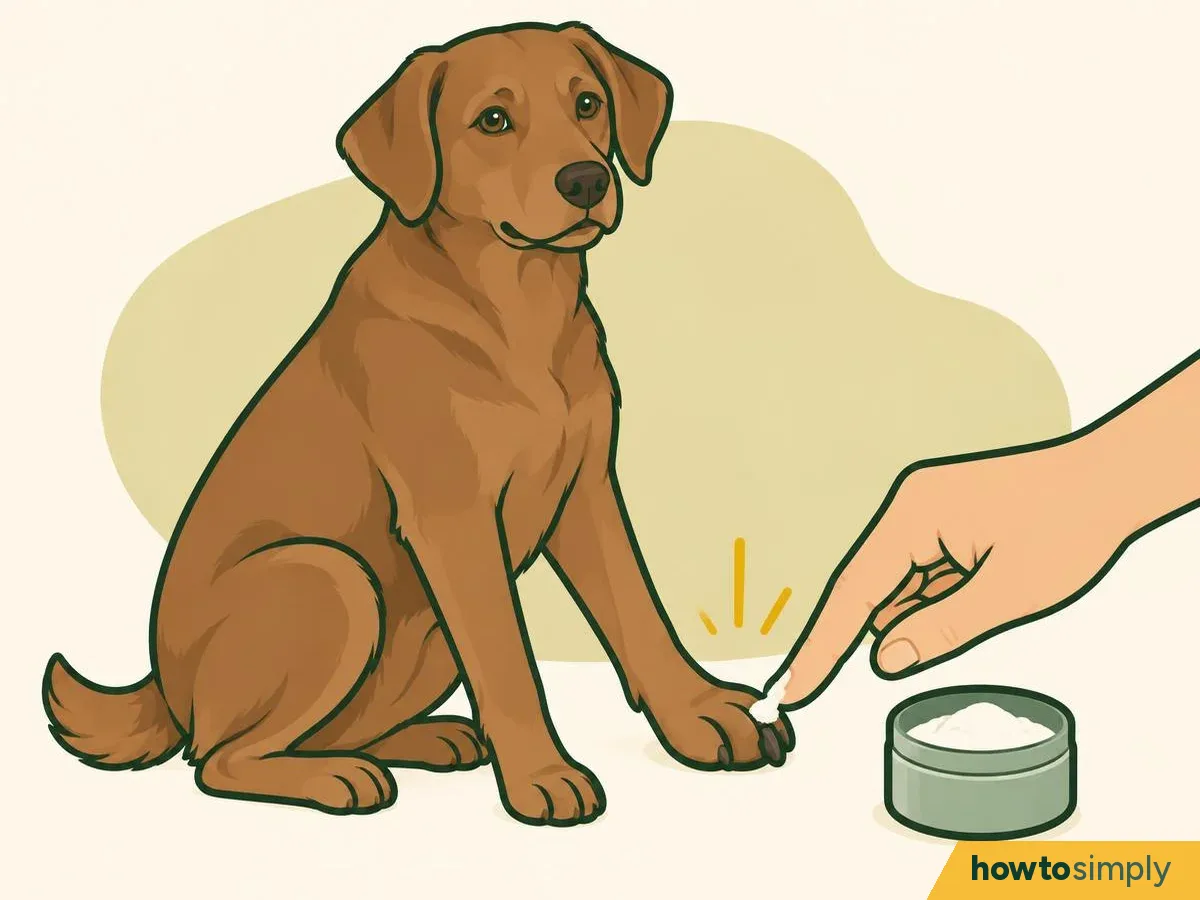
Don't be hard on yourself if this happens. Darker nails make it more difficult to see the quick (WSU). Press styptic powder or a styptic pencil onto the nail, dip it in cornflour, or hold cotton wool against it to stop the bleeding. If you don't have styptic powder, WSU says it can take about five minutes for the nail to stop bleeding. If the bleeding continues well beyond that, call your vet. Take less off that nail next time.
If something goes wrong
| What happens | What it means | What to do |
|---|---|---|
| Your dog pulls away or yelps when you squeeze the clippers | The quick is there (Dogs Trust) | Don't cut at that point (Dogs Trust) |
| You can't see the quick on a black nail | Normal for dark nails | Use a torch (Dogs Trust) and take several small slices (WSU) |
| A nail bleeds | Expect about 5 minutes before it stops if you have no styptic powder (WSU) | Press styptic powder or a styptic pencil onto the nail (Dogs Trust) |
Questions readers ask
How often should I trim my dog's nails?
Dogs Trust says to check them every couple of weeks, and to check a nail if your dog licks or nibbles it. Nails that are worn flat or don't touch the ground usually don't need clipping.
My dog's nails click on the floor. Are they too long?
Not necessarily: Dogs Trust says the sound alone doesn't mean they are too long. Look at the tip instead. A thin point that starts to curve, or nails that snag on rugs and bedding, may mean they need a trim.
Clippers or a grinder?
Both work. WSU's vet hospital calls guillotine-type clippers the easiest to use. Grinders might take longer to use and are louder, so introduce them gradually (Dogs Trust).
Can I use human nail clippers or scissors?
No. PDSA says to use dog nail clippers, never scissors or human clippers, which can crush the claw and make it split.
Sources and method
- Researched by
- Abu Bakar Saadat
- Tested by our team
- No. We have no record of anyone on our team trying these steps, so treat them as researched instructions from the sources below.
- Pictures
- 8 illustrations drawn for this article: drawings, not photos.
- Sources
- 3 named sources, linked below.
- What this page adds
- A cut-line drawing showing where to stop before the pink quick, a close-up of trimming a dewclaw, and a table on what to do if your dog yelps, the quick is hidden or a nail bleeds.
What to do next
Everyday care for your dog Step 2 of 6
Did this solve the problem?
Where did you get stuck?
What did you think?
Reaction counts are loading.
Sources
We use primary, official and specialist sources appropriate to the topic.