Dog ate chocolate? What to do now, and how much is dangerous
In short: Call your vet now, even if your dog seems fine, and keep the wrapper. Do not make your dog sick at home. Dark chocolate, baking chocolate and cocoa powder are the most dangerous; small dogs need far less to get ill.
By Abu Bakar SaadatPublished 28 October 20266 min readPublisher: Saadat Rafiq
✓ Reviewed by Dr Ramin Khan, veterinarian (DVM) · 28 October 2026
 Illustration
At a glance
- Do now
- Call your vet; keep the wrapper; note weight, type, amount and time
- Do not
- Make your dog sick at home (PDSA)
- Signs start
- Usually 2 to 4 hours, up to 12 (PDSA)
- Most dangerous
- Cocoa powder, baking chocolate, dark chocolate
- Advice from
- Merck Veterinary Manual, PDSA and ASPCA, read 28 October 2026
- Checked
- October 2026
Chocolate contains theobromine and caffeine, and theobromine stays in a dog's body a long time: the Merck Veterinary Manual gives a half-life of 17.5 hours. How ill a dog gets depends on the type of chocolate, how much it ate and its size (PDSA). Only a vet can judge that, so the steps below are about getting that call right.
Who to call
If your own vet is closed, call the out-of-hours vet they use, or a poison line:
| Where you are | Who to call | Cost |
|---|---|---|
| Anywhere | Your vet, or their out-of-hours service | Normal vet fees |
| UK | Animal PoisonLine, 01202 509000, 24 hours (listed by PDSA) | £35 per case 8am to 8pm Monday to Friday, £45 at other times (PDSA page) |
| US | ASPCA Animal Poison Control, (888) 426-4435, 24 hours | "A consultation fee may apply" (ASPCA); the amount isn't on its page |
| Germany and elsewhere | Your Tierarzt or the local tierärztlicher Notdienst (out-of-hours vet) | Ask when you call |
What to do now
Move your dog away from the chocolate and keep the wrapper.
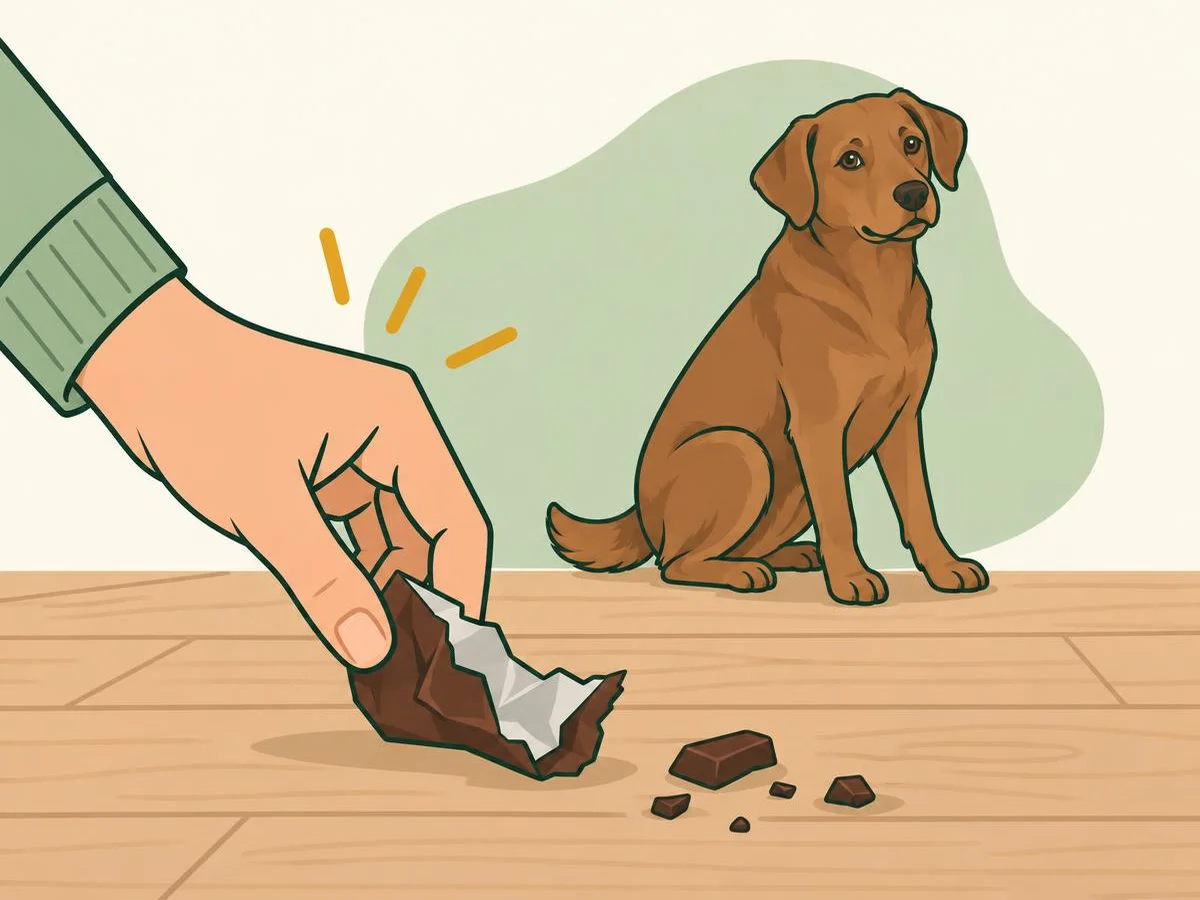
Illustration Put any chocolate left out of reach and keep the packaging. The wrapper tells your vet the type of chocolate and how much cocoa it contains (ASPCA, PDSA).
Check it for fillings: raisins and macadamia nuts are also toxic to dogs, and sugar-free chocolate may contain xylitol, which can cause low blood sugar and liver damage (ASPCA). Say so when you call.
You should see: no chocolate left within your dog's reach, and the wrapper in your hand, showing the type of chocolate and any fillings.
Note the type, the amount, your dog's weight and the time.
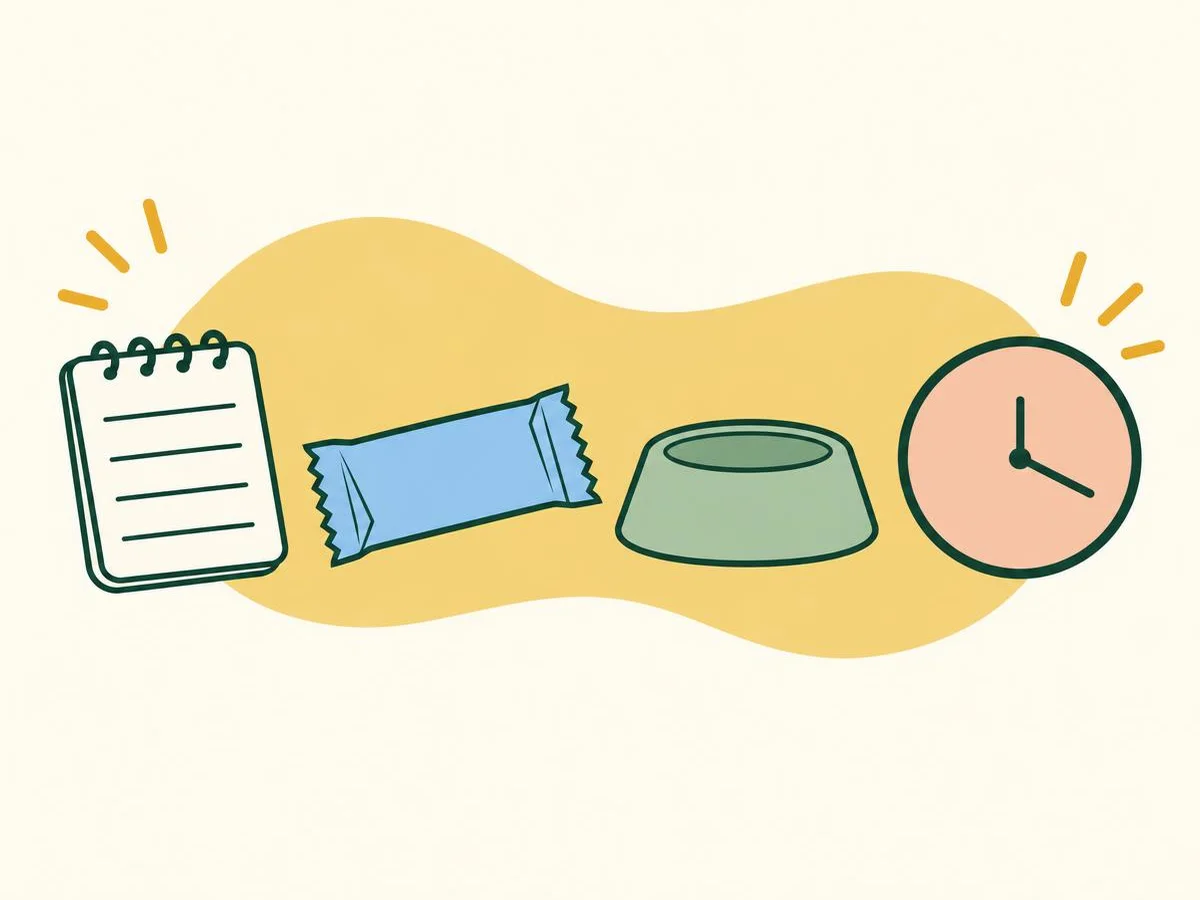
Illustration Have four things ready: the type of chocolate, roughly how much was eaten, your dog's weight, and when it happened (PDSA). Also mention any health problems your dog has (ASPCA).
Don't let this hold up the call. If you don't know one of them, call anyway and say so.
You should see: four short notes you can read out on the phone: type, amount, weight, time.
Call your vet now, even if your dog seems fine.

Illustration PDSA says to call your vet immediately. Use the numbers in Who to call if your own vet is closed. Signs usually start 2 to 4 hours after eating (PDSA), so a dog that looks well now can still become ill, and calling early gives the vet the most options.
You should see: a clear instruction from the vet or poison line. They may ask you to watch your dog at home, bring it in, or keep it in hospital (ASPCA).
Careful: don't try to make your dog sick at home (PDSA), and don't give your dog any human medicine.
Leave any vomiting to the vet and follow their advice.
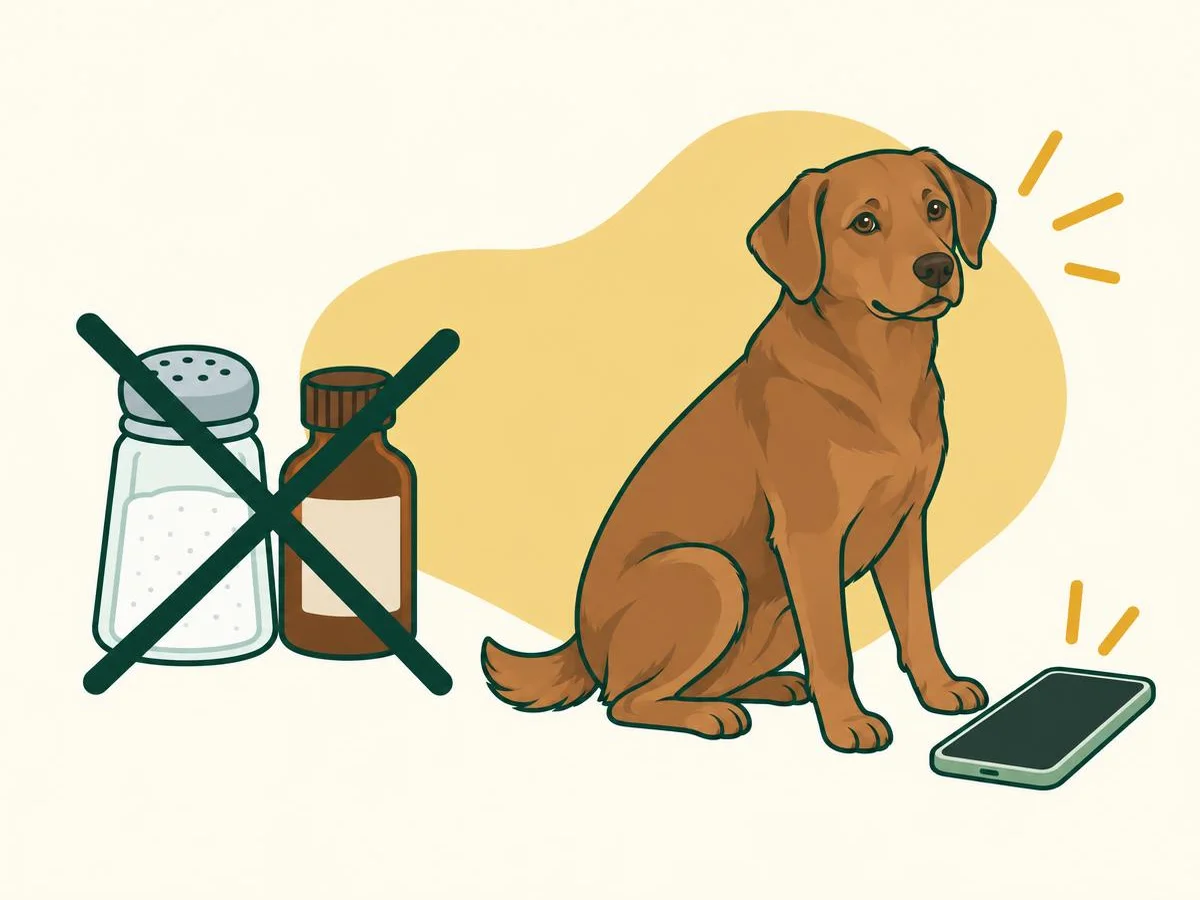
Illustration If vomiting is needed, the vet does it, usually by injection, if your dog arrives within a few hours of eating the chocolate (PDSA). That's another reason not to wait for signs before you call.
You should see: your dog on its way to the vet, or at home with you watching it, exactly as the vet said.
Careful: if you see trembling, a seizure or collapse, go to the nearest vet now.
Watch your dog for signs while you wait.
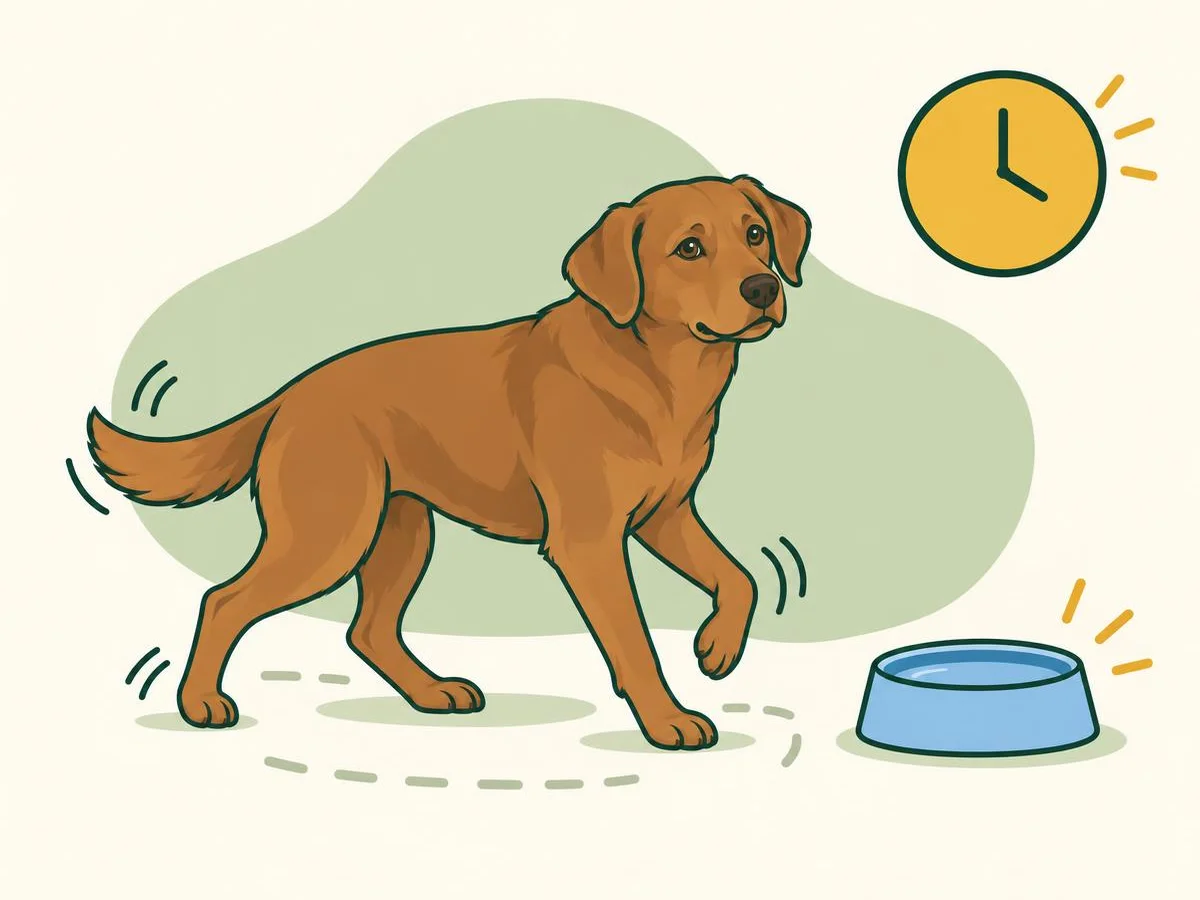
Illustration Signs usually start 2 to 4 hours after eating but can take up to 12 hours (PDSA); the Merck Veterinary Manual says 6 to 12 hours, and in severe cases they can last up to 72 hours.
Early signs are restlessness, hyperactivity, vomiting, diarrhoea, drinking and peeing more, and tummy pain. Serious signs are fast breathing, trembling, a racing heart, fever and seizures (PDSA).
If you see any sign: call your vet again straight away and say what you see and when it started.
How strong is the chocolate?
Darker means more dangerous (PDSA, ASPCA). The middle column is from the Merck Veterinary Manual: the amount of theobromine and caffeine (methylxanthines) in each gram. Merck says mild signs (vomiting, diarrhoea, thirst) appear in dogs at about 20 mg per kg of body weight, heart effects at 40 to 50 mg/kg, and seizures at 60 mg/kg or more. Severe signs can happen at lower doses.
| Type | mg per gram (Merck) | Our sum: grams that reach about 20 mg/kg in a 5 kg dog | …in a 20 kg dog |
|---|---|---|---|
| White chocolate | 0.04 (negligible) | Not a theobromine risk; fat and sugar can still upset the stomach | Same |
| Milk chocolate | 2.3 | About 43 g | About 174 g |
| Dark (semisweet) | 5.3 to 5.6 | About 18 g | About 71 g |
| Baking (unsweetened) | 15.5 | About 6 g | About 26 g |
| Cocoa powder | 28.5 | About 3.5 g | About 14 g |
The gram columns are our own arithmetic (weight × 20 ÷ mg per gram), to show how quickly small dogs reach the level where Merck says signs begin. They are not safe limits: brands vary, and a vet should decide. Call whatever the amount.
What the vet may do
Depending on the case: make your dog vomit, give activated charcoal, put it on a drip, give sedation for tremors or seizures, and monitor it, sometimes in hospital. Most dogs make a full recovery with the right treatment; severe cases treated late can be fatal (PDSA).
How to tell you've done everything
- You called your vet, their out-of-hours service or a poison line, even though your dog may seem fine (PDSA).
- You gave them the type, amount, your dog's weight and the time (PDSA), and mentioned any fillings or sugar-free chocolate (ASPCA).
- Nobody tried to make your dog sick at home, and it had no human medicine (PDSA).
- You are doing what the vet said: watching at home, or taking your dog in (ASPCA).
- You are still watching for signs, which can take up to 12 hours to start (PDSA).
If something goes wrong
| What happens | What it means | What to do |
|---|---|---|
| Your own vet is closed | You still need advice now | Call the out-of-hours vet they use, or a poison line (see Who to call) |
| You don't know how much your dog ate | The vet can still advise | Call anyway and keep the wrapper for the vet (ASPCA, PDSA) |
| The chocolate was sugar-free, or had raisins or macadamia nuts in it | Xylitol, raisins and macadamia nuts are also toxic to dogs (ASPCA) | Say so when you call |
| Your dog seemed fine, then becomes restless, vomits or has diarrhoea | Early signs of chocolate poisoning (PDSA) | Call your vet again straight away |
| Trembling, a seizure or collapse | Serious signs (PDSA) | Go to the nearest vet now |
Prevent it next time
- Keep chocolate, cocoa powder, baking chocolate and hot-chocolate mixes in closed cupboards, not on low tables or in bags on the floor.
- Take extra care at Easter, Christmas and birthdays, when wrapped chocolates and advent calendars sit within reach.
- Write your vet's and out-of-hours numbers in your phone now.
Questions readers ask
Should I make my dog sick at home?
No. PDSA says not to try to make your dog sick at home. If it is needed, a vet does it, usually by injection, and it works best within a few hours of eating the chocolate.
My dog ate chocolate but seems fine. Do I still need to call?
Yes. Signs usually start 2 to 4 hours after eating, but can take up to 12 hours (PDSA). Call while your dog still seems well, because early treatment is simpler.
Is white chocolate safe for dogs?
It has almost no theobromine, but it is high in fat and sugar. PDSA says it can still cause stomach upset and, in severe cases, pancreatitis. Call your vet if your dog ate a lot.
Can cats get chocolate poisoning?
Yes. PDSA and the ASPCA say chocolate is toxic to cats too. Cats eat it less often, but call your vet the same way if it happens.
Sources
We base our articles on the makers' official documentation.