How to check your dog or cat for ticks
Researched by Abu Bakar Saadat7 min read
Last updated: 15 November 2026References

On this page 11 sections
In short
Run your fingers through the fur after walks, checking the ears, face, collar, armpits, belly, tail and toes. Remove a tick with a tick-twister tool or fine tweezers, gripping right at the skin. Never squeeze, burn or smother it. Then clean the bite.
At a glance
- Check
- After every walk in grass or woods (PDSA, CDC)
- Tools
- Tick-twister tool or fine-tipped tweezers
- Never
- Squeeze, crush, burn, or use petroleum jelly or nail polish
- Call the vet
- Part of the tick left in the skin, limping, fever, low energy
- Advice from
- PDSA, CDC and the Merck Veterinary Manual, read 28 October 2026
- Checked
- November 2026
Well, finding a tick on your dog or cat can make anyone's skin crawl, and fretting about getting it wrong is completely understandable. If you're nervous about taking one off, your vet practice can do it or show you how.
Some ticks carry diseases such as Lyme disease, so remove one as soon as you notice it (PDSA). Remove it carefully so no part is left behind, and never squeeze it (PDSA).
Which removal method is for you?
You have a tick-twister tool
Slide the hook under the tick and twist it round in one direction, without pulling, until it lets go (PDSA). Packs often come with two or three hook sizes.
You have fine-tipped tweezers
Grip the tick right at the skin and pull straight out with steady pressure. Don't twist (CDC, Merck Veterinary Manual).
You have neither
PDSA says don't rush it with whatever is to hand: getting a proper tick tool is worth it, even if you have to wait an hour or two. Ordinary tweezers are a last resort.
I know it can feel confusing that the two methods disagree about twisting. PDSA's method is for a tick-twisting tool; the CDC method quoted by the Merck Veterinary Manual is for tweezers. What every source agrees on: grip as close to the skin as you can, and never squeeze the tick's body.
How to check for ticks
After each walk, run your fingertips slowly through the fur, feeling for small bumps.
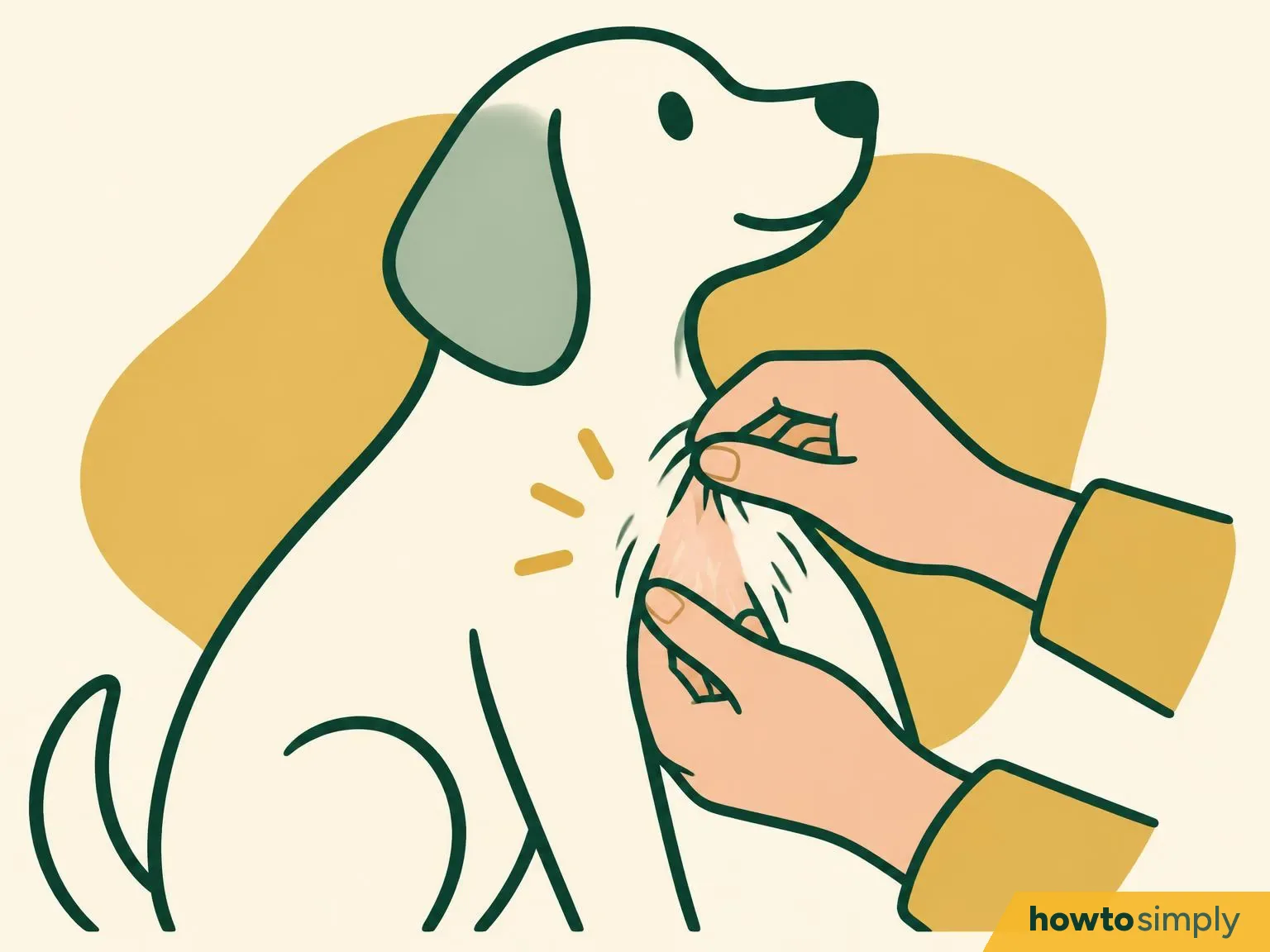
Illustration The CDC suggests a daily check, especially after time outdoors, using gentle pressure so you feel the skin, not just the coat. PDSA says to check after walks.
You should see: nothing but skin and fur. Any small, firm bump is worth a closer look.
Check the places ticks like most: head, ears, armpits, belly, tail and toes.
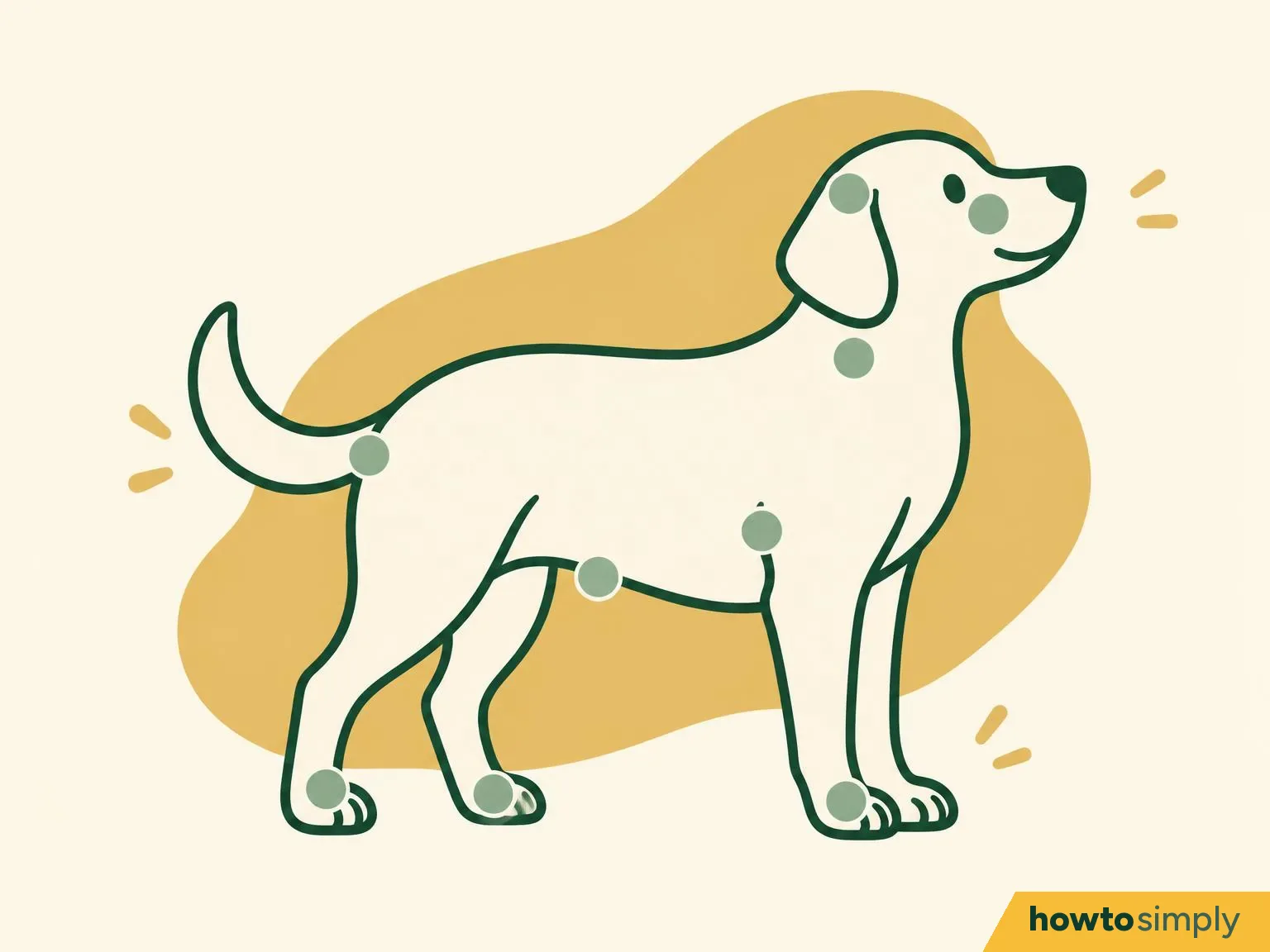
Illustration: the places to check Use the table below as a checklist, and spread the toes apart to look between them.
You should see: every area on the list checked, on both sides of the body.
Look closely at any bump: a tick has tiny legs where it meets the skin.
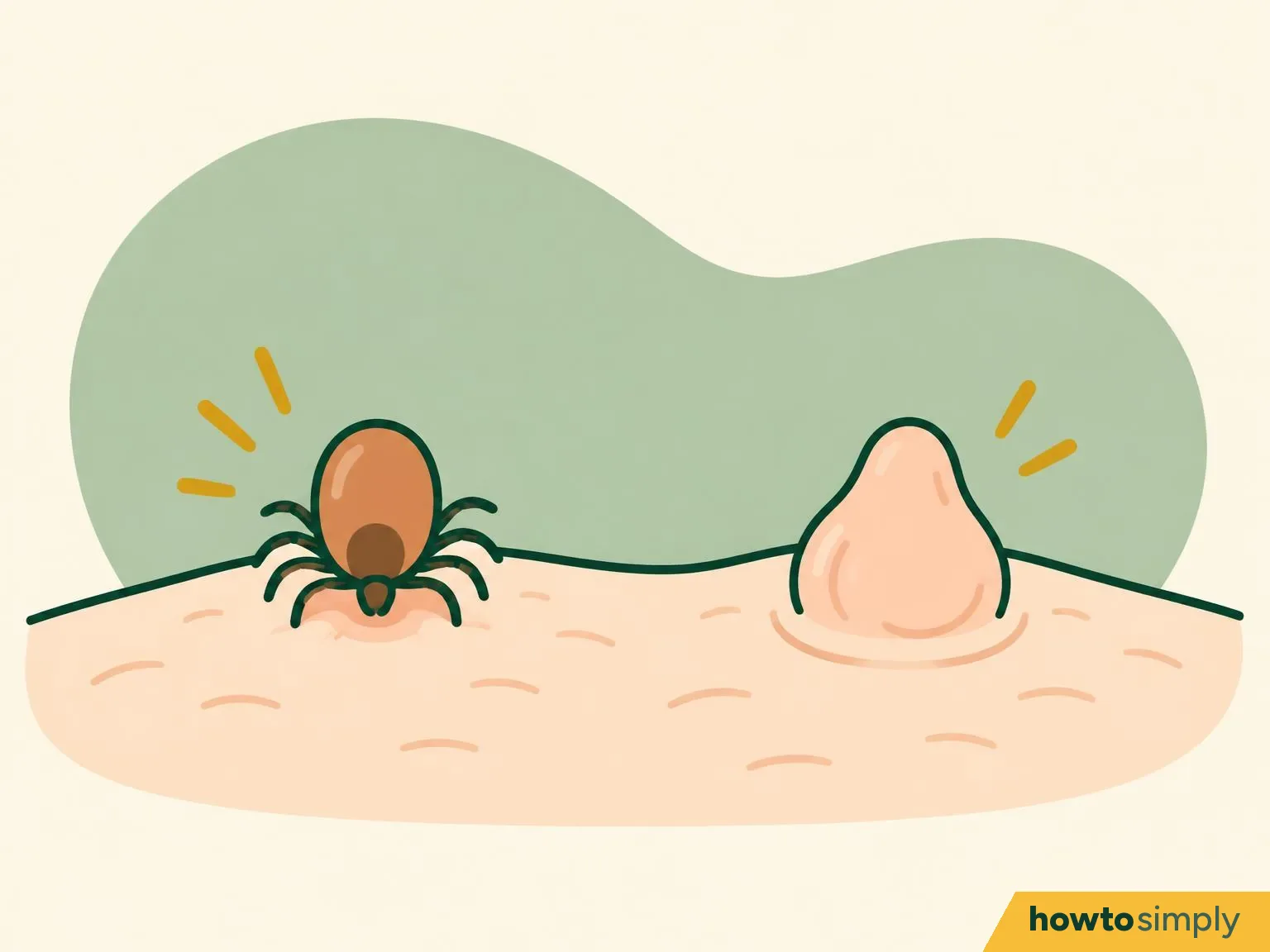
Illustration: tick (legs at the skin) and skin tag (no legs) Look for a small, round bump, often shiny, in black, pink, purple or a bluish grey. The body swells to about 1 cm as it feeds. They're often mistaken for skin tags, so look for legs near the skin (PDSA).
You should see: either legs (a tick: remove it now) or a smooth lump with no legs (not a tick; mention it to your vet if it's new).
Where to check
| Area | Listed by |
|---|---|
| Inside and around the ears; around the eyelids; the head | CDC; PDSA |
| Under the collar | CDC |
| Under the front legs (armpits) | CDC; PDSA |
| The belly and between the back legs | PDSA; CDC |
| Around the tail | CDC |
| Between the toes | CDC |
How to remove a tick
This is the fiddly part, so take a breath and get your helper and treats ready first. A steady hand matters here, not speed.
Careful: never pull a tick off with your fingers, crush it or squeeze its body: it can break and leave the mouthparts in the skin (PDSA). Don't smother or burn it with petroleum jelly, nail polish, alcohol or a hot match; the Merck Veterinary Manual says these don't make it let go and may make it release more saliva.
Get the tool right down at the skin, under the tick's body.
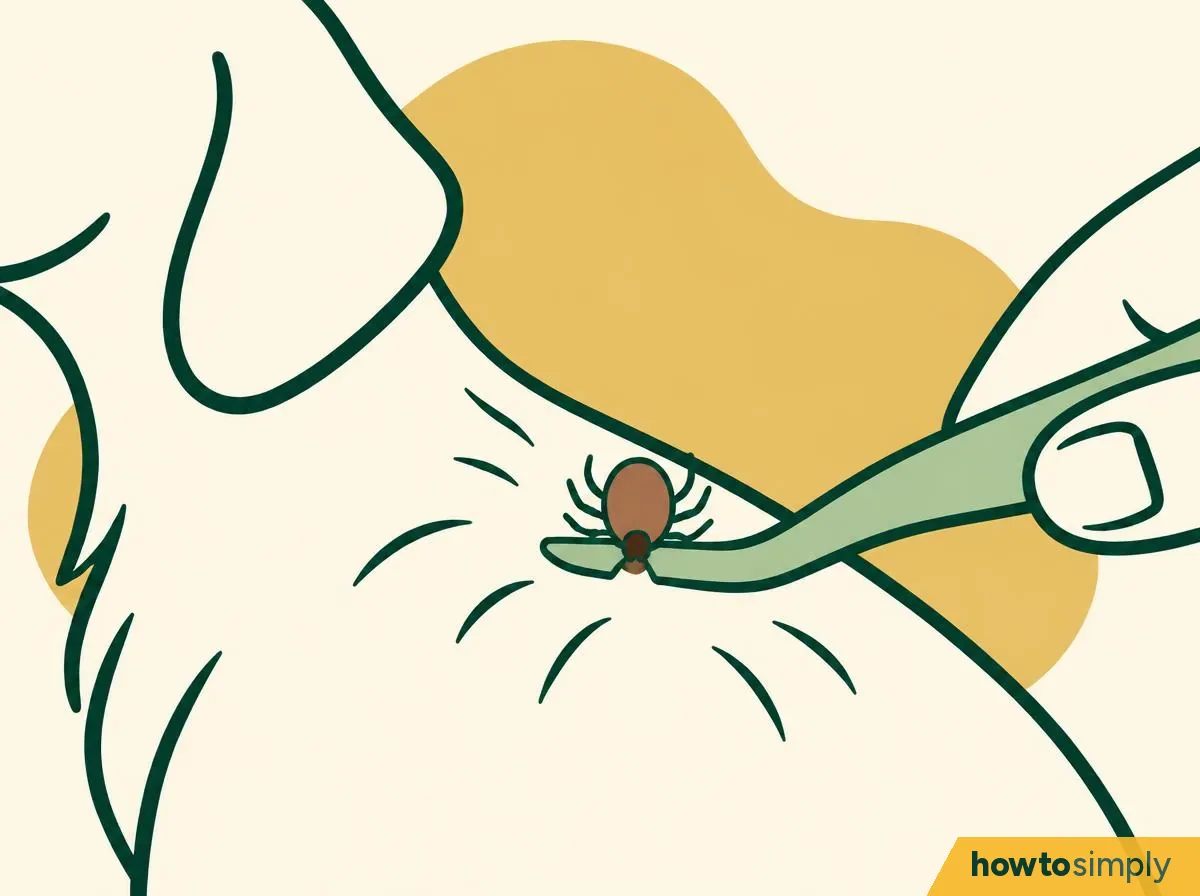
Illustration Twister tool: pick the size that fits neatly under the tick and slide it under as close to the skin as possible. Swap to another size if the tool doesn't sit snugly over the tick (PDSA).
Tweezers: take hold of the tick right down where it meets the skin (CDC, Merck Veterinary Manual).
You should see: the tool touching the skin, holding the tick where it's attached, not around its swollen body.
Take it out slowly and steadily.
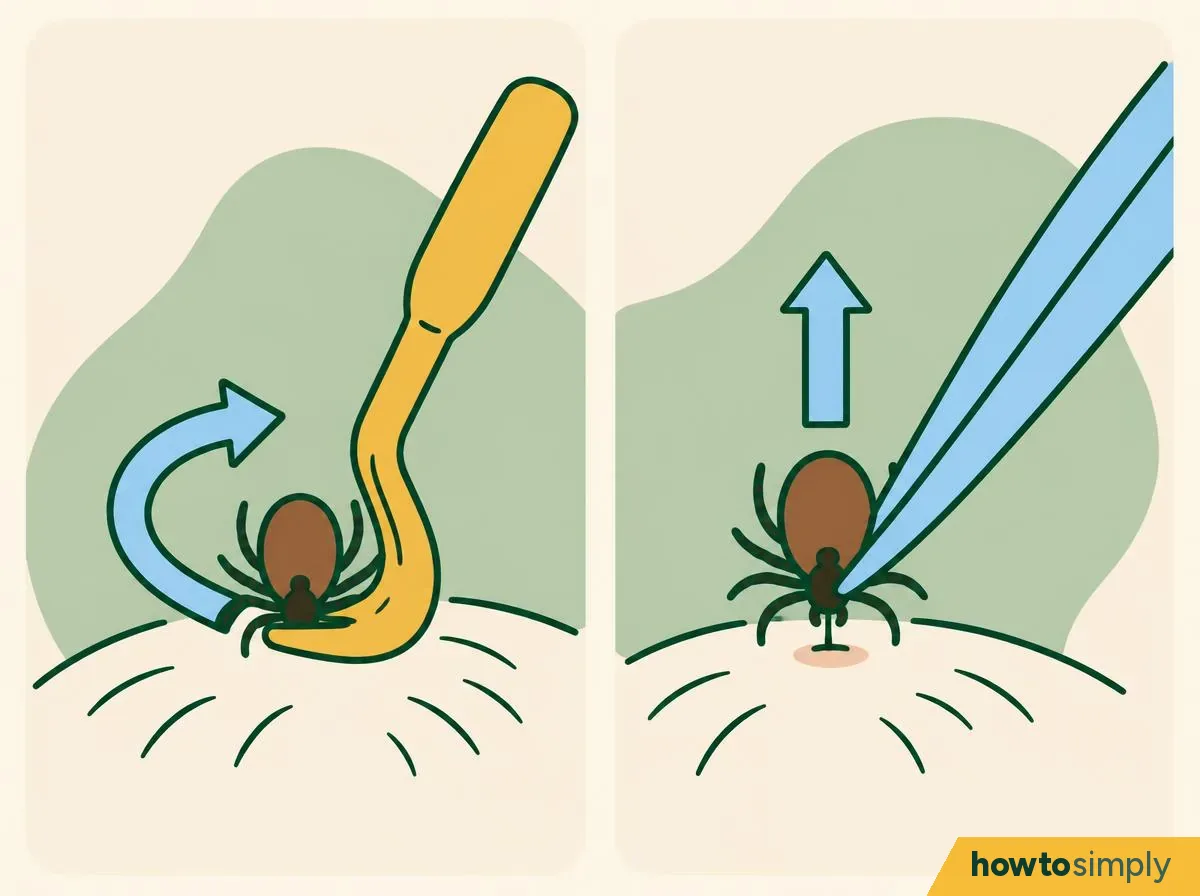
Illustration: twist the hook tool, pull the tweezers straight Twister tool: twist in one direction, without pulling, until the tick loosens, then slowly lift the tool away (PDSA).
Tweezers: pull straight away from the skin with steady, even pressure. Don't twist (CDC).
Don't worry if the tick doesn't let go straight away; keep going gently.
You should see: the whole tick in the tool.
Get rid of the tick so it can't reattach.
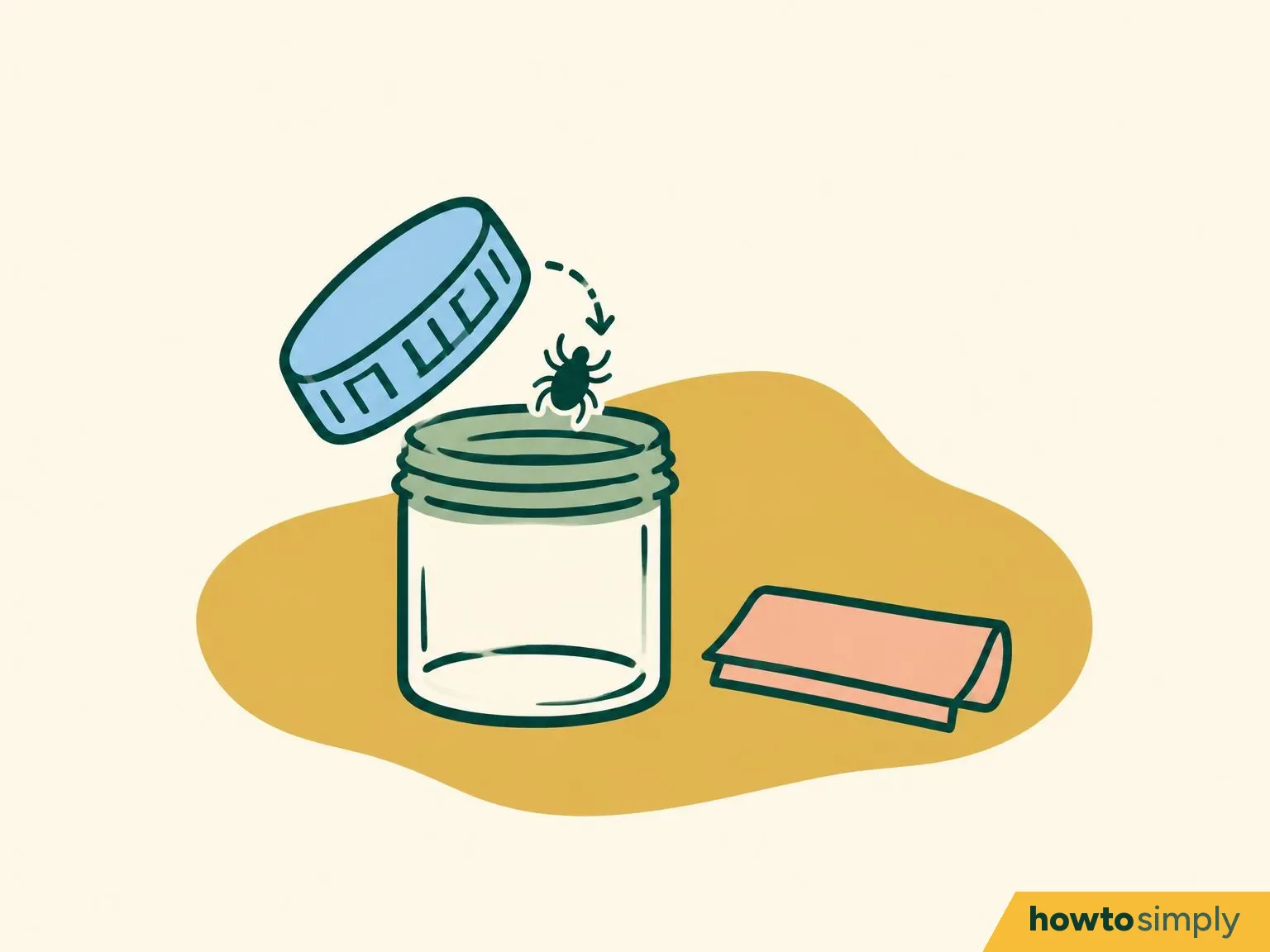
Illustration The CDC lists four ways: put it in a sealed container, wrap it tightly in tape, flush it down the toilet, or put it in alcohol. Don't crush it with your fingers (Merck Veterinary Manual).
You should see: the tick sealed away, not loose on the floor or the sofa.
Clean the bite and wash your hands.

Illustration PDSA suggests warm salty water for the bite. Wash your own hands with soap and water, rubbing alcohol or an iodine scrub (CDC, Merck Veterinary Manual).
You should see: a clean, small mark. Check the rest of your pet for more ticks while you're there (CDC).
After that, watch the bite spot and look out for any sign that your pet is unwell.

Illustration PDSA says to watch for redness, heat, swelling or discharge at the bite, and for lethargy or a poor appetite.
You should see: the mark fading, and your pet eating and moving as normal.
How to tell you got it all
- The tick in your pot or tape has its legs and head end, not just a body.
- No small black dot is left in the skin (PDSA).
- Over the next days the bite isn't getting redder, hotter or more swollen (PDSA).
- You've checked the rest of the body for other ticks (CDC).
If something goes wrong
If it didn't go perfectly, please don't be hard on yourself. Find what happened below; each one has a clear next step.
| What happens | What it means | What to do |
|---|---|---|
| A small black dot stays in the skin | Mouthparts may be left behind (PDSA) | Don't dig. The Merck Veterinary Manual says if clean tweezers can't lift any leftover bits easily, leave them; PDSA says a leftover piece is a good reason to book a vet check |
| The bite becomes hot, red, swollen or weeps | Possible infection (PDSA) | Contact your vet if you're concerned |
| The tool doesn't fit neatly | Wrong size (PDSA) | Use a different size |
| Your pet won't keep still | You're worried about removing it yourself | Ask your vet practice for help (PDSA) |
| Limping, fever or low energy in the weeks after | Possible tick-borne disease such as Lyme disease (PDSA) | Book a vet appointment (PDSA) |
Questions readers ask
Can a tick on my dog bite me too?
Yes. PDSA says ticks can't live on people but can bite and feed on them. If you're bitten and then get a rash or fever within a few weeks, the CDC says to see a doctor and say when and where the bite happened.
When are ticks most common?
In the UK, PDSA says from spring to autumn, when the weather is warm, in long grass, woodland and moorland, and where there is a lot of wildlife or farm animals.
Should I keep the tick to show my vet?
You can. A sealed container is one of the CDC's ways to dispose of a tick, so a closed pot or a tick taped to a card keeps it safe until the appointment.
Does my pet need treatment after a tick bite?
Usually not. PDSA says most pets need no treatment if the tick was removed properly. Keep watching for any sign your pet is unwell, and ring your vet if something worries you (PDSA).
Sources and method
- Researched by
- Abu Bakar Saadat
- Tested by our team
- No. We have no record of anyone on our team trying these steps, so treat them as researched instructions from the sources below.
- Pictures
- 10 illustrations drawn for this article: drawings, not photos.
- Sources
- 6 named sources, linked below.
- What this page adds
- A close-up comparing a tick's legs with a skin tag, a drawing of twisting a hook tool versus pulling tweezers straight up, and a map of where on the body to check.
What to do next
Everyday care for your dog Step 3 of 6
- How to keep a dog calm during fireworks (Bonfire Night, Diwali, New Year)Plan before the bangs start.
- Is my dog too hot? Heatstroke signs and how to cool your dog fastThe warning signs on hot days.
- Dog ate chocolate? What to do now, and how much is dangerousWhat to do if your dog gets into the chocolate.
Did this solve the problem?
Where did you get stuck?
What did you think?
Reaction counts are loading.
Sources
We use primary, official and specialist sources appropriate to the topic.
- PDSA: How to remove a tick from a dog or cat (July 2022)
- PDSA: Ticks on pets, Pet Health Hub leaflet (April 2020)
- CDC: Where to check your pet for ticks (leaflet)
- CDC: Tick removal fact sheet (2025)
- Merck Veterinary Manual: Tick removal (Michael L. Levin, full review June 2025)
- PDSA: Permethrin toxicity in cats (December 2023)