Wear boots that grip, with non-slip soles and ankle support, and take short, slow steps with your weight over your feet. Clear snow early, never with water, and spread salt, sand or grit where it's allowed. If you fall, get up slowly, and call for help if you might be hurt.
Researched by Abu Bakar SaadatPublished 30 October 2026Last changed 17 November 2026Verified 17 November 2026Version 6See all changes
A pavement sparkling with frost can make a short trip to the shops feel daunting, especially when you, or someone you care about, can lose their footing a bit. You're wise to take the risk seriously, and with a few basic precautions, including the right footwear, short strides and a cleared path, you can get around more safely.
As people get older, ice makes a fall more likely. According to NHS Lanarkshire and GOV.UK, wearing good boots, walking with short, slow steps and having a path that's been cleared and gritted can help prevent falls. The NHS also explains how to get up safely if you do fall. Who has to clear the pavement varies a lot between the UK, Germany and the US, so see the table near the end.
Call 999 (UK) if you may have hurt your head, back, neck or hip in a fall, or you can't get up. Keep warm while you wait (NHS).
Our example: Mira and her mum on the first icy morning
Every step below follows one story, and each drawing shows that moment. Mira lives in Berlin with her mum, Hana, who is 76 and walks with a stick. On the first icy morning of winter they walk to the bakery together, and on the way home Hana slips. The next morning, after fresh snow, Mira clears and grits their path so Hana can get out safely.
Before you go out
Wear shoes or boots with good grip.
Illustration
In our story: Mira holds up her smooth-soled shoe next to her boot and picks the boots, with deep tread and ankle support. Hana wears her grippy ankle boots too.
On slippery ground, go for shoes or boots that grip well, with non-slip soles and support round the ankle (NHS Lanarkshire). The NHS also says to choose shoes that fit properly, stay on your feet and grip well.
Dress warmly in layers, with something reflective.
Illustration
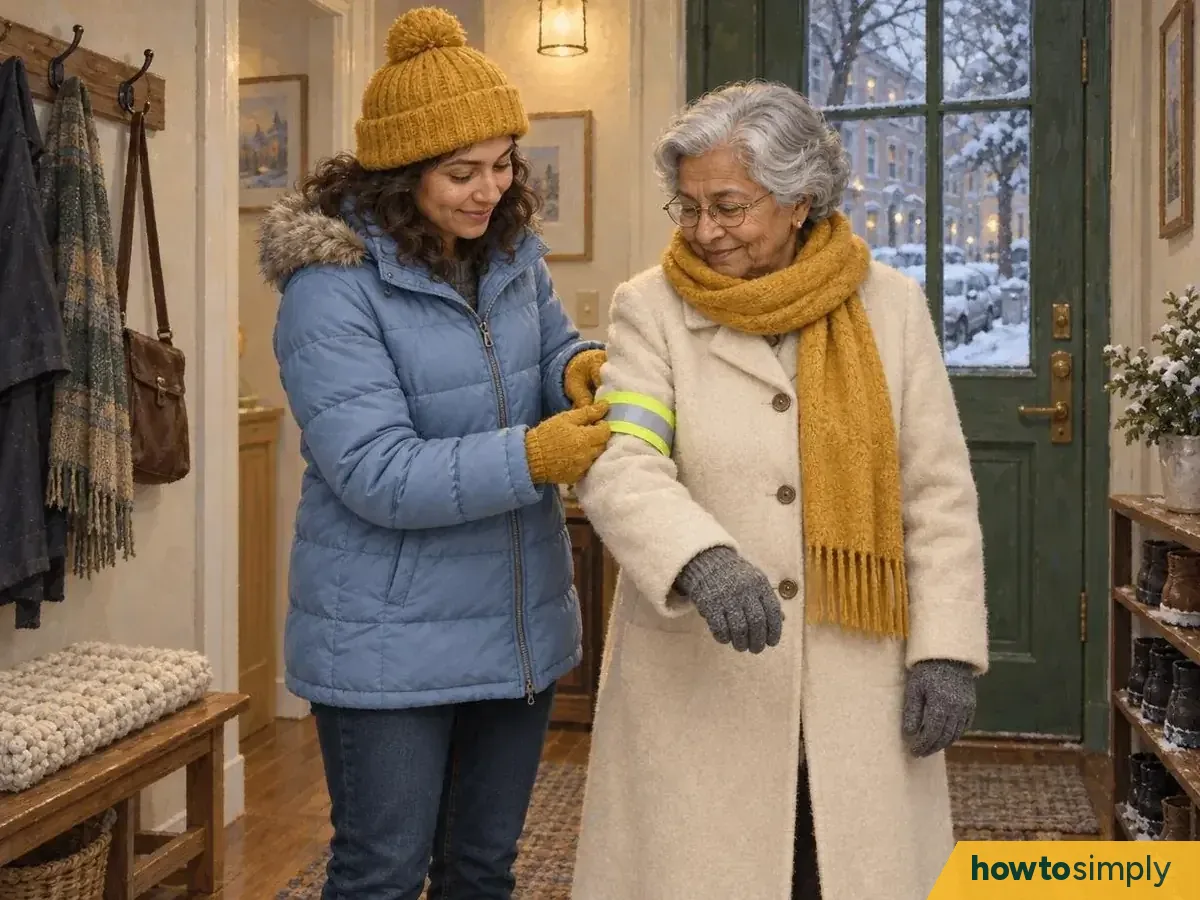
In our story: It is still dark outside. Mira helps Hana into her coat over a jumper and fastens a reflective band round her sleeve.
Layers keep your muscles warm, and cold muscles are more prone to injury. Reflective clothing helps others see you on dark winter days (NHS Lanarkshire).
Check the rubber tip on your walking stick.
Illustration
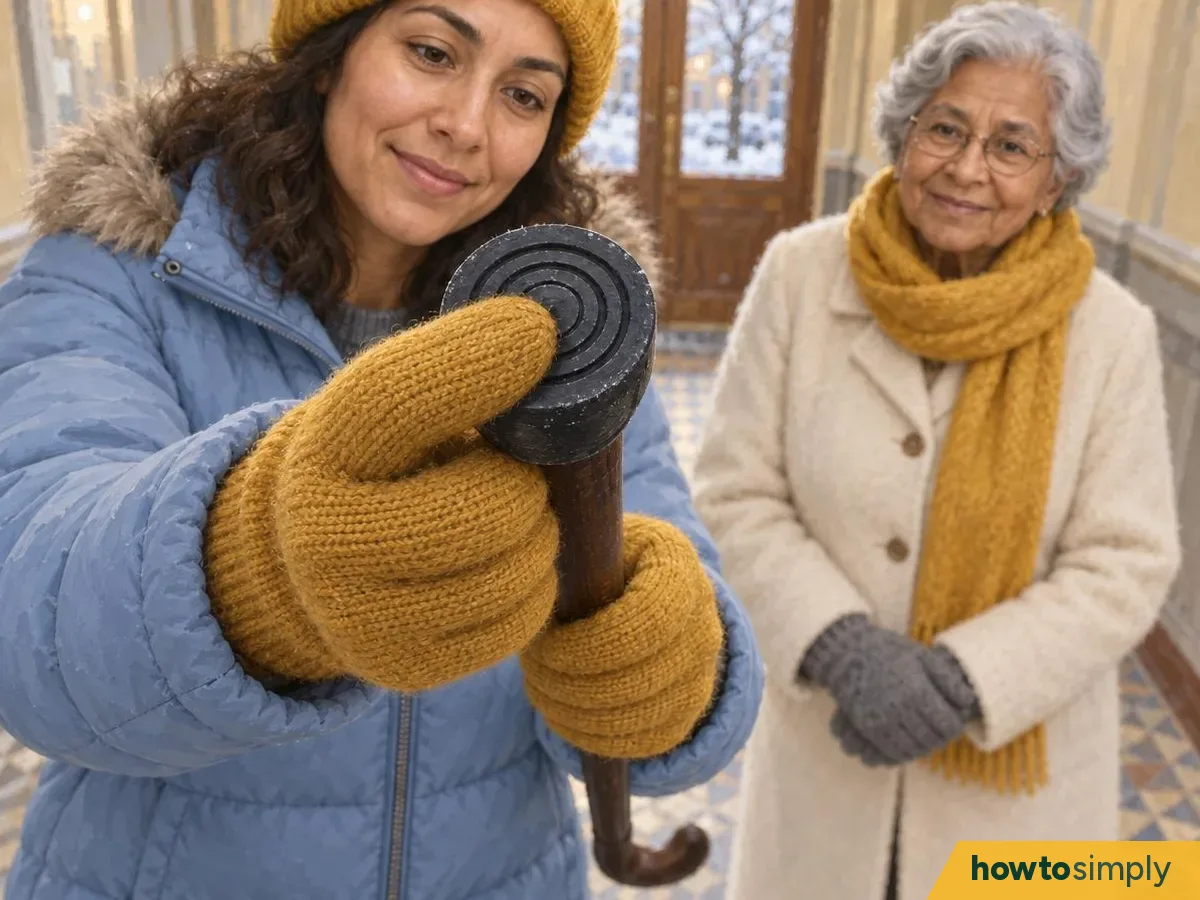
In our story: Mira turns Hana's stick over and checks the rubber tip. It still has its grooves, so it will grip.
If you use a walking stick or frame, make sure it has a non-slip rubber tip (ferrule) (NHS Lanarkshire). A worn tip slips more easily, so it is worth turning the stick over for a look before you go.
Give yourself extra time.
Illustration
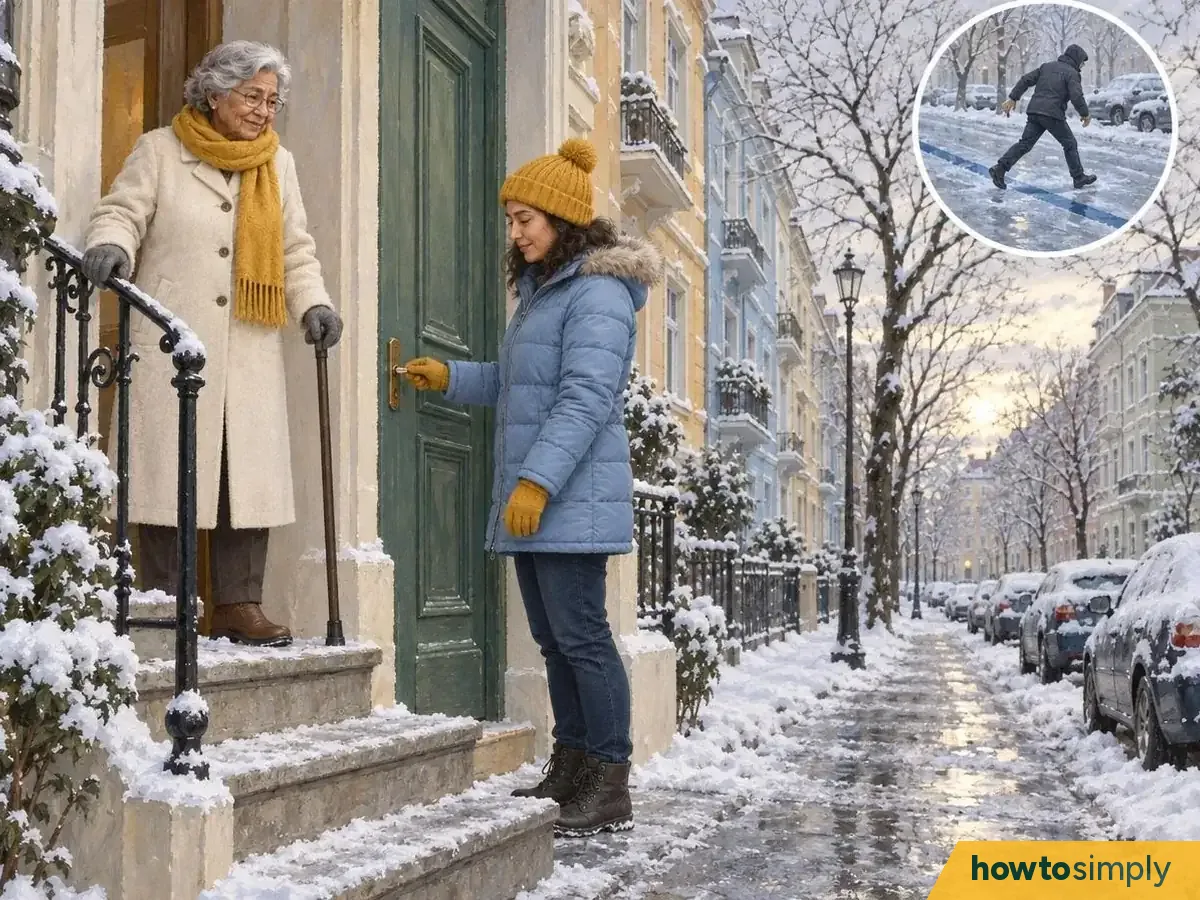
In our story: They leave early, so nobody needs to rush. Mira locks the door while Hana waits by the handrail.
Avoid rushing out in icy weather (NHS Lanarkshire). Leaving a little earlier means you won't need to hurry.
Walk like a penguin
Take short, slow steps with your weight over your feet.
Illustration
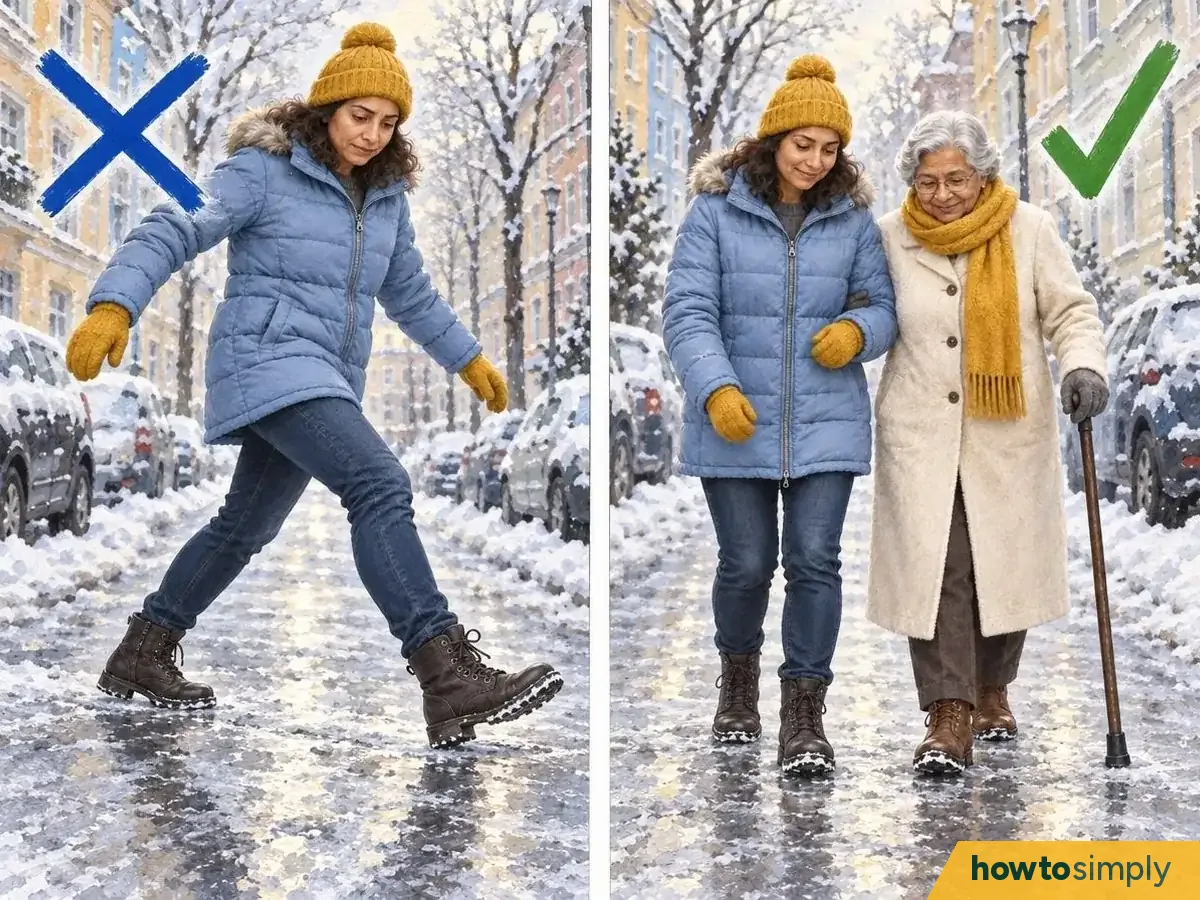
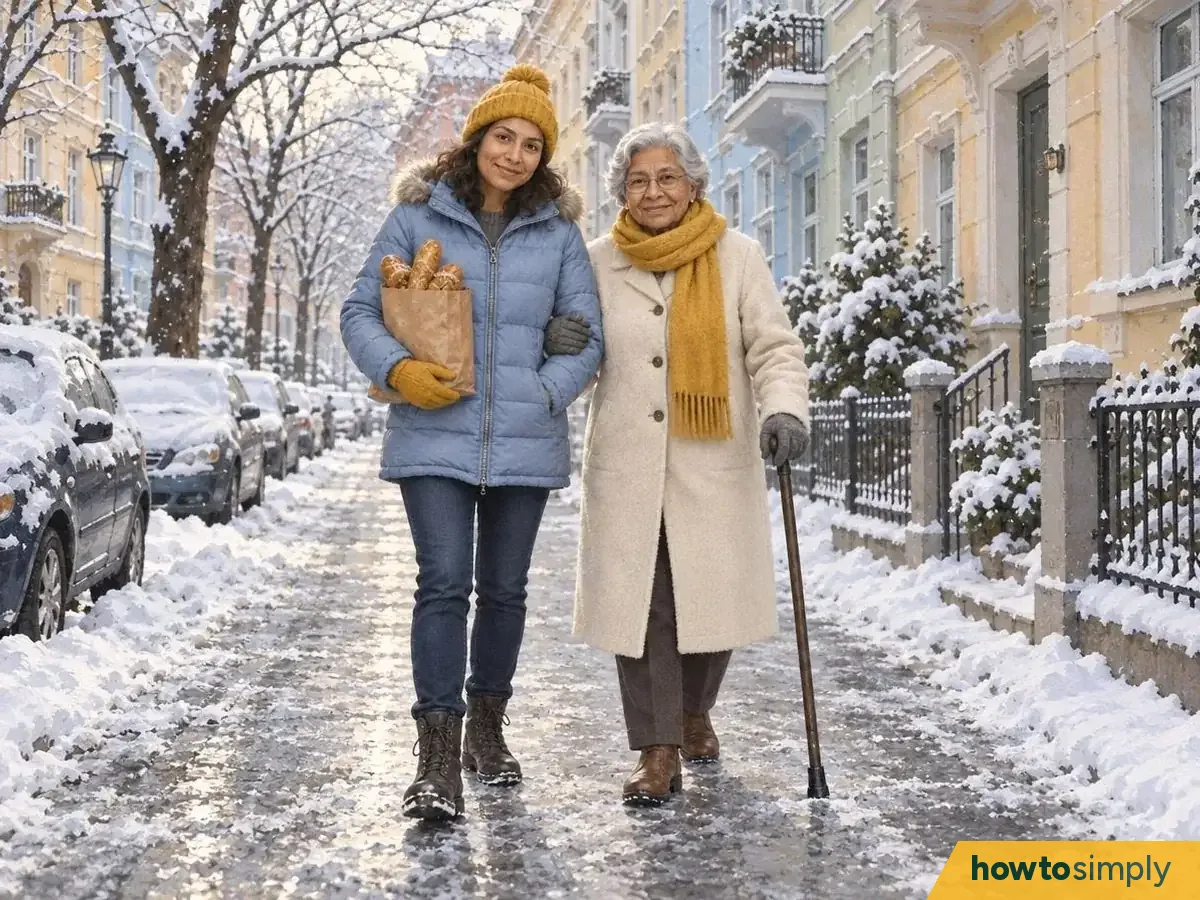
In our story: Mira usually takes long strides. Today she matches Hana: short, slow steps, weight over their feet.
NHS Lanarkshire calls it the "penguin walk": keep your weight over your feet, take shorter steps and go slowly. Don't worry if it feels a little funny at first; nobody is judging your style on an icy morning.
Watch out for icy patches.
Illustration
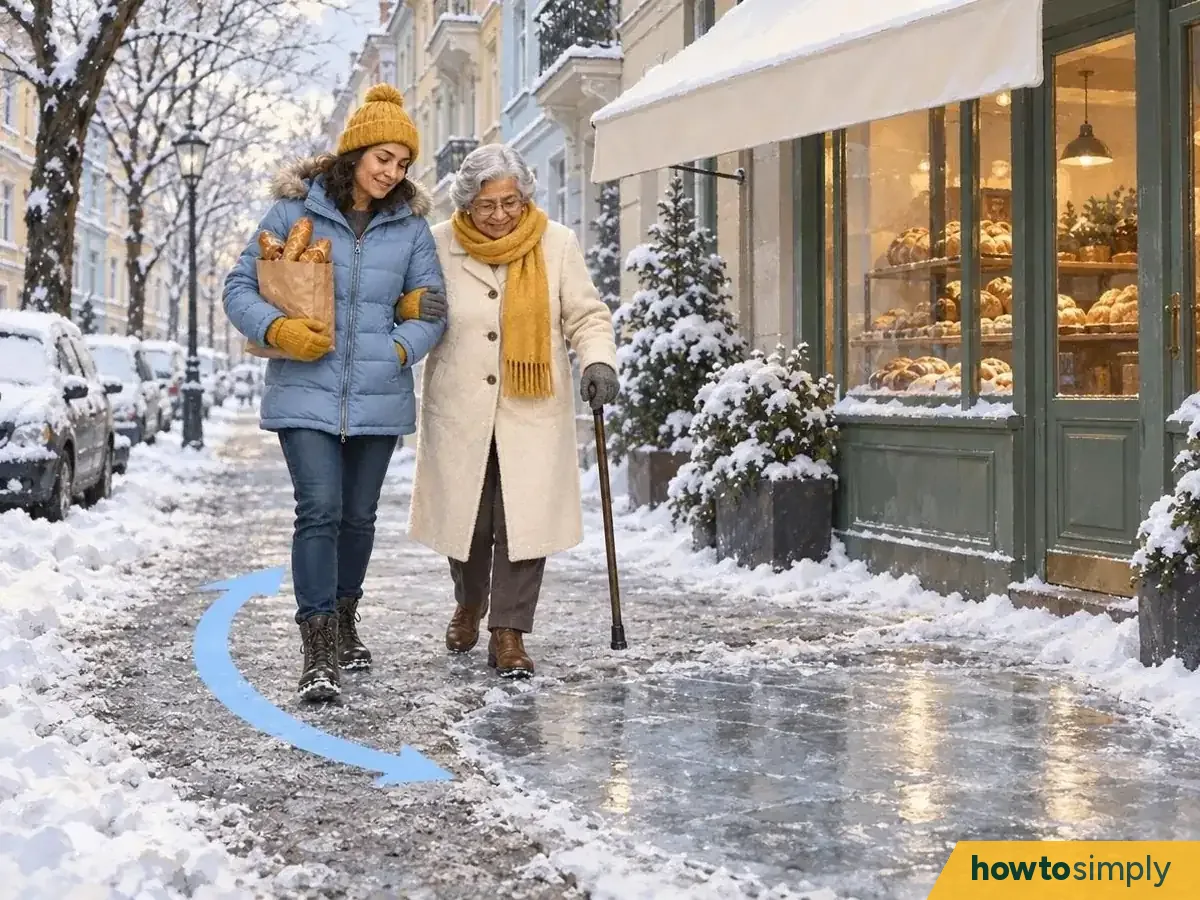
In our story: Outside the bakery, a shiny patch looks wet. Mira steers Hana round it onto the gritted part.
Be mindful of icy patches (NHS Lanarkshire). GOV.UK says water can freeze again and become black ice.
Ask for help when you need it.
Illustration
In our story: On the way home Mira carries the bread, so Hana has one hand for her stick and one for Mira's arm.
Ask family, friends or neighbours for help when you need it (NHS Lanarkshire). Asking for an arm, or a hand with the bags, is not being a bother. It is the sensible thing to do on a day like this.
If you fall
A fall is a shock, even a small one. The steps below are slow on purpose, so take them one at a time.
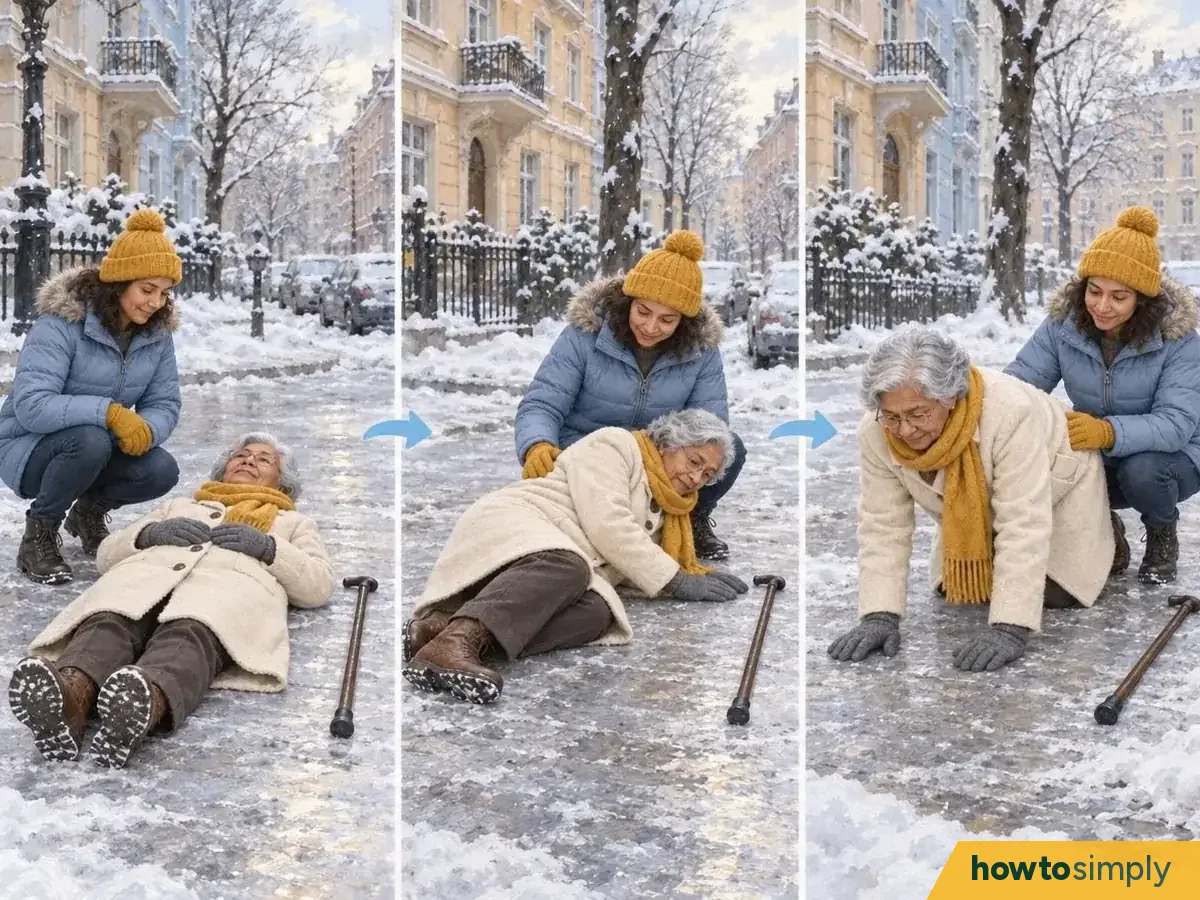
Take your time. Turn onto your side first, then get up onto your hands and knees.
Illustration
In our story: On a corner nobody has gritted, Hana slips and sits down hard. She lies still for a moment and checks herself. Nothing hurts, so she rolls onto her side, then onto her hands and knees.
Don't get up too quickly. If you're not hurt, roll onto your side, then push up onto your hands and knees (NHS).
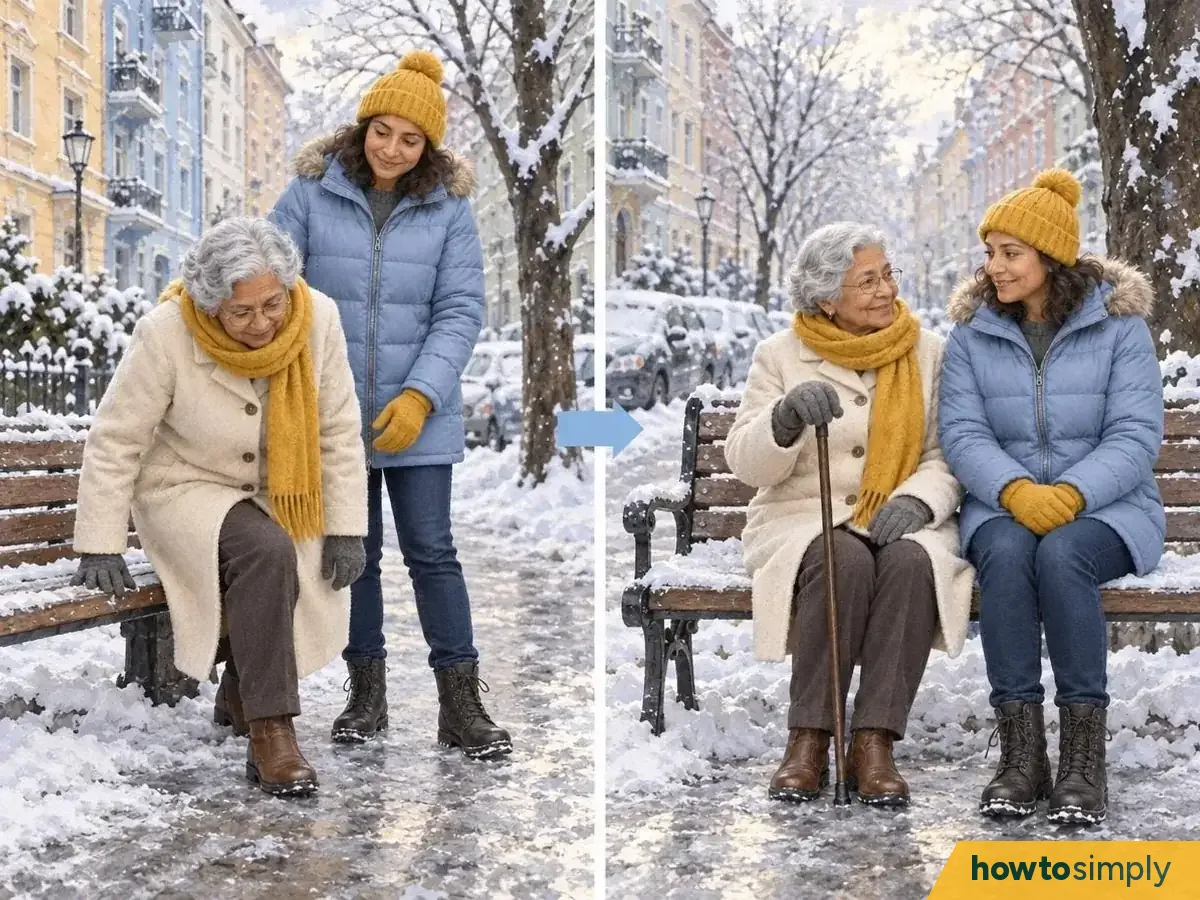
Use something sturdy to stand up slowly, then rest.
Illustration
In our story: A bench stands right beside them. Hana holds its seat, puts one foot flat, stands up slowly, then sits down to rest.
Find something sturdy to hold, put one foot flat on the ground and stand up slowly. Then sit down and rest (NHS).
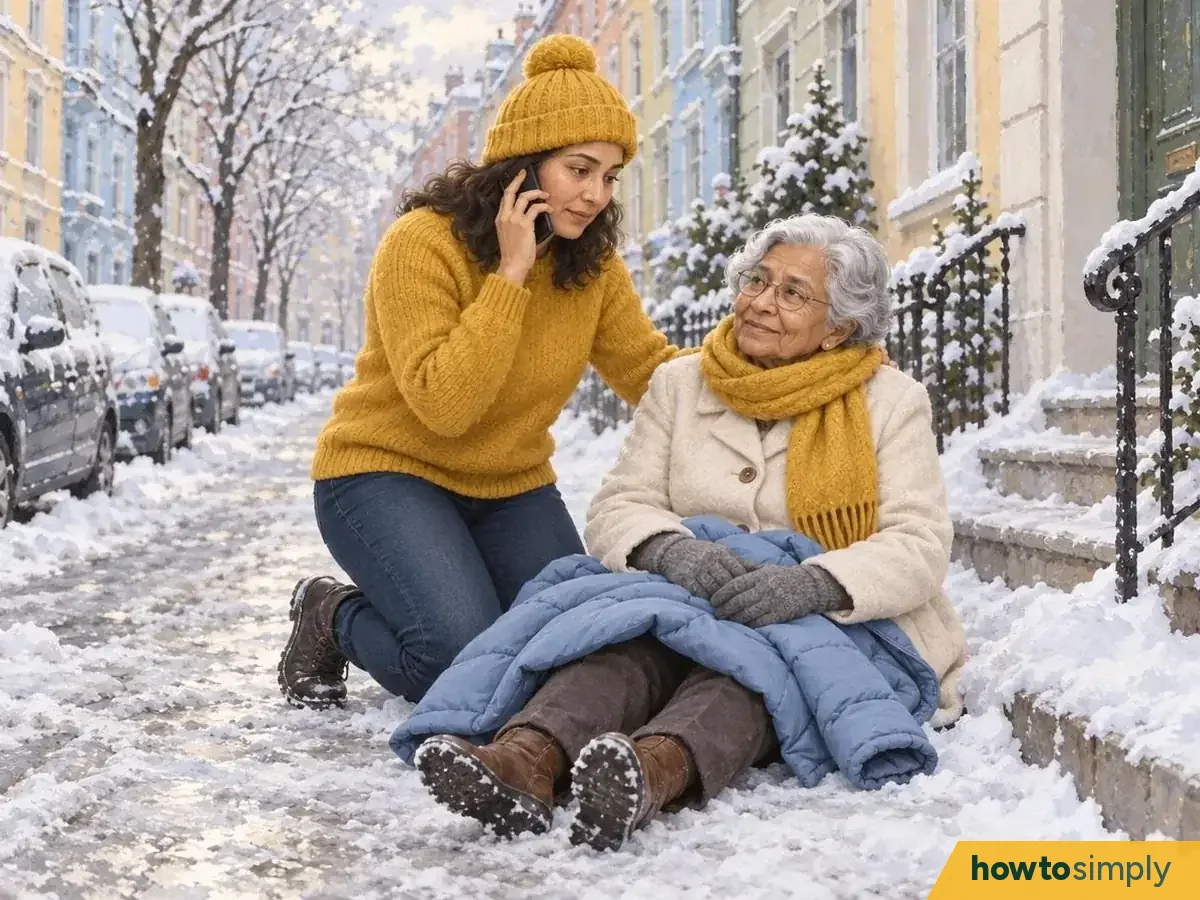
If you're hurt or can't get up, call for help and keep warm.
Illustration
In our story: Hana is fine. If she had hurt her hip or couldn't get up, Mira would cover her with her coat and call for help, as this drawing shows.
Call 999 (UK) if you may have hurt your head, back, neck or hip, or can't get up. While you wait, cover yourself with a coat or blanket to stay warm, and gently move your arms and legs (NHS). In Germany call 112, in the US 911.
Clear your path
Next, the path outside your own door. NHS Lanarkshire says clearing paths helps make winter safer for you and for other people.
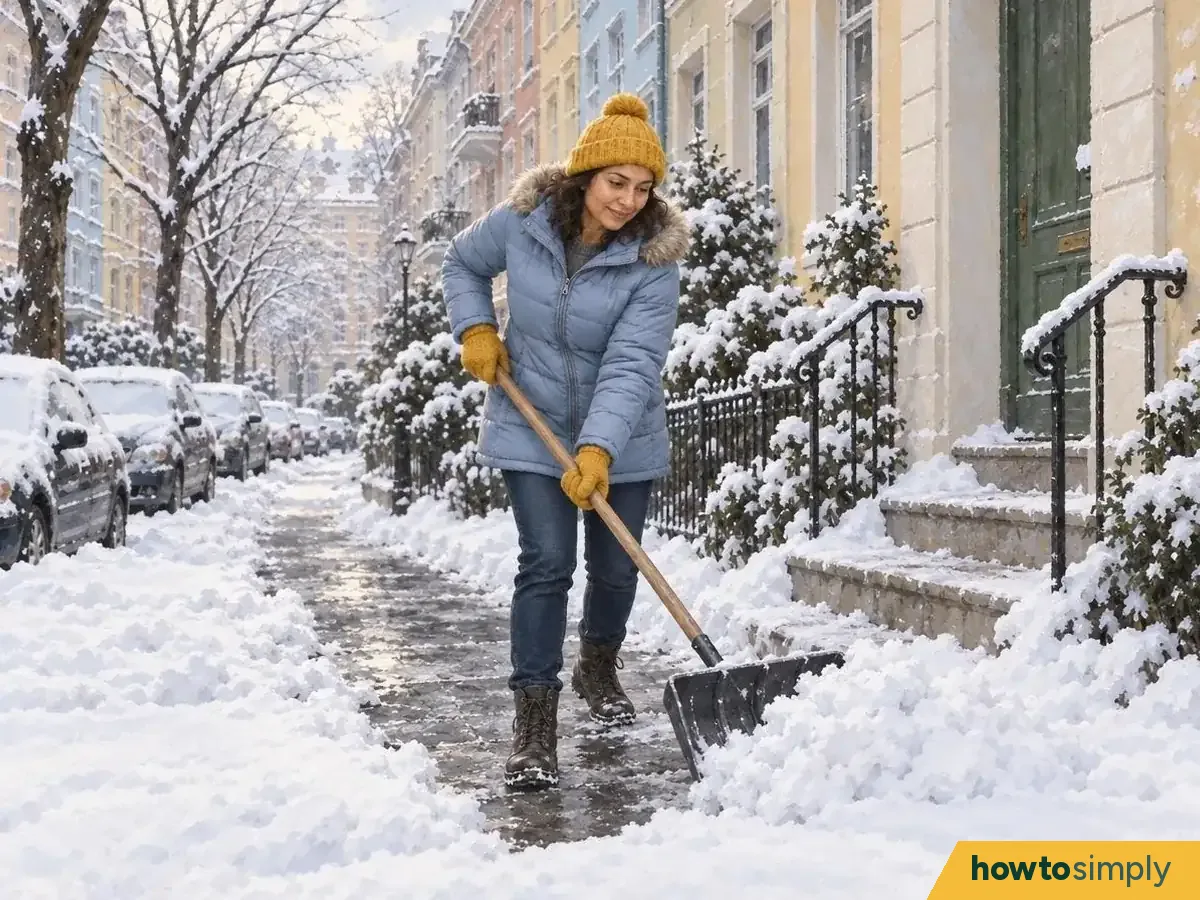
Clear snow early in the day.
Illustration
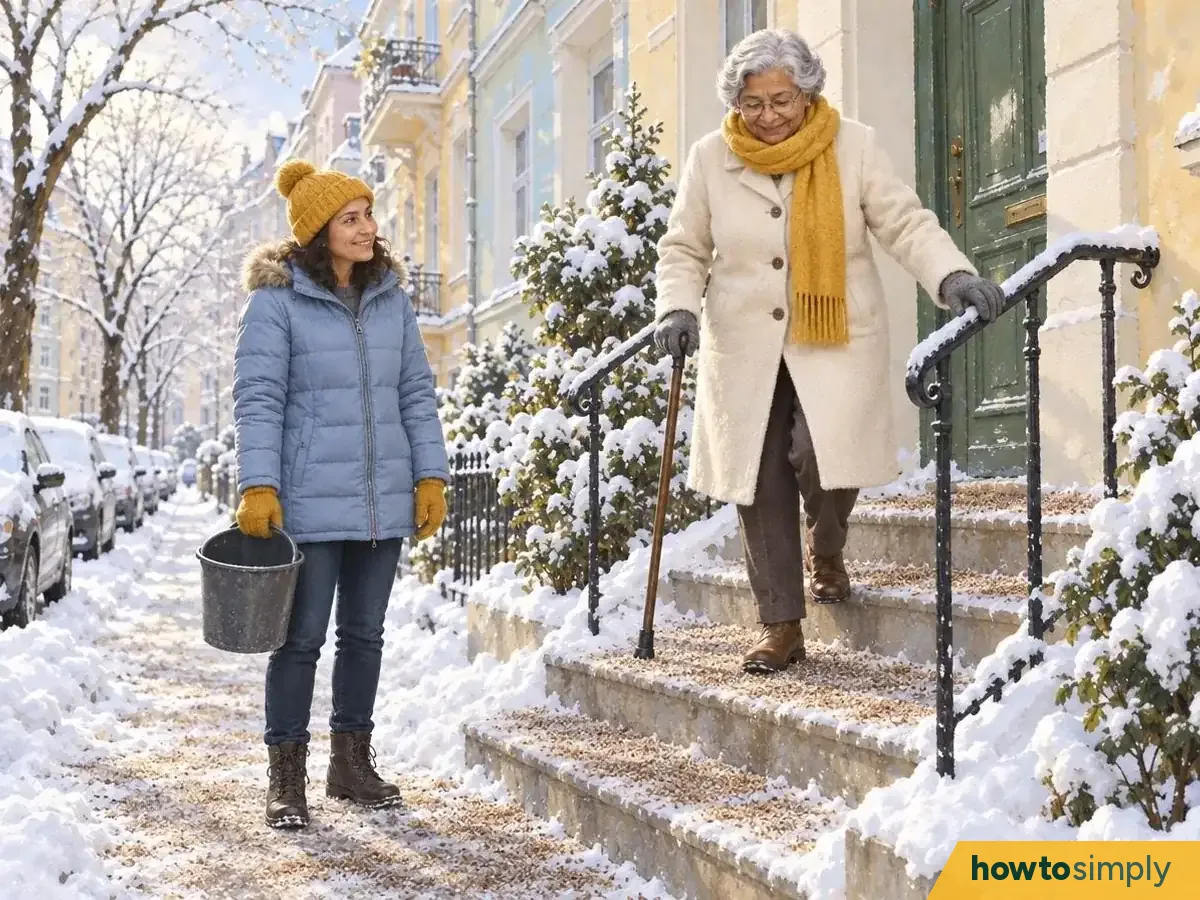
In our story: Next morning there is fresh snow. Before 7, Mira shovels it off their path and the pavement in front of the house.
Get out early: snow that has just fallen and is still loose shifts more easily (GOV.UK). In Germany and many US cities, there are set times to have it done (see the table below).
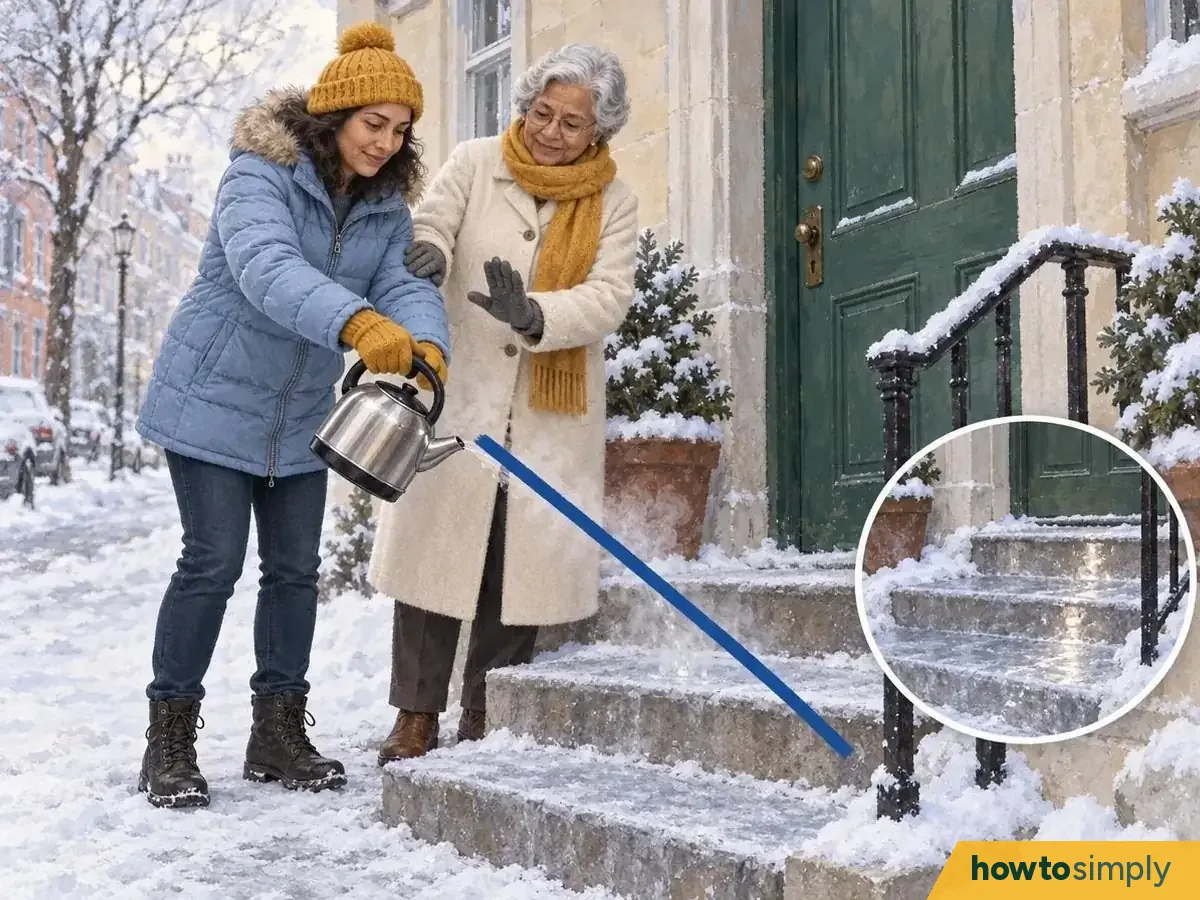
Never pour water on it.
Illustration
In our story: Mira reaches for a kettle of hot water to melt the icy steps. Hana stops her: the water would freeze again into black ice.
Skip the water: it can freeze again and become black ice (GOV.UK).
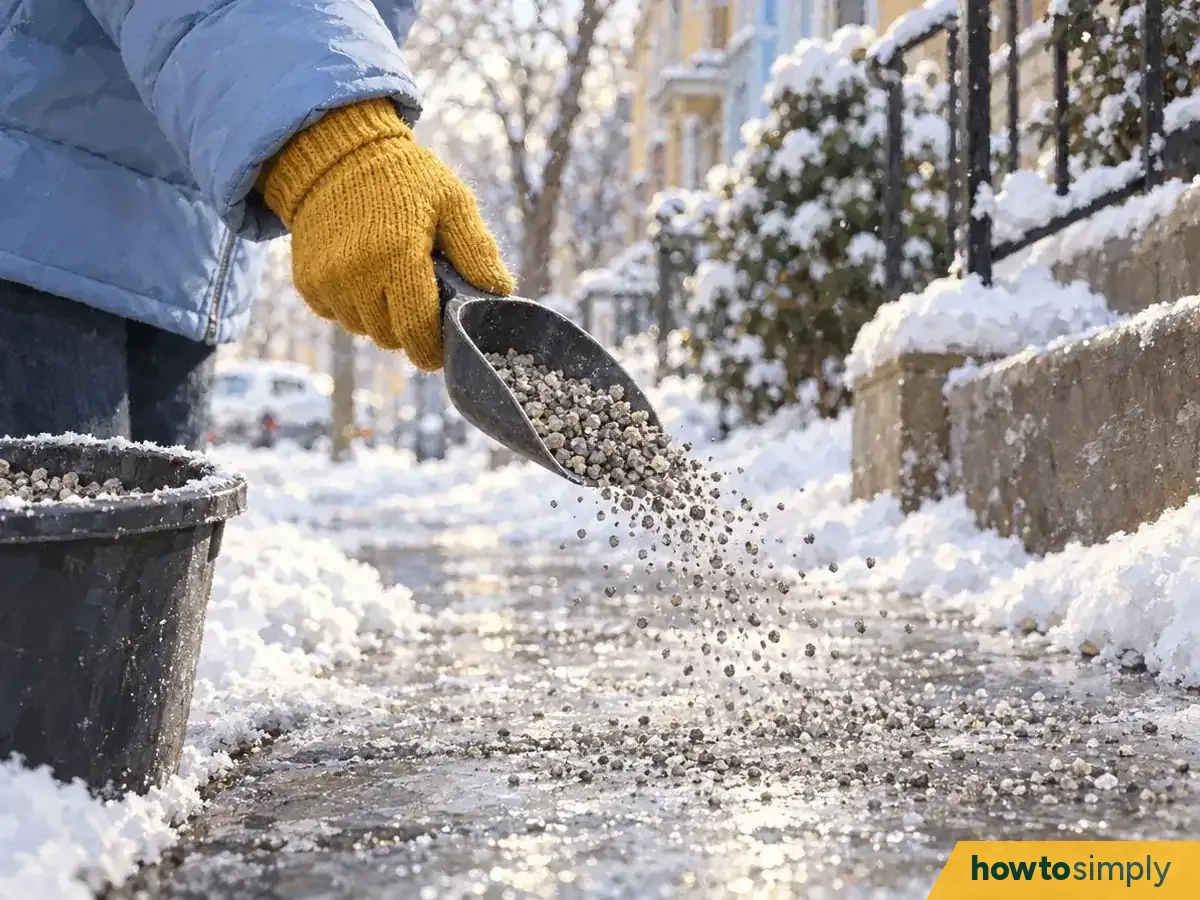
Spread grit on the cleared path.
Illustration
In our story: They live in Berlin, where salt is banned on pavements, so Mira scatters grit from a bucket over the cleared path.
In the UK, use salt if you can: it melts ice and stops it refreezing overnight. Don't take salt from the roadside grit bins, which are for the roads. Ash or sand give grip if you don't have enough salt (GOV.UK). Some German towns ban salt: in Berlin, all de-icers are banned on pavements, so use sand, chippings or granules (Berlin Senate).
Take extra care on steps and slopes.
Illustration
In our story: Mira adds extra grit on the steps and checks the handrail is firm. Hana comes down holding the rail, safe and steady, ready to go out again.
Take extra care on steps and steep paths; a bit more salt can help there (GOV.UK). If you can, fit safety rails on outdoor steps (NHS).
Who has to clear the pavement: UK, Germany and the US
UK
Germany (Berlin example)
US (New York City example)
Who clears it
You can clear it yourself; it's unlikely you'll be sued if you clear it carefully (GOV.UK)
Each town sets its own rules. In Berlin, the owners of the next-door property must (Berlin Senate)
Each city sets its own rules. In NYC, property owners must (NYC311)
By when
Early in the day is easiest (GOV.UK)
Straight after snowfall; if it snows or freezes after 8 pm, by 7 am the next day (9 am on Sundays and holidays) (Berlin Senate)
Within 4 hours if snow stops 7 am to 5 pm; within 14 hours if 5 to 9 pm; by 11 am if 9 pm to 7 am (NYC311)
How wide
No rule found
At least 1 m, or 1.5 m on busier streets (Berlin Senate)
A path at least 4 feet wide (NYC311)
Salt
Use salt if you can, but not from grit bins (GOV.UK)
Banned on pavements; use sand, chippings or granules (Berlin Senate)
Spread salt, sand or other grit if the ground is frozen (NYC311)
If you don't
No duty found
Rules and fines vary by town
Fine of up to $250 (NYC311)
We couldn't find a national pavement-clearing rule for Pakistan or India, so check with your local council.
How to tell you're doing it right
Your boots grip and your ankles feel supported (NHS Lanarkshire).
You're taking short, slow steps with your weight over your feet, as NHS Lanarkshire describes.
Your path is clear and gritted, with no water left to refreeze (GOV.UK).
If something goes wrong
What happens
What it means
What to do
The path is icy again next morning
Melted snow or water refroze
Clear it again and add grit; never use water (GOV.UK)
You slip even in boots
Steps too long or too fast
Shorter, slower steps, weight over your feet (NHS Lanarkshire)
You fell but feel fine
You still need to recover
Get up slowly, then sit and rest (NHS)
Pain or trouble moving after a fall
You may be injured
Get help promptly (NHS Lanarkshire); call 999 (UK) for head, back, neck or hip (NHS)
You can't clear your own path
You need a hand
Ask family, friends or neighbours (NHS Lanarkshire)
What should I do while I wait for help after a fall?
The NHS says cover yourself with anything you can reach, such as a coat or blanket, keep gently moving your arms and legs, and change position about every 30 minutes to help prevent pressure sores.[2]
Can someone lift me up after a fall?
The NHS says a helper should keep you comfortable and warm and carefully help you up if you can manage it, but shouldn't try to lift you themselves.[2]
Who has to clear the pavement in Berlin, and by when?
The owners of the property next to it. They must clear it straight after snow stops; if snow or ice comes after 8 pm, they have until 7 am the next day, or 9 am on Sundays and public holidays.[4]
How wide does the cleared path need to be?
At least 1 metre in Berlin, or 1.5 metres on busier streets[4], and at least 4 feet in New York City[5]. GOV.UK gives no width[3].
Can I use salt from the council's grit bin?
No. GOV.UK says that salt is there to keep the roads clear.[3]
What is the safest way to walk on ice?
NHS Lanarkshire calls it the "penguin walk": keep your weight over your feet, take shorter steps and go slowly. Choose shoes or boots that grip well, with non-slip soles and support round the ankle.
Can I be sued for clearing the pavement outside my house in the UK?
GOV.UK says if you've cleared a path with care, it's unlikely you'd be sued or blamed if someone hurt themselves on it.
Can I put salt on the pavement in Germany?
It depends on your town. In Berlin, salt and all other de-icers are banned on pavements; you must use grit such as sand, chippings or granules (Berlin Senate). Check your town's rules.
Why not pour hot water on ice?
GOV.UK says to skip the water, since it can freeze again and become black ice.
What if I fall and can't get up?
Call for help (999 in the UK) and keep warm with a coat or blanket while you wait. The NHS says to call if you may have hurt your head, back, neck or hip, or can't get up.
Do walking sticks help on ice?
NHS Lanarkshire says make sure sticks and frames have non-slip rubber tips (ferrules).
The pictures on this page are illustrations, not photos.
How we know this: sources, checks and every change
Current advice
Walk the 'penguin' way in boots with good grip, clear paths early without water, and after a fall get up slowly, or call 999 if you may have hurt your head, back, neck or hip or can't get up[1][2][3].
Advice last changed
17 November 2026
Sources
NHS Lanarkshire and NHS and GOV.UK and Berlin Senate and NYC311
Information, not professional advice.
Latest update
17 November 2026. We re-read the sources. All five opened today and still support the walking tips, the NHS get-up steps and the pavement table.
What changed in this version
Credit: the steps section credited NHS Lanarkshire with 'make sure handrails are secure'. NHS Lanarkshire says this about the home, so the step now gives the NHS falls page's advice to fit safety rails on outdoor steps[1][2].
Added: Berlin can fine anyone who doesn't clear their pavement up to 10,000 euros; the page's table says only that rules and fines vary by town[4].
Added: while you wait for help after a fall, the NHS says keep moving gently and change position about every 30 minutes[2].
Key facts
NHS Lanarkshire's 'penguin walk': keep your centre of gravity over your feet, take shorter steps and go slowly.[1]
Wear shoes or boots with good grip, non-slip soles and ankle support, and fit sticks and frames with non-slip rubber ferrules.[1]
If you fall and feel able to get up, take your time: roll onto your side, get onto your hands and knees, hold something stable, put one foot flat, stand slowly, then sit and rest.[2]
Call 999 if someone has fallen and may have hurt their head, back, neck or hip, or can't get up. Keep them warm, and don't try to lift them yourself.[2]
Clear snow early in the day while it's fresh and loose, and never use water, which can freeze again as black ice.[3]
In the UK, use salt if you can but not from the council's grit bins; ash or sand give grip if you run short. If you clear carefully, you're unlikely to be sued.[3]
Berlin bans salt and all other de-icers on pavements. The owners next to the pavement must clear at least 1 metre, or 1.5 metres on busier streets.[4]
In New York City, property owners must clear a path at least 4 feet wide, within 4 hours if snow stops between 7 am and 5 pm, or face a fine of up to $250.[5]
After a minor fall, get up slowly with something sturdy to hold, then rest.[1][2]
Get help promptly if a fall leaves pain or trouble moving.[1][2]
Ask other people for help rather than struggling alone.[1][2]
Spread something gritty on an icy path; sand is on every list.[1][3][4][5]
Where the sources differ, or nothing is confirmed
Salt: GOV.UK says use it if you can, NYC lists it alongside sand, and Berlin bans it and every other de-icer on pavements.[3][4][5]
Deadlines: Berlin wants pavements cleared straight after snowfall, or by 7 am (9 am on Sundays and holidays) after evening snow; NYC gives 4 hours, 14 hours or until 11 am depending on when the snow stops; GOV.UK sets none.[3][4][5]
Handrails: NHS Lanarkshire mentions secure handrails for the home; the NHS suggests safety rails on steps.[1][2]
Not from a source: the 112 (Germany) and 911 (US) numbers, and the line that no national pavement rule was found for Pakistan or India, are the writer's own.
Record history
Version 6. Sources re-read; record layout added with key facts, a pavement table, agree and differ notes, this history and more questions.
Version 5. Wording reworked in parts of the page.
Version 4. Wording rewritten throughout.
Version 3. Wording rewritten in the house voice.
Version 2. Published on the site.
Version 1. First written, as one illustrated story with 16 drawings.
16 illustrations drawn for this article: drawings, not photos.
Sources
Steps checked against the 5 named sources linked below.
What this page adds
A worked story of Mira and her mum, crossed-out drawings of smooth soles and hot water on steps, and a UK, Germany and US table on who must clear the pavement and by when.
What we checked
On 17 November 2026 we re-read NHS Lanarkshire's winter falls advice, the NHS falls page (reviewed 6 March 2025), GOV.UK's snow clearing page, the Berlin Senate's winter service FAQ and NYC311's sidewalk page, and checked each step, rule and table cell against them.