How to bleed a radiator, then bring a Worcester Bosch boiler back to 1 to 1.5 bar
With the heating off, fit a radiator key into the small valve at a top corner, turn it anticlockwise until air hisses out, and close it clockwise as soon as water appears. Then switch the heating back on and check the boiler pressure, because bleeding lets out a little water.
Researched by Abu Bakar SaadatLast changed 17 November 2026Verified 17 November 2026Version 4See all changes
 Illustration
On this page 18 sections
In short
With the heating off, fit a radiator key into the small valve at a top corner, turn it anticlockwise until air hisses out, and close it clockwise as soon as water appears. Then switch the heating back on and check the boiler pressure, because bleeding lets out a little water.
Current advice
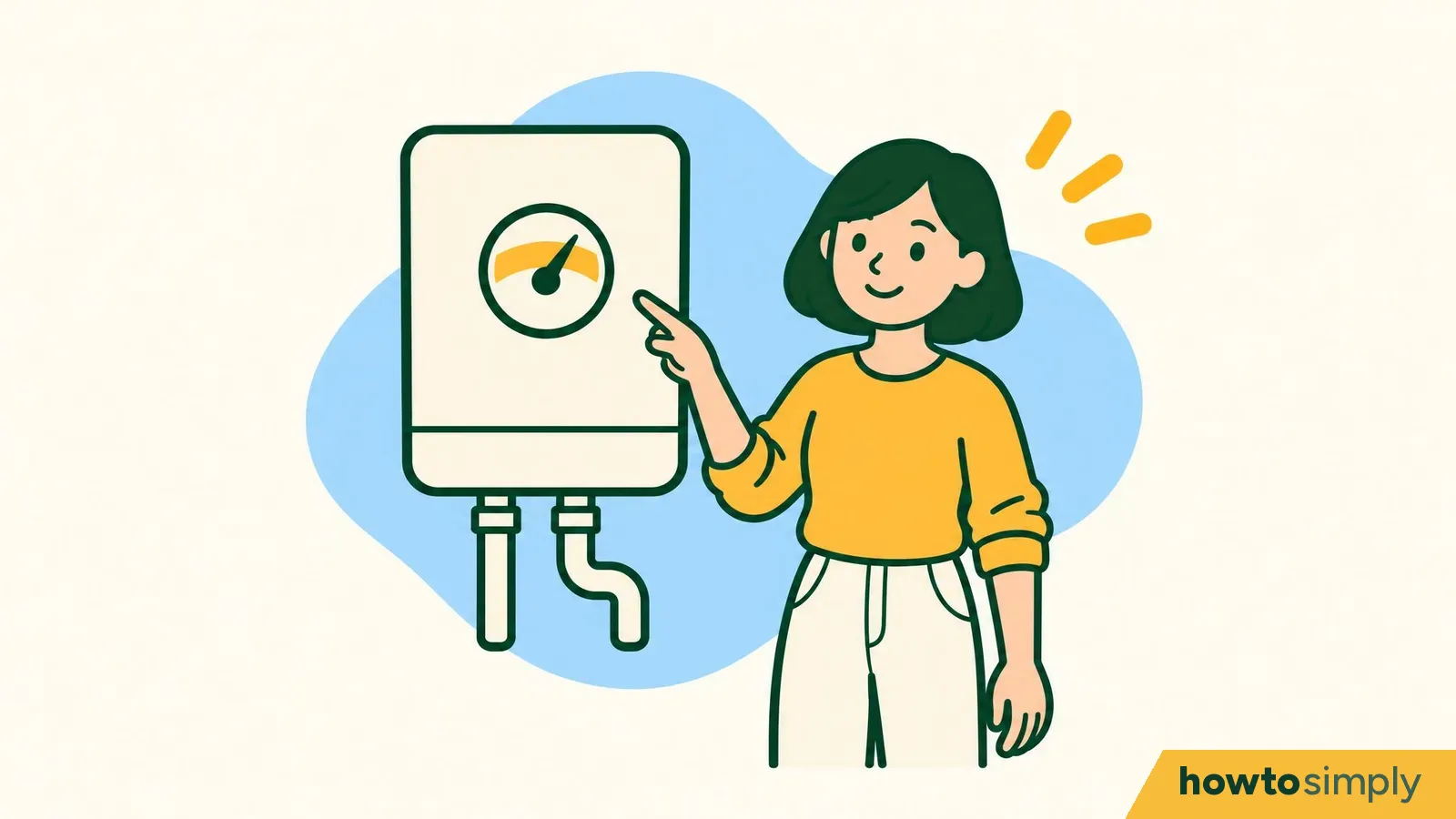
Bleed a radiator that is cold at the top: open the bleed valve anticlockwise, close it clockwise once water comes, then check the boiler pressure and top it up if it has dropped[1][3]. On a Worcester Bosch boiler the target is between 1 and 1.5 bar[2].
Information, not professional advice.
Latest update
17 November 2026. We re-read the sources. All three pages opened today and still support the steps, the waiting time, the timing advice and the warnings on this page. Nothing needed correcting.
What changed in this version
- Added the record layout: key facts with numbered sources, a table of what a cold or noisy radiator may mean, what the sources agree on and where they differ, a record history and reader questions.
- Named the Worcester Bosch pressure range of 1 to 1.5 bar from its homeowner guide, so you know what to aim for after topping up.
Key facts
- A radiator that is colder at the top than at the bottom usually has air in it. Cold at the bottom and hot at the top can point to sludge instead.[1]
- Gurgling or rushing noises, or radiators that stay partly cold, are also signs of air.[3]
- Open the bleed valve anticlockwise with a radiator key and close it clockwise once water comes out.[1][3]
- Viessmann says to turn all the thermostats fully up and wait 30 to 60 minutes first, so the air gathers at the top.[3]
- The water and air that come out can be hot.[3]
- Bleeding lets out water, so boiler pressure can drop. Worcester Bosch says to top it up afterwards, to between 1 and 1.5 bar on its boilers.[1][2]
- Viessmann advises bleeding once a year, before the heating season in autumn.[3]
Sitting in a chilly room beside a radiator that's cold at the top is miserable, especially when it's freezing outside. Luckily, it's an easy fix you can do yourself. All you need is a little key, a cloth and a bit of patience.
Does it need bleeding?
First, check that air really is the problem, because bleeding only lets air out. Feel the radiator with your hand and match it to one of these:
- Cold at the top, warm at the bottom: air is trapped. Bleed it (Worcester Bosch).
- Gurgling or flowing noises, or radiators that stay partly cold: bleed it (Viessmann).
- Warm at the top, cold at the bottom: Worcester Bosch says this could mean sludge has built up in the radiator, and your system might need cleaning.
The UK and German routines side by side
| UK (Worcester Bosch) | Germany (Viessmann) | |
|---|---|---|
| Before | Heating on to find the cold radiators, then off and let them cool | Circulation pump off (renters: close the flat's own heating circuit if it has a shut-off valve), all thermostats fully open, wait 30 to 60 minutes |
| Which first | Any radiator that needs it | The highest radiator, where most air collects |
| Open | Key anticlockwise | Square key, slowly anticlockwise |
| Close | Clockwise once water flows steadily | Quickly, as soon as water comes out |
| After | Heating on, check radiators are warm all over, top up boiler pressure | Pump back on, check the pressure gauge, refill if needed; after an hour, recheck the radiator farthest from the boiler |
Step by step
Before you start
- Time: Viessmann says to wait 30 to 60 minutes with the thermostats fully open before you start, and that the bleeding itself usually does not take long[3].
- Who it's for: Radiators that are cold at the top, gurgle, or stay partly cold[1][3].
- Not for: A radiator that is cold at the bottom and hot at the top, which Worcester Bosch links to sludge[1], or a radiator that stays cold after bleeding, which Viessmann says needs a heating engineer[3].
Find the cold radiators
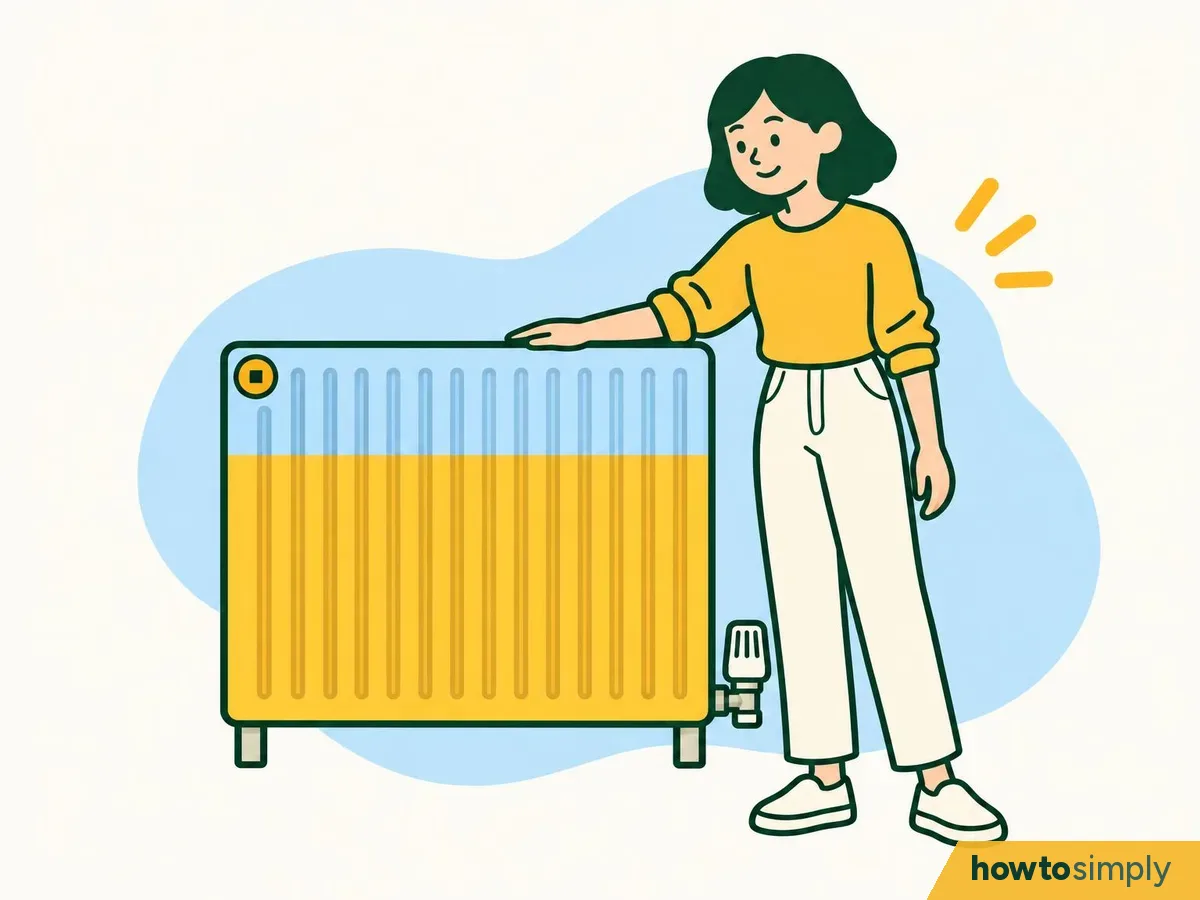
Illustration Turn the heating on, wait for the radiators to warm up, then feel each one with your hand. Write down which ones are cold at the top (Worcester Bosch), because once the heating's off they'll all feel the same.
Turn the heating off and open the thermostats
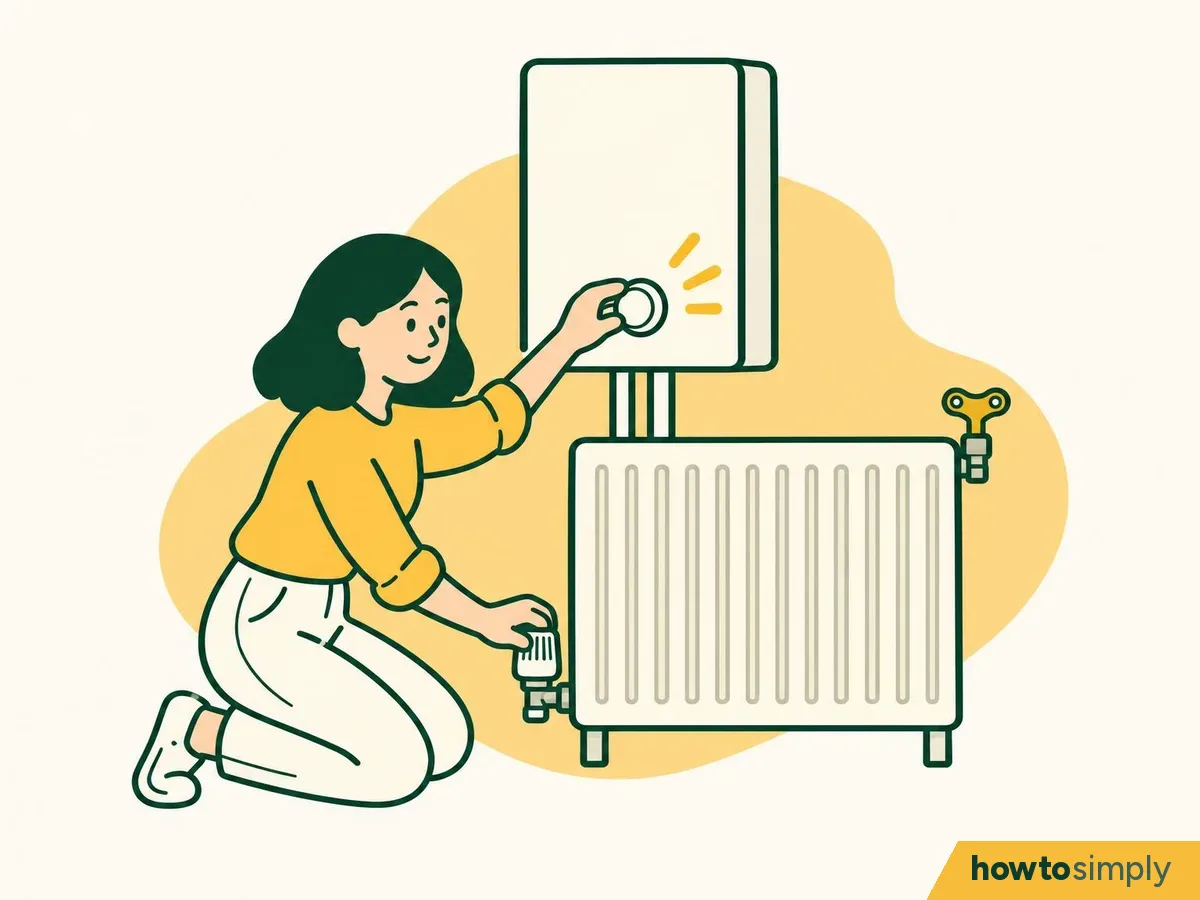
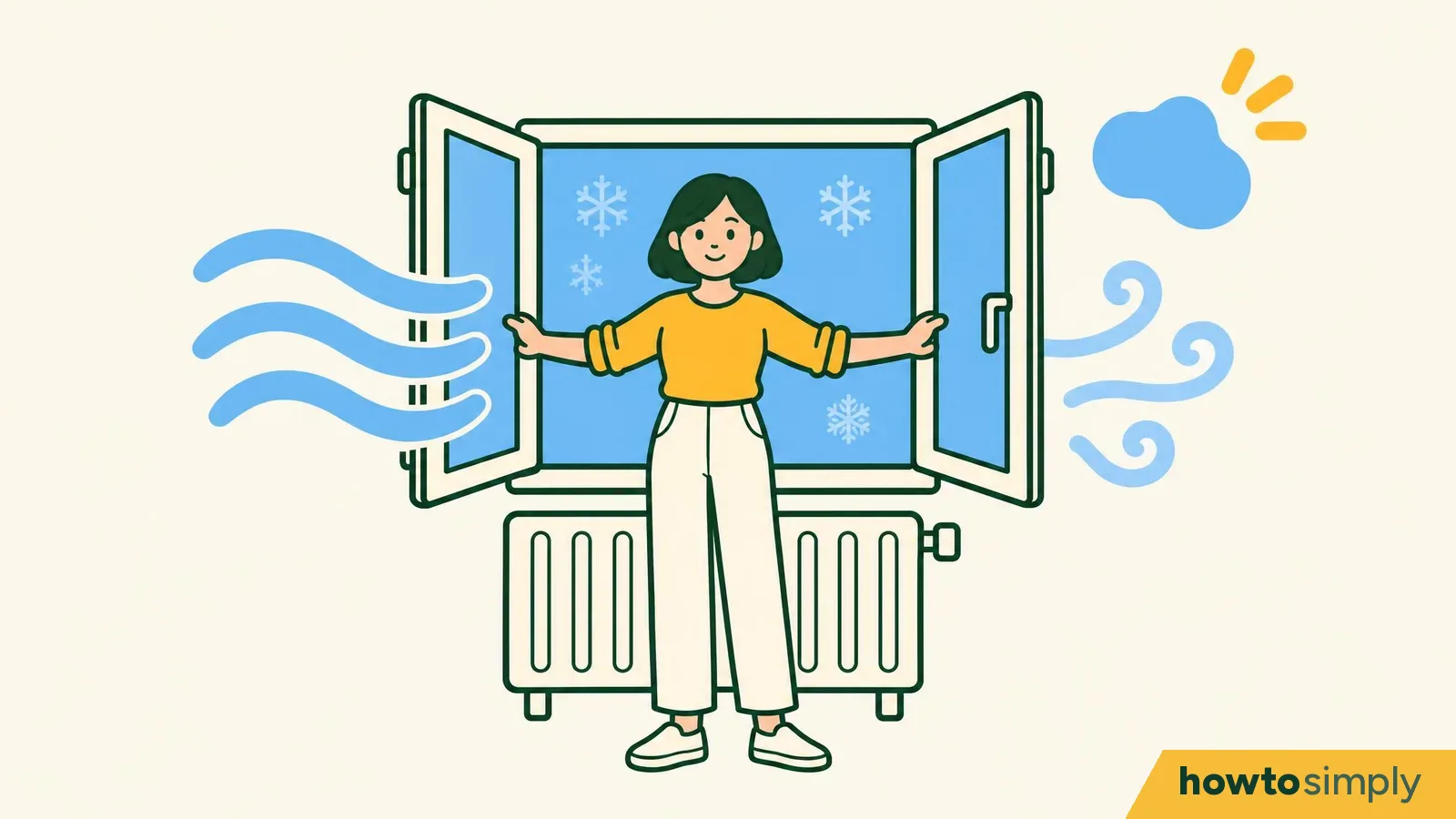
Illustration Switch the heating off and let the radiators cool down (Worcester Bosch). Viessmann also says to turn every radiator thermostat fully up and wait 30 to 60 minutes. That gives the air time to gather at the top, exactly where you can let it out. While you wait, get a cloth and a small cup ready.
Turn the key anticlockwise until air hisses out
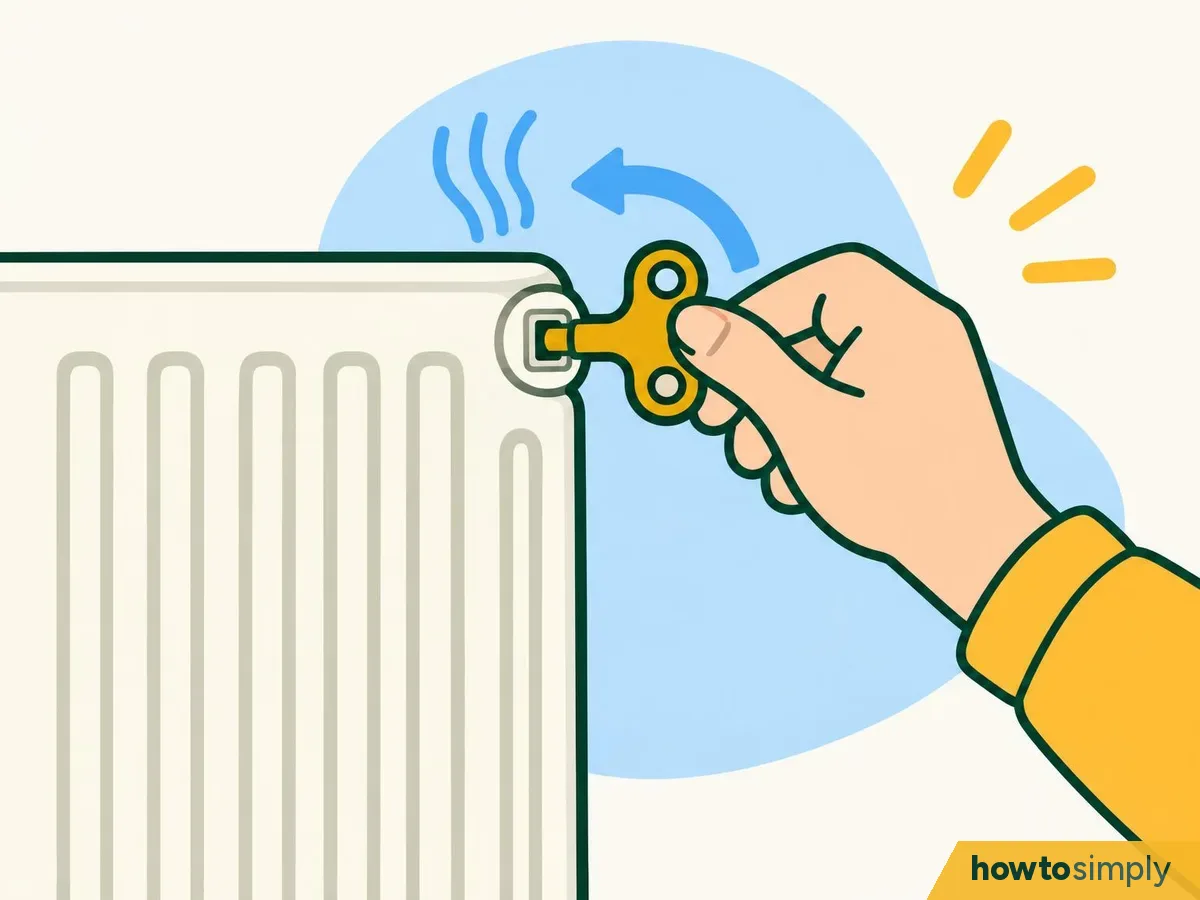
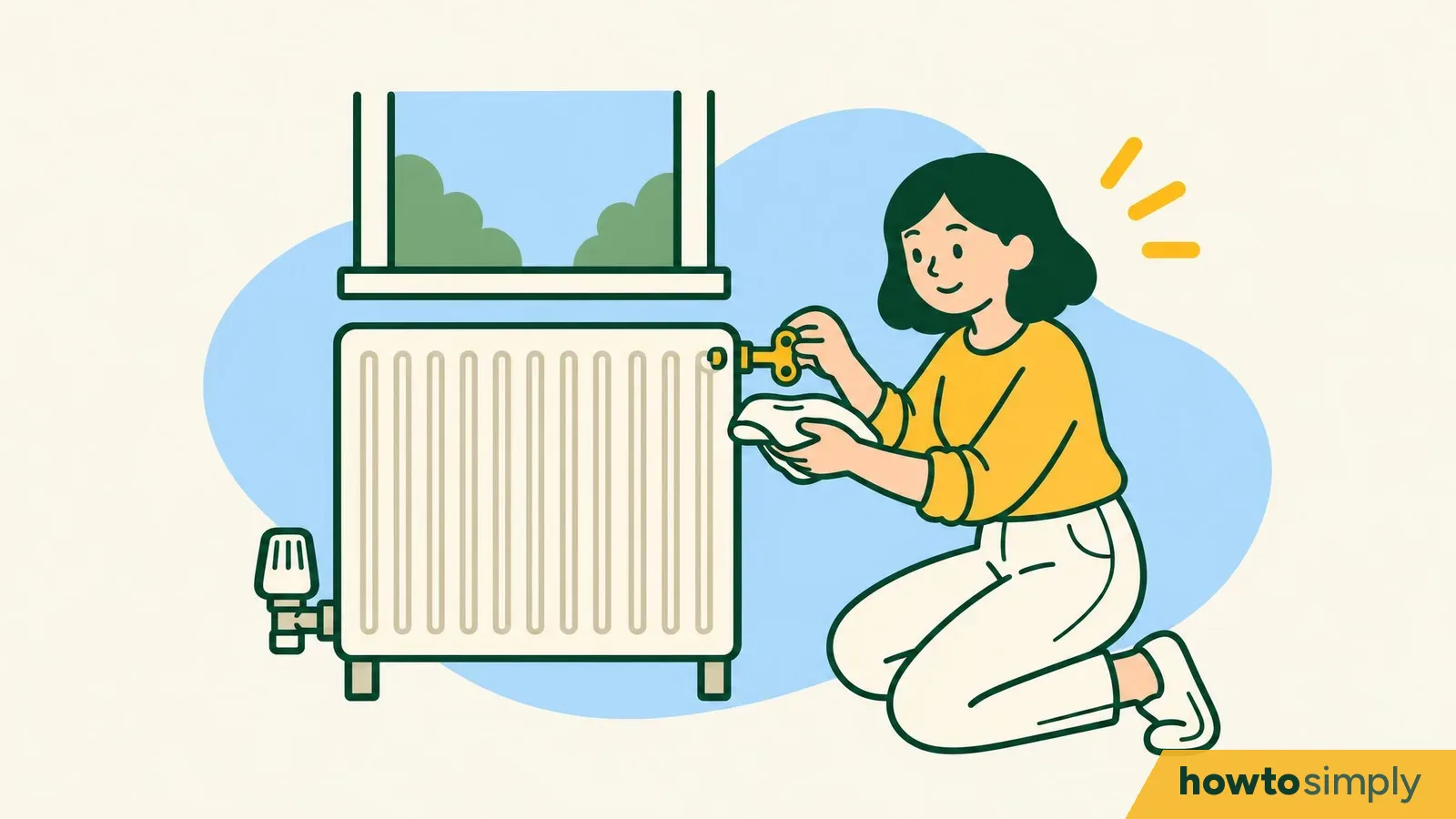
Illustration The bleed valve is the small screw with a square or a slot in the middle, at a top corner, on the side opposite the thermostat (Viessmann). Fit the key and turn it slowly anticlockwise. You'll hear a hiss as the air comes out. Don't worry about the noise; it's exactly what you want to hear. The water can be hot, so keep your hand away from the opening.
Catch the drips
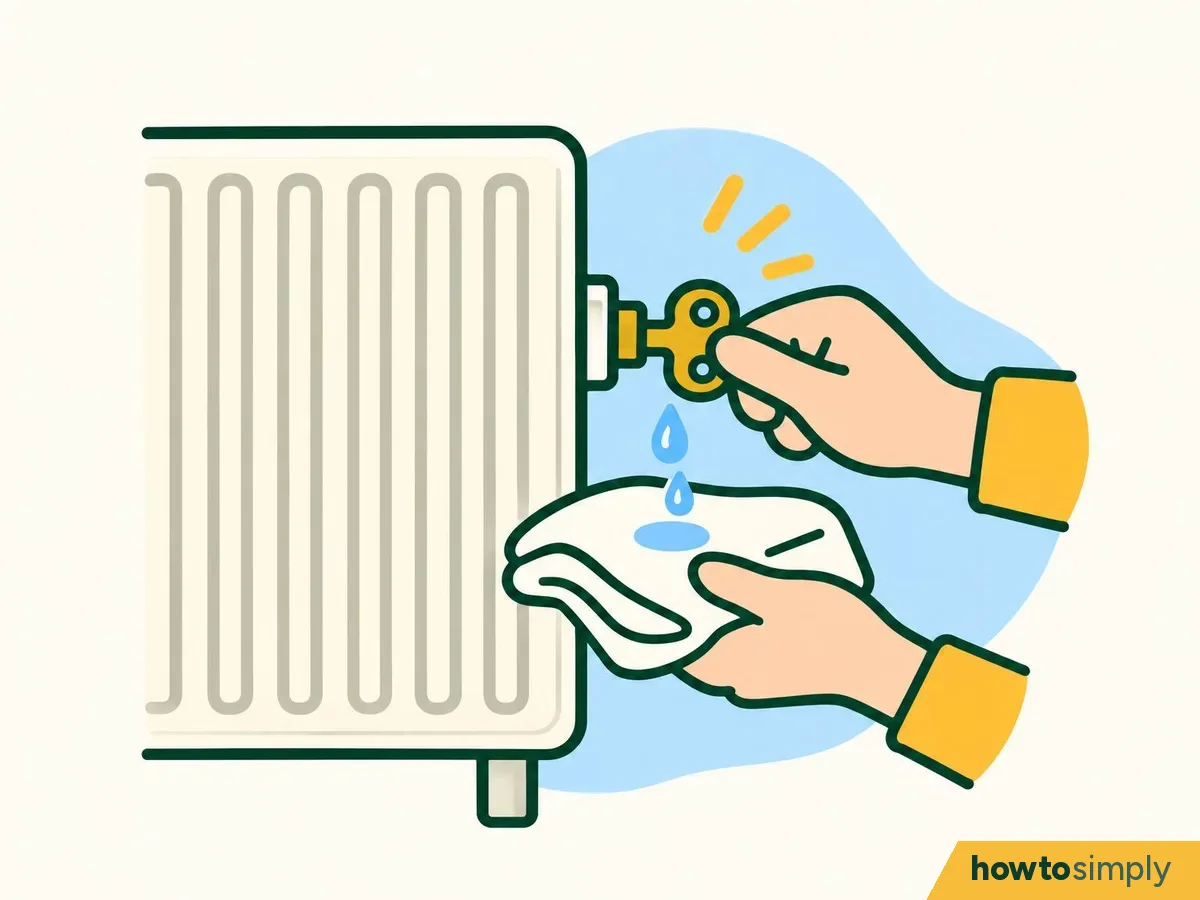
Illustration Hold the cloth or cup just under the valve, with another cloth on the floor underneath (Viessmann). Catching a few drips is far easier than scrubbing them out of a carpet.
Close it clockwise as soon as water comes out
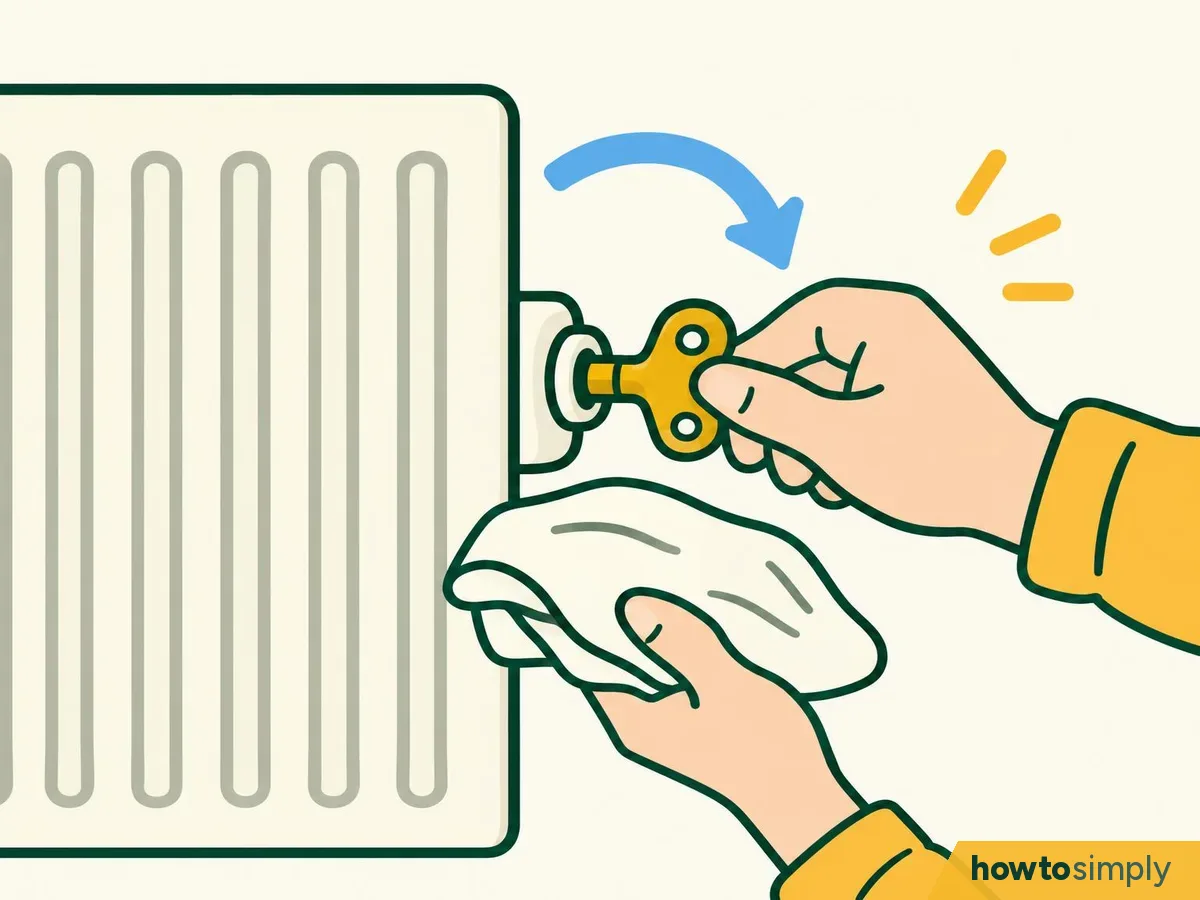
Illustration When water comes out instead of air, the radiator is clear, so turn the key clockwise to shut the valve. That's all there is to it. Viessmann says to close it quickly so you don't lose too much heating water. Do the same for every radiator that needs it.
Heating back on, then check the pressure

Illustration Next comes the step people forget. Turn the heating (or pump) back on and check that the radiators are warm all over. Bleeding lets out water, so the boiler pressure can drop, which is why you mustn't skip this check. Worcester Bosch says to make sure you top up your boiler pressure, and if you overdo it, to bleed a radiator to lower it. Other boilers may have a different range, so check your boiler's manual.
How to tell it worked
How often to bleed
Timing matters too. Viessmann suggests bleeding the system roughly once a year, ideally in autumn before the heating season begins. Do it sooner if radiators heat unevenly or gurgle. It's also worth doing after a noticeable loss of water from the system, after maintenance and after a radiator has been replaced.
What you need
- A radiator key: usually a square-headed key from a heating specialist, hardware shop or plumbers' merchant. Some valves open with a flat-head screwdriver instead (Viessmann).
- A cloth or rag to catch drips (Worcester Bosch), plus a small container and a cloth to protect the floor (Viessmann). Wipe up any drips and spills once you've finished (Worcester Bosch).
Common mistakes
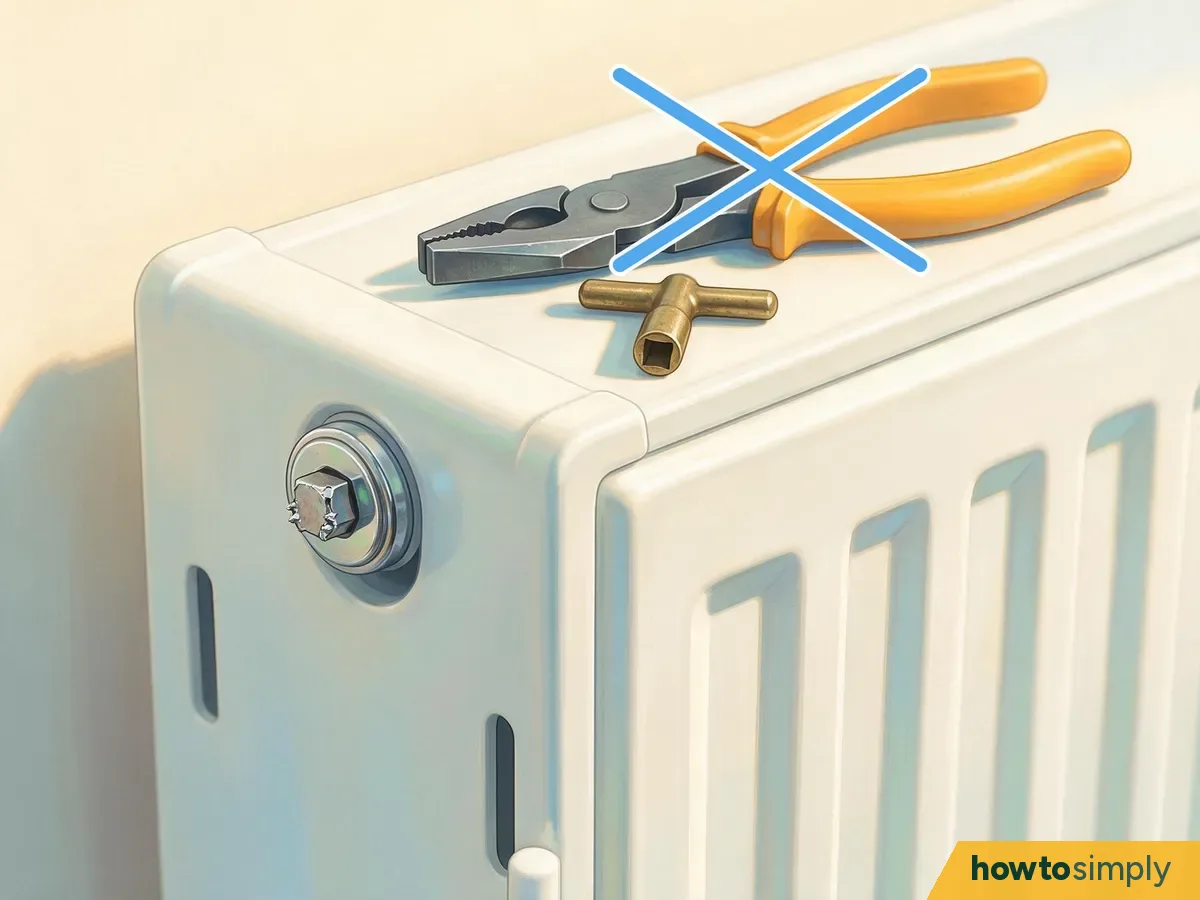
- Using pliers instead of a key: Viessmann says pliers can round off the valve, so the key won't fit any more and the valve may not close properly, letting water escape. A proper key costs less than the repair, so please don't be tempted.
- Turning up the thermostat instead: pockets of air stop the water flowing round evenly, so some radiators stay cold, and Viessmann says turning the thermostat up to compensate pushes up energy use and heating bills. So if you always reach for the thermostat when a room feels cold, you're paying extra on your heating bill.
- Topping up the wrong way: Viessmann lists incorrect refilling of heating water among the ways air gets into the system. See how to top up boiler pressure.
If this doesn't work
If a radiator still isn't right after bleeding, it isn't your fault. Some of the causes below need a heating engineer, and that's completely normal.
- Still cold after bleeding: Viessmann says it could be a stuck thermostat valve, missing hydraulic balancing or the heating controls. Ask a heating engineer.
- You rent: you're allowed to bleed your radiators, but other repairs are your landlord's responsibility. If the heat still isn't spreading properly, let your landlord know first (Viessmann, for Germany).
- You have to bleed them over and over: Viessmann says this can be a sign of a bigger problem, and it names leaks and a porous expansion vessel among the ways air gets in. Have the system checked.
- Pressure keeps dropping after top-ups: call the boiler maker or a heating engineer.
What your radiator is telling you, before and after bleeding
| What you notice | What the sources say it may mean | What to do |
|---|---|---|
| Cold at the top, warm at the bottom | Air trapped in the radiator[1] | Bleed it |
| Gurgling or rushing noises, or partly cold radiators | Air bubbles moving round the system[3] | Bleed it |
| Cold at the bottom, hot at the top | Sludge may have built up[1] | The system may need cleaning |
| Still cold after a successful bleed | A stuck thermostat valve, missing hydraulic balancing, or heating control settings[3] | Ask a heating engineer |
| Needs bleeding again and again | A deeper problem, such as leaks or a porous expansion vessel[3] | Have the system checked |
| Boiler gauge low after bleeding | Bleeding lets out water[1][3] | Top up; 1 to 1.5 bar on a Worcester Bosch boiler[2] |
Graphic by howtosimply, from the sources below.
What the sources agree on
Where the sources differ, or nothing is confirmed
- What to switch off: Worcester Bosch says turn the heating off and let the radiators cool; Viessmann says switch off the circulation pump and turn every thermostat fully up.[1][3]
- Order: Viessmann starts with the highest radiator; Worcester Bosch does not name an order.[1][3]
- Target pressure: Worcester Bosch gives 1 to 1.5 bar for its boilers; Viessmann does not give a figure on its bleeding page and says to read the gauge and refill if needed. Check your own boiler's manual for its range.[2][3]
- Renters: the advice that tenants may bleed radiators but other repairs fall to the landlord comes from Viessmann and describes Germany.[3]
Record history
- Version 4. Sources re-read and the page moved to the record layout, with numbered key facts, a table of radiator signs, agree and differ lists, this history and reader questions.
- Version 3. Rewrote the introduction and several explanations to make them clearer; the steps and sources stayed the same.
- Version 2. Rewritten in the house voice; facts, steps, sources, tables and illustrations unchanged.
- Version 1. First published, with the UK and German steps from Worcester Bosch and Viessmann.
Questions
Where is the bleed valve on a radiator?
At the top of the radiator[1]. Viessmann says it sits in a top corner on the side opposite the thermostat, and usually looks like a screw with a square or a slot in the middle[3].
What do I need?
A radiator key and a cloth to catch drips[1]. Viessmann adds a cup or glass to catch the water and a cloth to protect the floor[3].
How often should I bleed my radiators?
Viessmann suggests once a year, before the heating season in autumn, and sooner if radiators heat unevenly or gurgle. It also suggests bleeding after maintenance and after a radiator is replaced.[3]
What pressure should the boiler show afterwards?
Worcester Bosch says between 1 and 1.5 bar on its boilers, and that the reading rises while the heating is on and settles back when the system cools[2]. Other makes may differ, so check your boiler's manual.
Why do I have to bleed the same radiator again and again?
Viessmann says repeated bleeding can point to a deeper problem. It names leaks at pipes and joints, a porous expansion vessel and incorrect refilling as ways air gets in, so have the system checked.[3]
Which way do I turn a radiator key?
Anticlockwise to open the bleed valve and let the air out, clockwise to close it. Worcester Bosch says both; Viessmann also says to open it anticlockwise.
How long does it take to bleed a radiator?
Usually not long. Viessmann says to keep it open until no more air comes out and water appears, then close it quickly.
What if I lose my radiator key?
Viessmann says a pointed pair of pliers or a flat screwdriver can work on some valves, but warns you can round off the valve so it no longer closes. A new key is cheaper than that repair.
Sources
- Worcester Bosch: How to bleed a radiator. Read 17 November 2026.
- Worcester Bosch: Maintaining your boiler pressure (homeowner guide, PDF). Read 17 November 2026.
- Viessmann: Heizung entlüften (German). Read 17 November 2026.
Sources and method
- Researched by
- Abu Bakar Saadat
- Tested by our team
- No. We have no record of anyone on our team trying these steps, so treat them as researched instructions from the sources below.
- Pictures
- 8 illustrations drawn for this article, each marked Illustration (drawings, not photos).
- Sources
- 3 named sources, linked below.
- What this page adds
- The UK and German bleeding routines side by side, drawings of turning the key at the bleed valve, and a picture of a rounded-off valve next to a proper square key.
- What we checked
- On 17 November 2026 we re-read the Worcester Bosch radiator bleeding page, the Worcester Bosch homeowner guide to boiler pressure (PDF) and Viessmann's German guide to bleeding a heating system, and checked every step, time, warning and pressure figure against them.
What to do next
Get your home ready for winter Step 1 of 6
- How to top up your boiler pressure: the three UK filling methods, and the German ruleBleeding radiators drops the boiler pressure, so check it next.
- How to set a boiler timer: dial pins, digital programmers and the clocks-change fixHeat the house only when you are in it.
- How to thaw a frozen pipe safely, and stop pipes freezing (UK, Germany, US)Protect the pipes before the first hard frost.
Remind me
Bleed your radiators before the heating season every 12 months (Viessmann). Add a repeating reminder to your own calendar. It links back to this page.
Nothing is sent to us. The reminder lives only in your calendar.
Did this solve the problem?
Where did you get stuck?
What did you think?
Reaction counts are loading.