How to make saffron and cardamom milk
Researched by Abu Bakar Saadat3 min read
Last updated: 21 November 2026References
 Illustration
On this page 8 sections
In short
Soak a pinch of saffron in a spoonful of hot water, crack four cardamom pods, warm them with 500 ml milk and a little sugar until steaming, rest 5 minutes covered and strain into two mugs. About 20 minutes.
Overview
Two mugs of warm, lightly sweet milk, golden from saffron and fragrant with cardamom. It's a calm drink for Christmas morning. A spoonful of hot water pulls the colour out of the saffron first, and lightly cracked cardamom pods give the milk a warm, slightly citrusy scent without leaving bits to chew on.
| What | This recipe |
|---|---|
| Makes | 2 mugs, about 250 ml (1 cup) each |
| Prep | 4 minutes, including boiling the kettle |
| Cooking | 6–8 minutes on the hob |
| Resting | 10 minutes: 5 for the saffron, 5 for the milk |
| Total | 20–22 minutes |
| Allergens | Contains milk |
Before you start
- You'll need: a kettle, a chopping board, a tablespoon, a small heatproof ramekin or egg cup, a measuring jug, a 1-litre saucepan with a lid, a fine-mesh strainer (tea strainer) and two 300 ml (10 oz) mugs.
- Saffron comes as thin red threads, sold in tiny jars or packets in the spice aisle. A small pinch is all you need; using more can make the milk taste bitter.
- Green cardamom pods are small, pale green pods with sticky black seeds inside. Cracking them lets the flavour out.
- Each picture below shows four moments of its step. Read it from top left to bottom right.
Ingredients
- 4 whole green cardamom pods
- 1 small pinch saffron threads, about 0.05 g
- 15 ml (1 tablespoon) freshly boiled water
- 500 ml (about 2 cups) whole milk
- 12 g (about 1 level tablespoon) granulated sugar
Steps
1. Open the pods and soak the saffron
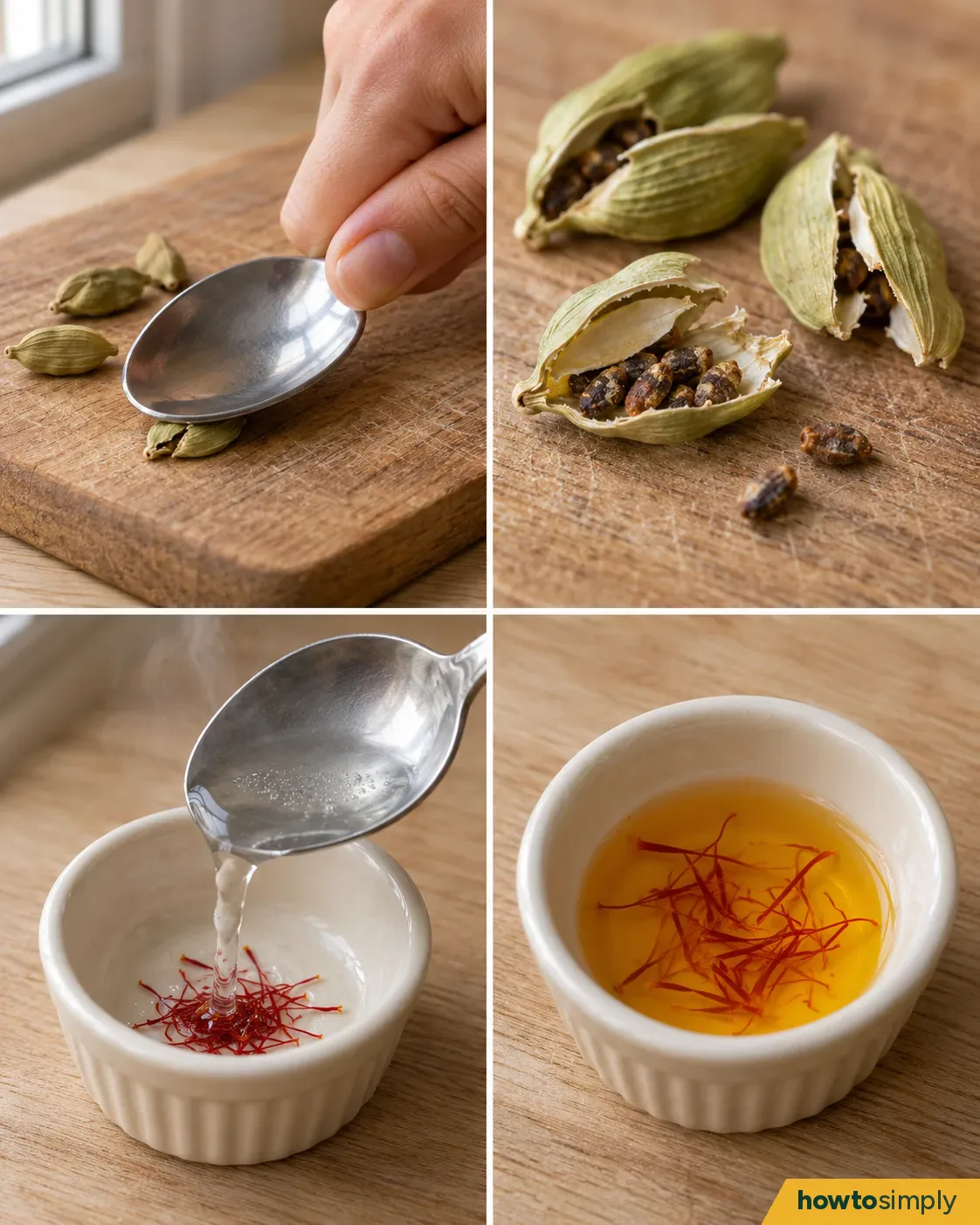
Press each cardamom pod gently against the board with the back of the spoon. Stop as soon as the husk splits and you can see the dark seeds inside. Keep the husks and any loose seeds together.
Put the saffron in the ramekin, pour the hot water over it and leave it for 5 minutes. The water should turn a deep amber colour and the threads should go soft.
2. Warm the milk, let it stand and strain
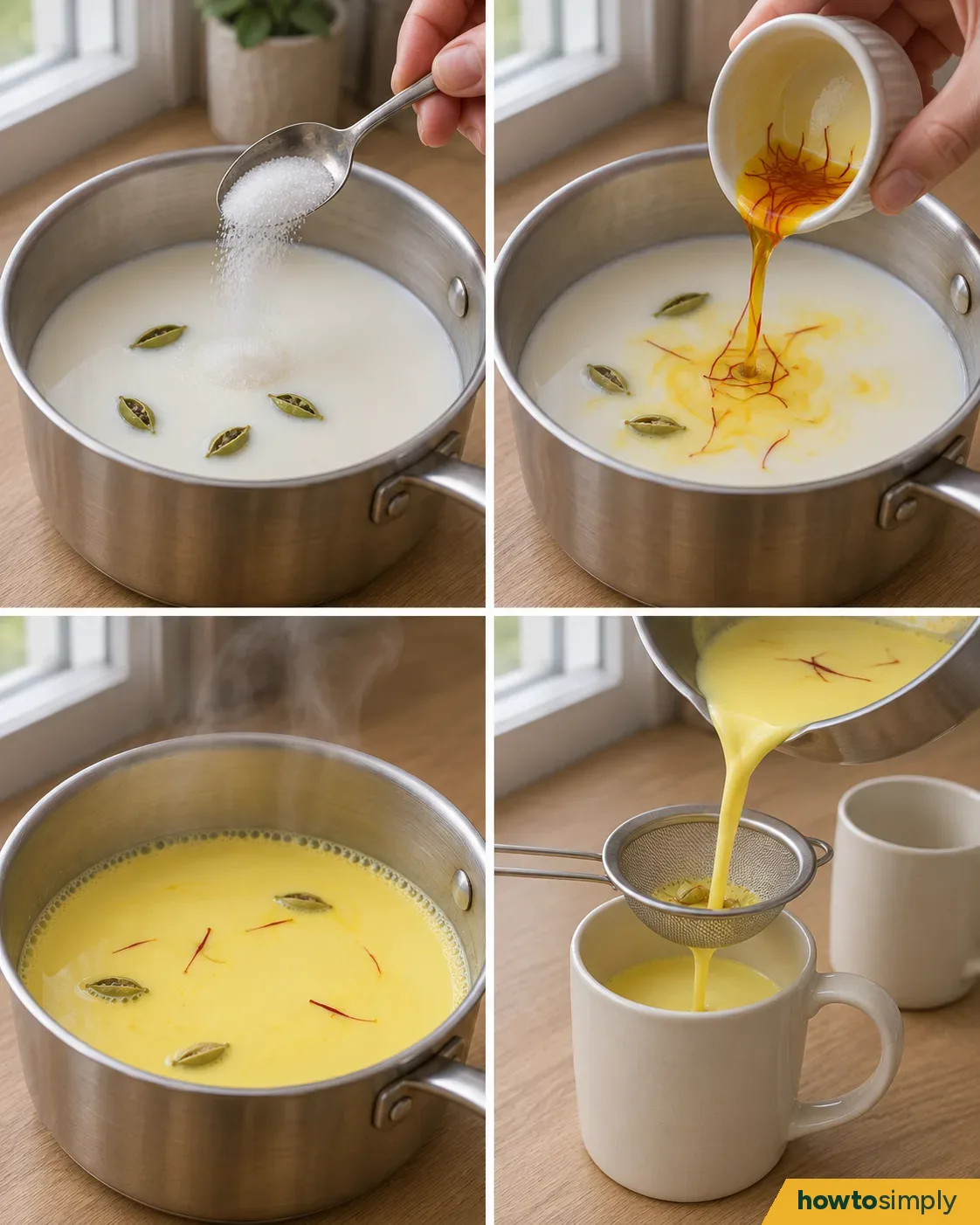
Put the milk, cardamom husks and seeds, and sugar in the saucepan. Tip in the saffron with all its soaking water. Warm over a medium-low heat for 6–8 minutes, stirring along the bottom of the pan often so the milk doesn't catch. When steam rises and a ring of tiny bubbles forms around the edge, take the pan off the heat.
Put the lid on and leave it for 5 minutes so the spices can flavour the milk. Pour it through the strainer into the two mugs, sharing it equally. Throw away the spices left in the strainer.
If this doesn't work
- The milk starts to foam up the pan: lift it off the hob straight away and stir until the foam settles. It's already hot enough, so put the lid on and start the 5-minute rest.
- A skin forms on top: that happens when milk sits hot. Stir it back in or lift it off with a spoon before straining.
- The colour is pale: the saffron may be old or the pinch was very small. Next time, give the threads the full 5 minutes in hot water, or a few minutes longer.
Serving and storing
Serve warm with gingerbread or a slice of Christmas loaf cake. If any strained milk is left over, get it into the fridge, covered, within 1–2 hours and drink it within 48 hours.1 Reheat it gently in a small pan, stirring until it's steaming all the way through.
Sources
- Food Standards Agency, How to chill, freeze and defrost food safely, section 1, "Chilling food".
Related
- How to make orange hot chocolate
- How to make gingerbread snacking cake
- How to make date and walnut loaf cake
The pictures in this recipe are illustrations.
Sources and method
- Researched by
- Abu Bakar Saadat
- Pictures
- 2 illustrations drawn for this article: drawings, not photos.
Did this solve the problem?
Where did you get stuck?
Get new guides by email
Our newest guides, sent to your inbox. Free, and you can unsubscribe in one click.
We'll email you to confirm. How we use your email
Follow howtosimply on Facebook
We share every new article on our Facebook page, so the next fix turns up in your feed.
Follow on FacebookWhat did you think?
Reaction counts are loading.