How to make honey and saffron semolina cake
Researched by Abu Bakar Saadat5 min read
Last updated: 21 November 2026References
 Illustration
On this page 7 sections
In short
Stir semolina, sugar, yogurt and melted butter, rest 15 minutes, mark into diamonds with an almond on each, bake in a 20 cm square tin at 180°C (160°C fan) for 30–38 minutes, then soak with warm saffron honey syrup. Serves 8–10.
Overview
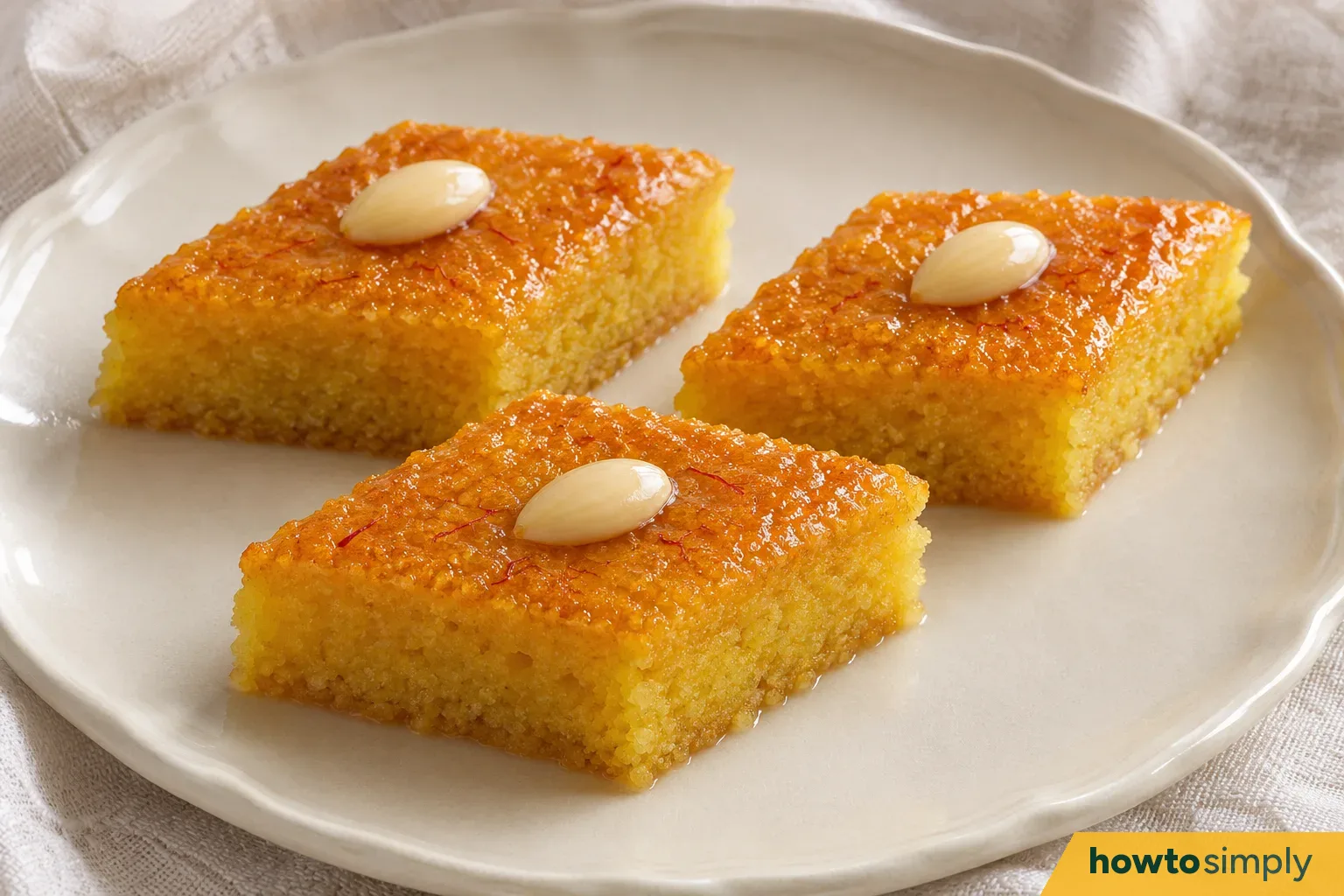
A soft, slightly grainy semolina cake, marked into diamonds before baking with an almond pressed into each one. While it's still warm you spoon over a honey syrup coloured with saffron, which soaks in and leaves a light shine on top. There's no egg in it, and everything is stirred in one bowl.
| What | This recipe |
|---|---|
| Makes | One 20 cm (8 inch) square cake, 8–10 servings |
| Oven | 180°C conventional, 160°C fan (about 350°F), middle shelf |
| Prep | 20 minutes, including the syrup |
| Resting before baking | 15 minutes |
| Baking | 30–38 minutes |
| Soaking after the syrup | 1 hour |
| Total | About 2 hours 5 minutes to 2 hours 15 minutes |
| Allergens | Contains wheat (semolina, gluten), milk (butter, yogurt) and tree nuts (almonds). No egg. |
Before you start
- You'll need: a 20 × 20 cm (8 × 8 inch) light-coloured metal cake tin at least 4 cm (1½ inches) deep, kitchen scales, a measuring jug or spoons, a small heatproof cup, a mixing bowl, a small saucepan, a pastry brush, a silicone spatula, a small knife, a wooden skewer, a tablespoon and a cooling rack.
- Use fine semolina, the sandy kind sold for semolina pudding, not coarse semolina or semolina flour for pasta.
- Use runny yogurt, the kind that slides off a spoon. Thick Greek-style yogurt makes the batter too stiff.
- Each step picture below shows four moments of its step. Read it from top left to bottom right.
Ingredients
- 85 g (about 6 tablespoons) unsalted butter, split into 5 g for the tin and 80 g for the batter
- 1 generous pinch saffron threads (about 0.05 g)
- 70 ml water, split into 20 ml (4 teaspoons) just-boiled water for the saffron and 50 ml (about 3½ tablespoons) for the syrup
- 250 g fine semolina
- 80 g (about ⅓ cup plus 1 tablespoon) caster sugar or granulated sugar
- 6 g (about 1½ level teaspoons) baking powder
- 1 g (a small pinch) fine salt
- 220 g runny plain whole-milk yogurt
- About 20 whole blanched almonds (about 25 g)
- 100 g mild runny honey
- 10 ml (2 teaspoons) lemon juice
Steps
Butter the tin and mix the batter
Heat the oven to 180°C conventional or 160°C fan (about 350°F), with a shelf in the middle. Melt the butter over low heat. Brush about 5 g (a teaspoon) over the base and sides of the tin and leave the other 80 g to cool until just warm.
Crumble the saffron between your fingertips into the cup, pour in the 20 ml of just-boiled water and leave it until step 3; it turns amber. A generous pinch is all you need, which is much less than the picture shows.
In the bowl, stir the semolina, sugar, baking powder and salt together. Add the yogurt and the 80 g of melted butter. Stir for about 1 minute, scraping the bottom, until every grain is damp and the batter falls off the spatula in soft clumps.
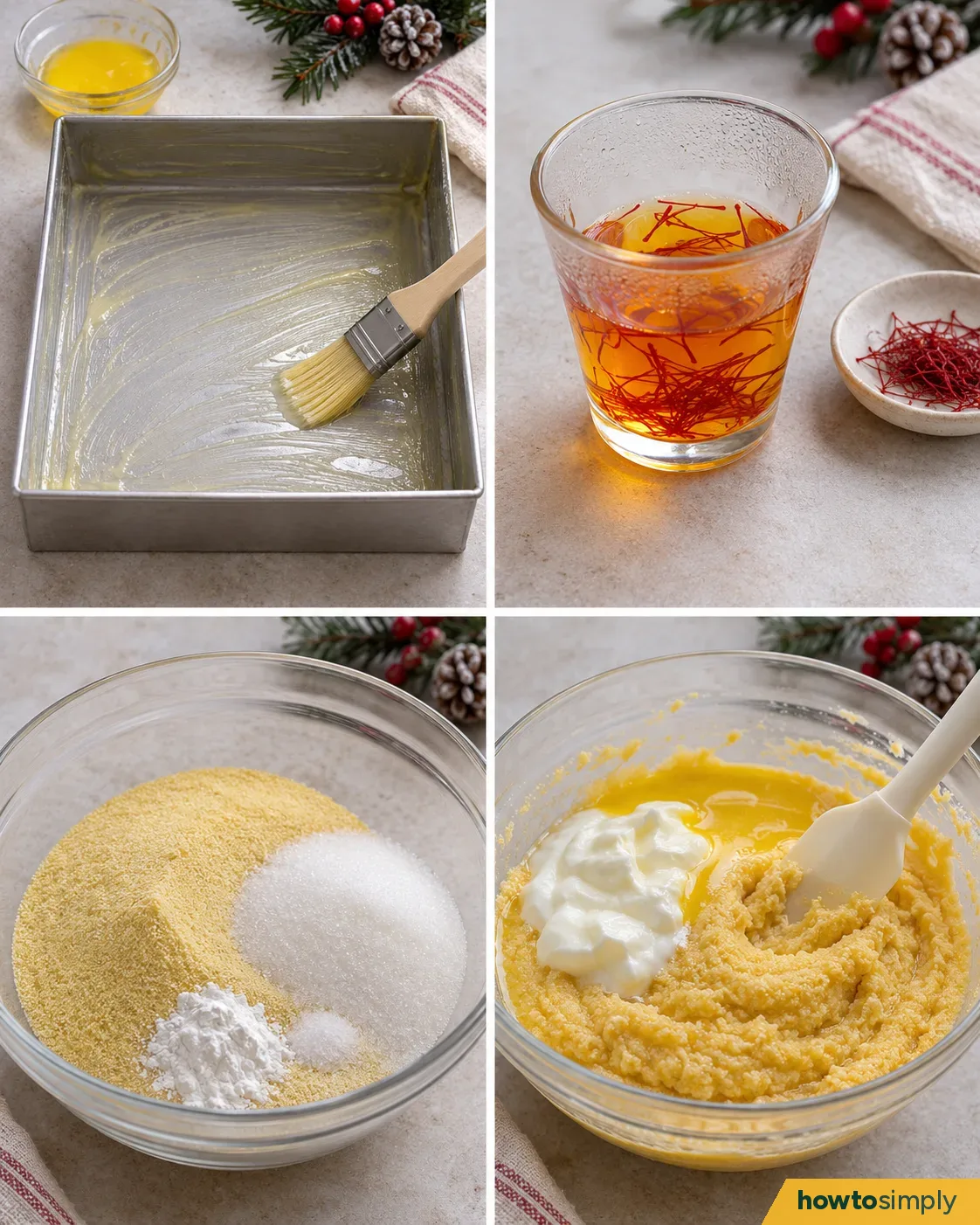
Smooth the batter, rest it and mark the diamonds
Scrape the batter into the tin, push it into the corners and smooth the top. Leave it for 15 minutes so the semolina can soak up the yogurt. It's ready when the top holds a light knife mark.
With the small knife, draw three straight lines about 3 mm deep to divide the cake into four equal strips. Then draw slanting lines about 5 cm apart across the strips. You'll get diamonds in the middle and smaller pieces at the edges. Press one almond lightly into the middle of each piece that's big enough to hold one.
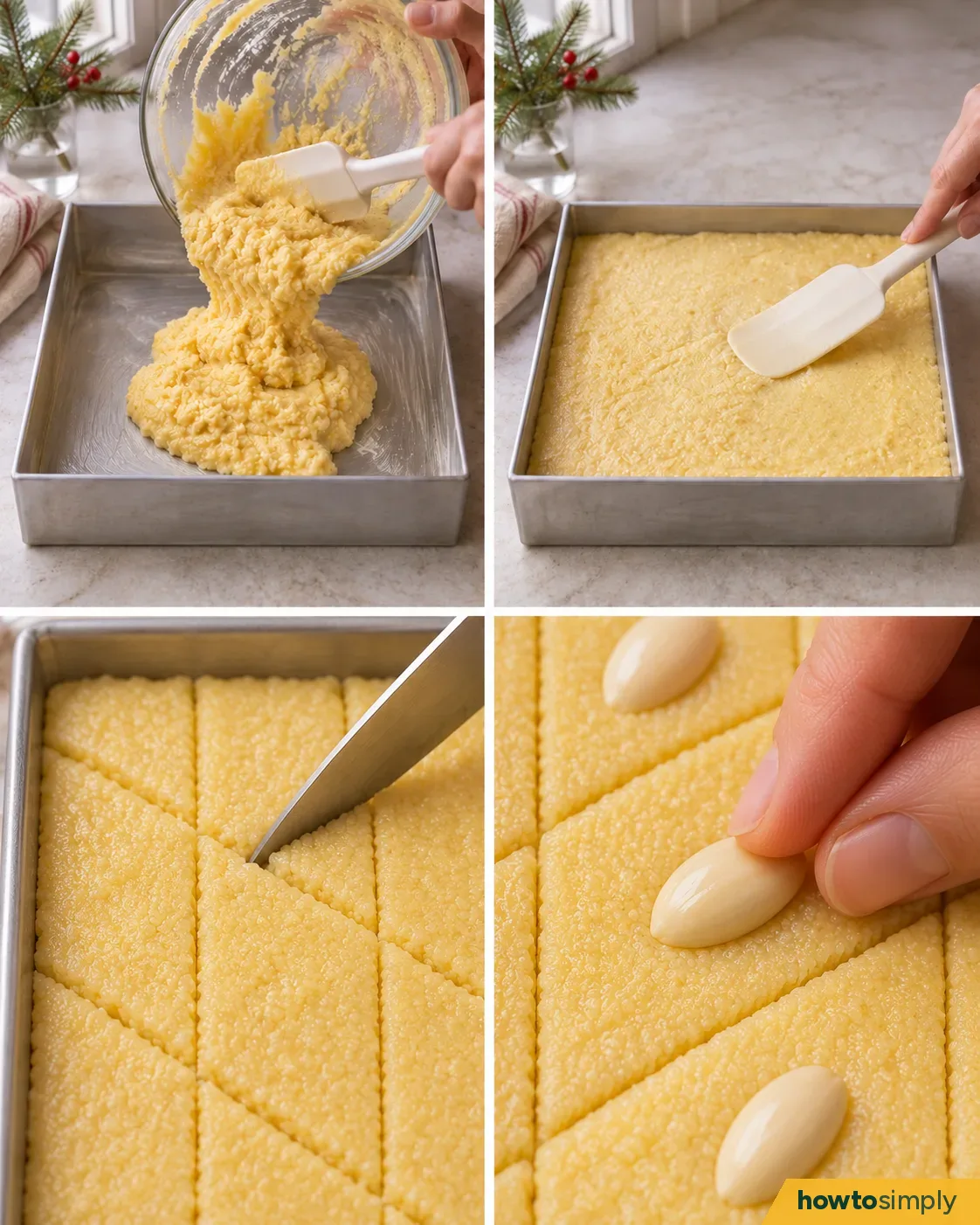
Bake, then spoon over the warm syrup
Bake for 30–38 minutes, checking from 30 minutes. The top should be golden right to the middle, the edges a deeper brown, and a skewer in the middle should come out with no wet batter. Put the tin on the rack.
Put the honey, the other 50 ml of water, the lemon juice and the saffron water with its threads in the saucepan. Warm over medium heat, stirring, for 2–3 minutes, until the honey has dissolved and small bubbles appear at the edge. Take it off the heat while it still pours easily.
Spoon the warm syrup slowly over the warm cake in two goes, covering the middle, the marked lines and the corners. Leave the cake in the tin for 1 hour, until the syrup has soaked in and a piece holds together when you lift it. Cut right through along the marked lines and lift the pieces out with a spatula.
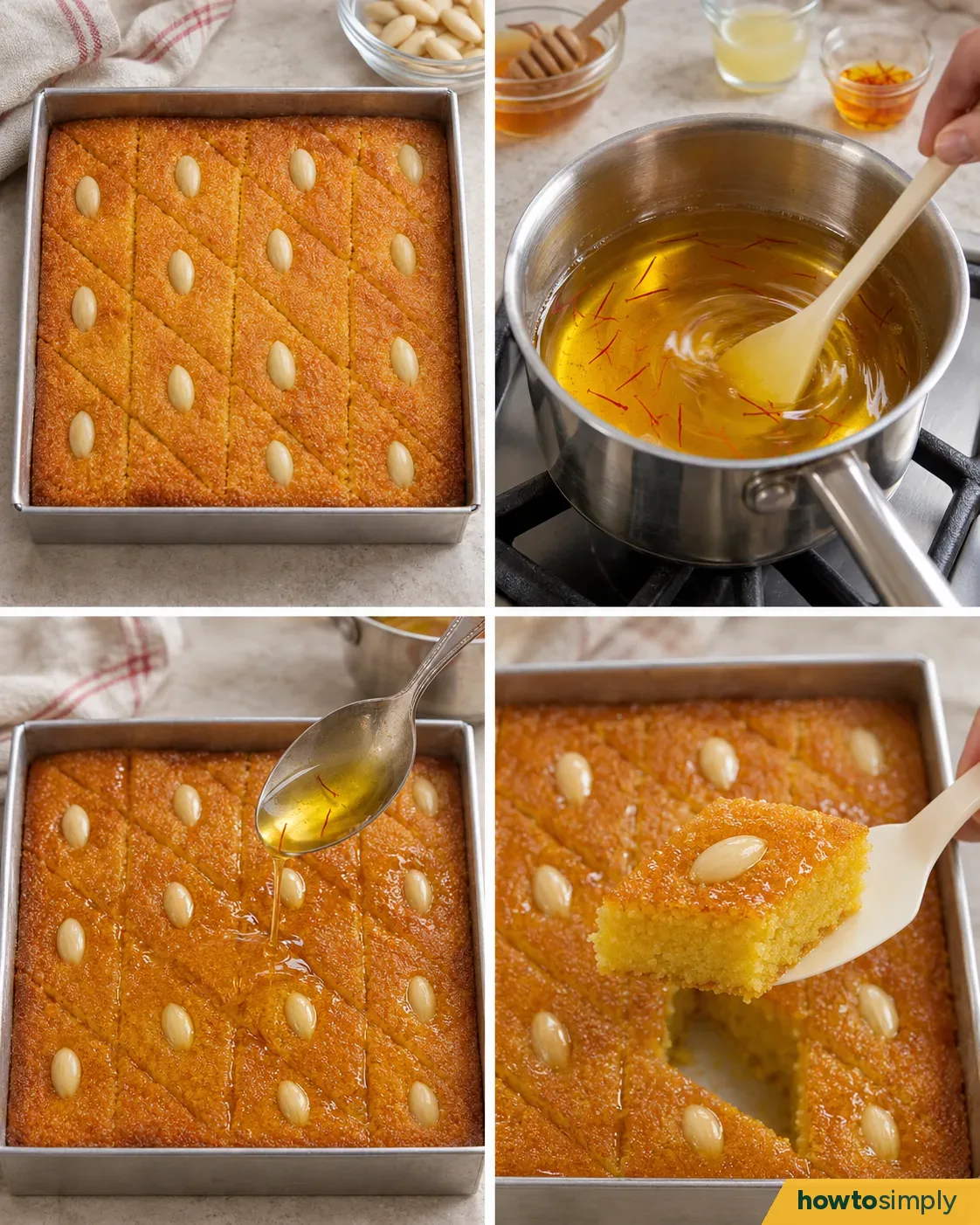
If this doesn't work
- The syrup sits in puddles on top: stop after the first pass. Run the knife lightly along the baked lines, wait 5 minutes until the puddles shrink, then spoon the rest along the lines a little at a time.
- The pieces crumble when you lift them: they need longer to soak. Give the cake the full hour before cutting.
- The cake is dry: it was probably baked too long, or the syrup went on after the cake had cooled. Pour warm syrup over warm cake.
Serving and storing
Serve at room temperature with black tea or coffee. For a Christmas plate, set the diamonds almond side up and tuck the smaller edge pieces between them. Once cool, keep the cake in an airtight container in the fridge, and take out the pieces you want about 30 minutes before serving so the butter softens.
Related
- How to make saffron and cardamom milk
- How to make pistachio and rosewater friands
- How to make cherry and almond cake
The pictures in this recipe are illustrations.
Sources and method
- Researched by
- Abu Bakar Saadat
- Pictures
- 4 illustrations drawn for this article: drawings, not photos.
Did this solve the problem?
Where did you get stuck?
Get new guides by email
Our newest guides, sent to your inbox. Free, and you can unsubscribe in one click.
We'll email you to confirm. How we use your email
Follow howtosimply on Facebook
We share every new article on our Facebook page, so the next fix turns up in your feed.
Follow on FacebookWhat did you think?
Reaction counts are loading.