How to make a marble Bundt cake
Researched by Abu Bakar Saadat4 min read
Last updated: 21 November 2026References
 Illustration
On this page 7 sections
In short
Whisk a yogurt vanilla batter, stir cocoa into a third of it, spoon both into a greased and floured 2-litre ring tin, swirl once and bake at 175°C (155°C fan) for 35–45 minutes. Serves 10.
Overview
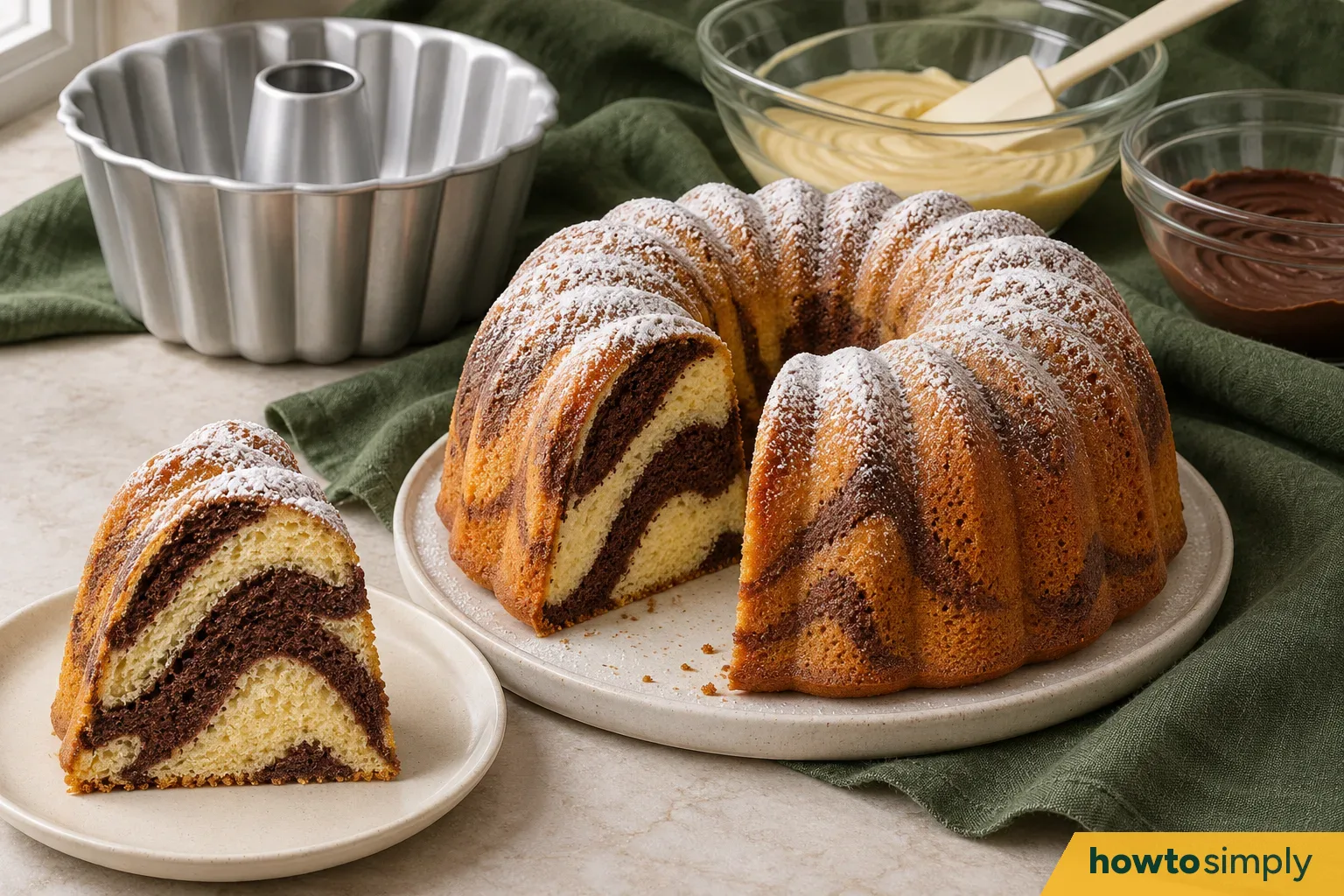
A ring-shaped vanilla cake with wide ribbons of cocoa running through it, baked in a fluted Bundt tin so it looks like a Christmas wreath. You make one bowl of vanilla batter, turn a third of it brown with cocoa, spoon the two into the tin and give them a single swirl. Bring it to the table whole, so the first slice shows the pattern.
| What | This recipe |
|---|---|
| Makes | One ring cake, 10 slices |
| Oven | 175°C conventional, 155°C fan (about 350°F), middle shelf |
| Prep | 20 minutes |
| Baking | 35–45 minutes |
| Cooling | 10 minutes in the tin, then about 50 minutes on a rack |
| Total | About 1 hour 55 minutes to 2 hours 5 minutes |
| Allergens | Contains egg, milk (butter, yogurt, milk) and wheat (gluten) |
Before you start
- You'll need: a 2-litre (about 8½ cup) fluted metal ring tin, also called a Bundt tin, about 22 cm (8½–9 inches) across; a pastry brush, kitchen scales, a measuring jug, a large and a medium mixing bowl, a whisk, a flexible spatula, two tablespoons, a wooden skewer, oven mitts, a cooling rack and a fine sieve.
- Grease and flour the tin properly. Fluted tins have lots of corners where cake can stick, so this is the step that decides whether it comes out in one piece.
- Use unsweetened cocoa powder, not drinking chocolate, which is mostly sugar.
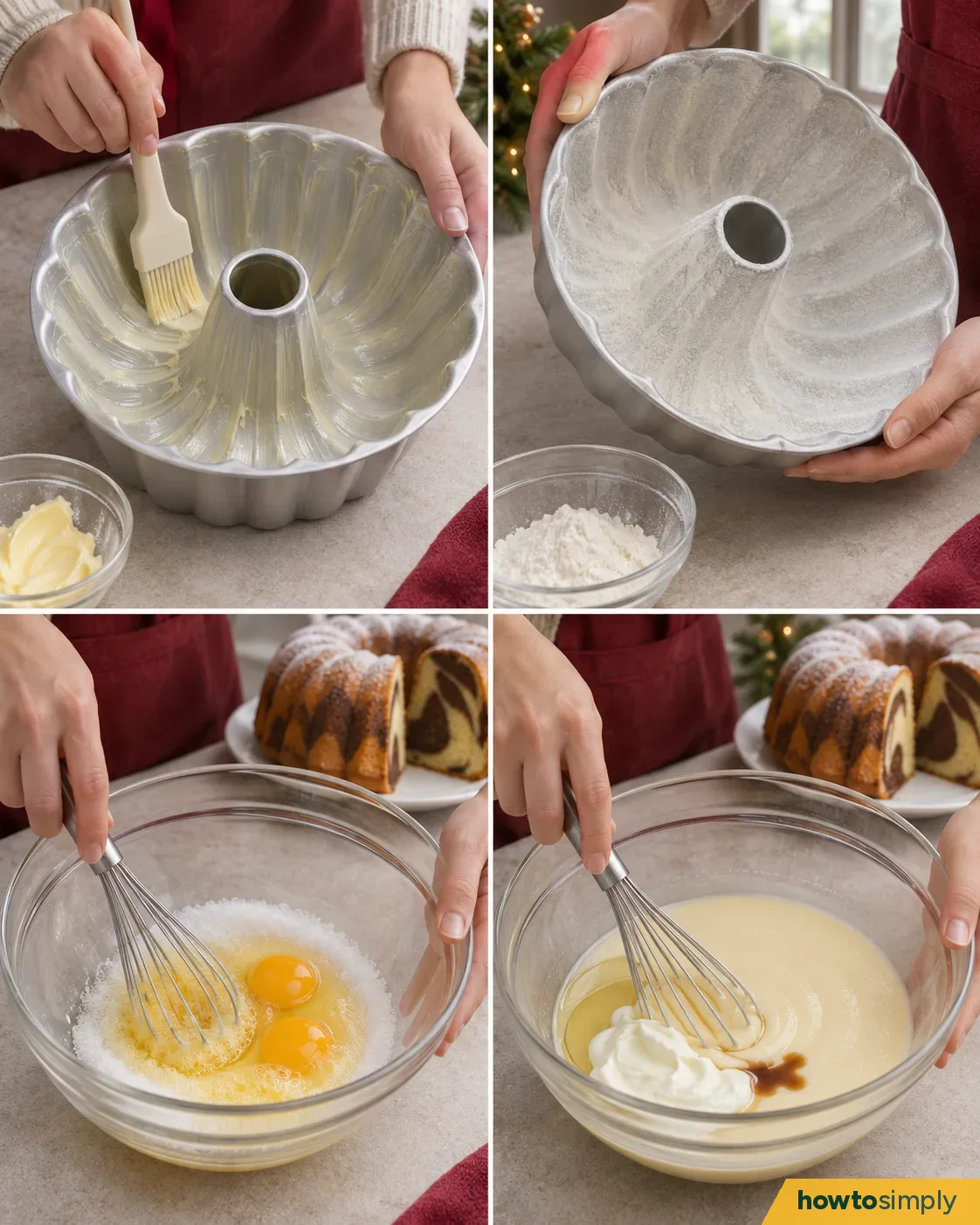
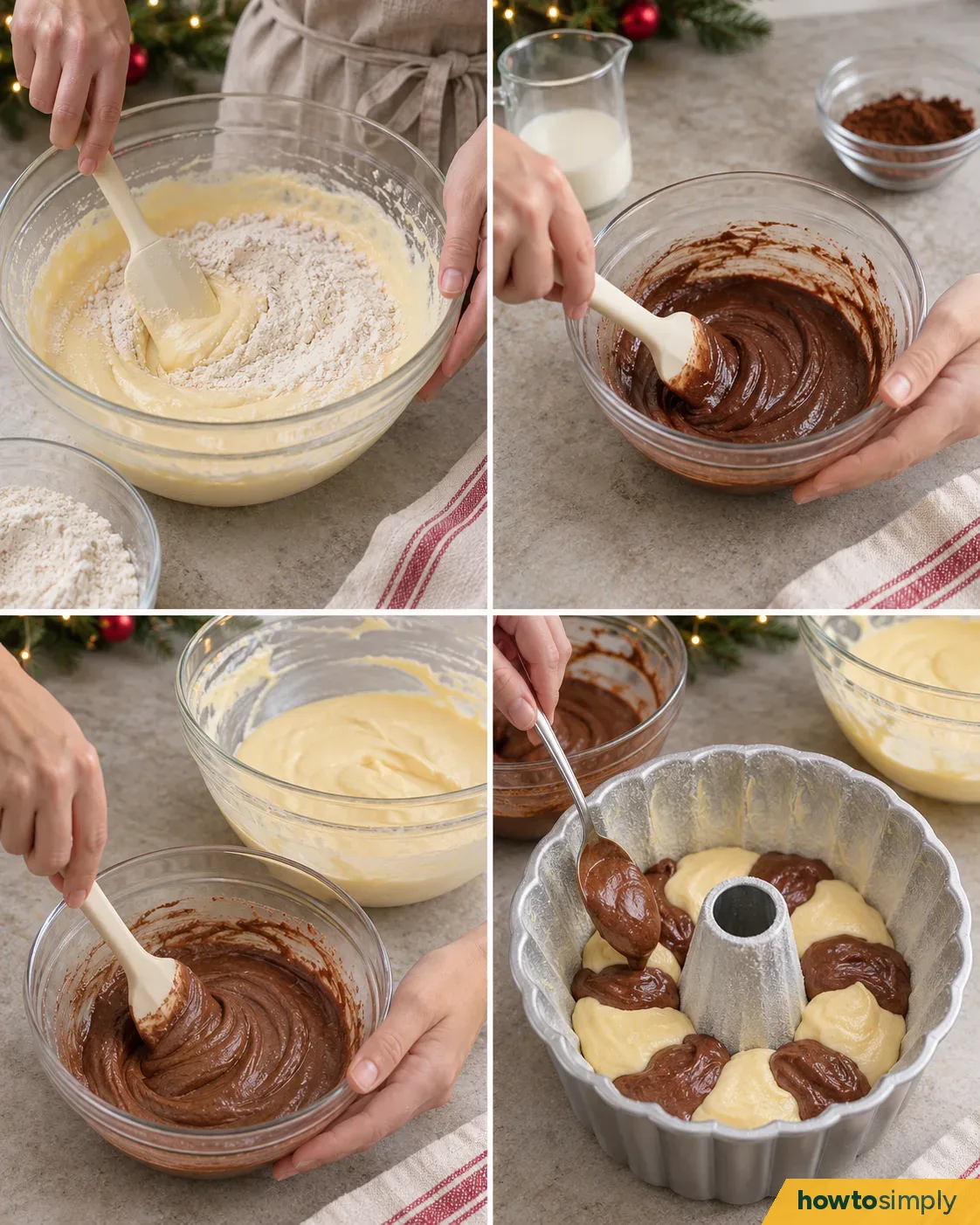
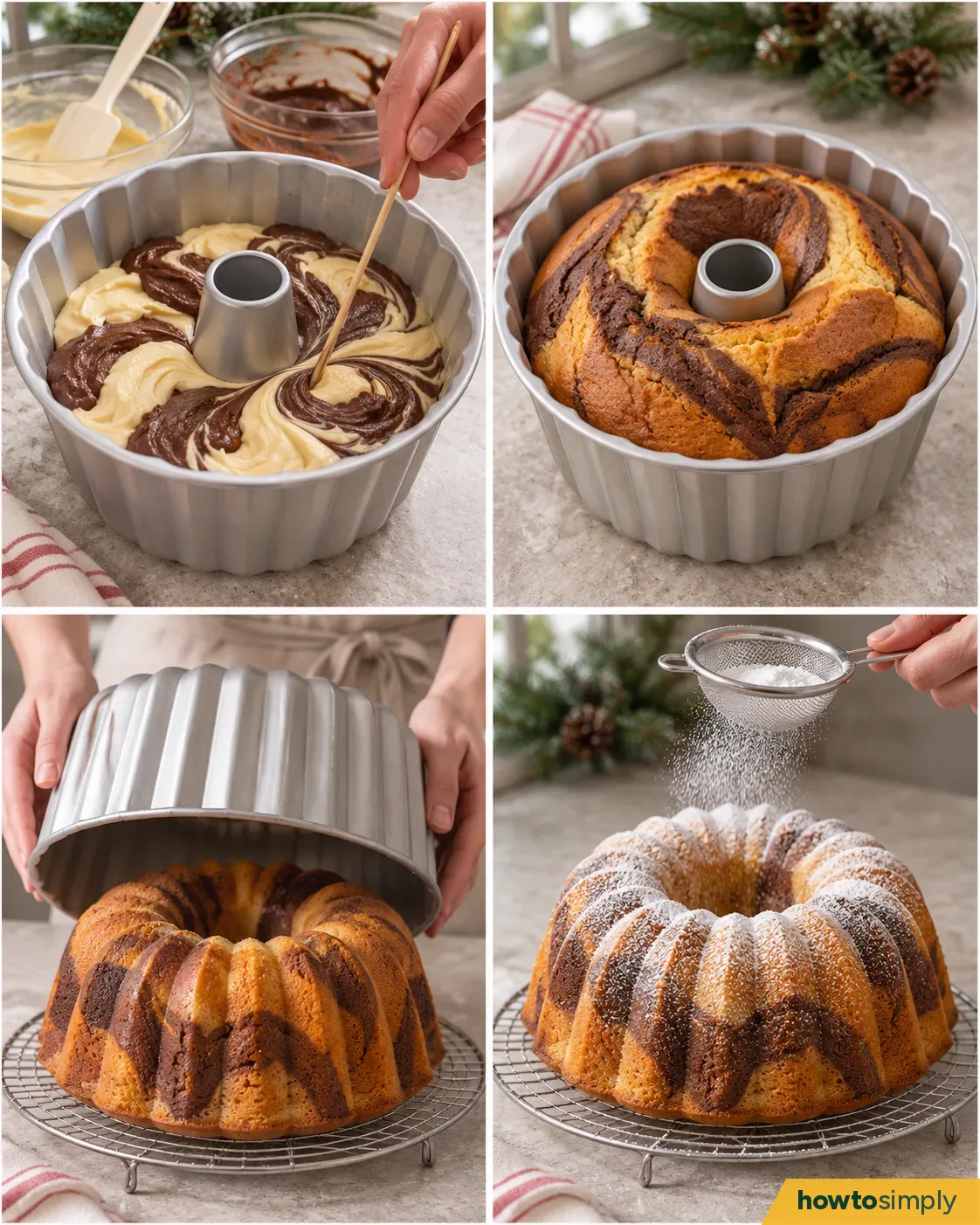
- Each step picture below shows four moments of its step. Read it from top left to bottom right.
Ingredients
- 10 g (about 2 teaspoons) soft unsalted butter, for the tin
- 250 g plain flour (all-purpose flour), split into 10 g for the tin and 240 g (about 2 cups) for the batter
- 2 large eggs, about 100 g without their shells
- 190 g (about 1 cup) caster sugar or fine granulated sugar
- 110 ml (just under ½ cup) mild vegetable oil
- 180 g plain whole-milk yogurt (not strained or Greek-style)
- 10 ml (2 teaspoons) vanilla extract
- 10 g (about 2½ teaspoons) baking powder
- 2 g (about ⅓ teaspoon) fine salt
- 20 g unsweetened cocoa powder
- 35 ml (a little over 2 tablespoons) warm milk
- 5 g icing sugar (powdered sugar), for dusting
Steps
Grease and flour the tin, then whisk the wet ingredients
Heat the oven to 175°C conventional or 155°C fan (about 350°F), with a shelf in the middle. Brush the butter all over the inside of the tin, working it into every groove and around the middle tube. Tip in 10 g of the flour, tilt and turn the tin until it's coated, then tap out the loose flour. Look for any bare patches and touch them up.
In the large bowl, whisk the eggs and sugar for 1–2 minutes, until pale and foamy. Slowly whisk in the oil, then the yogurt and vanilla, until smooth.
Make two colours and fill the tin
Stir the other 240 g of flour with the baking powder and salt, then tip it into the wet mixture. Scrape the spatula down the side of the bowl and lift batter from the bottom over the flour. Repeat just until the last dry patches disappear.
In the medium bowl, stir the cocoa and warm milk into a smooth paste. Add about a third of the vanilla batter (roughly 275 g) and stir until it's evenly brown. Using a different spoon for each colour, drop big spoonfuls around the tin, alternating vanilla and chocolate. For the next layer, put chocolate on top of vanilla and vanilla on top of chocolate.
Swirl once, bake and turn out
Push the skewer almost to the bottom of the tin and draw it once around the ring in a loose wavy line, then lift it out. Stop there: you want clear patches of both colours, not a muddy brown. The picture shows more swirling than you need.
Bake for 35–45 minutes. At 35 minutes, test halfway between the outer edge and the middle tube. It's done when it springs back when you press it and a skewer comes out with just a few crumbs. If it has shiny batter on it, bake for 3 more minutes and check again.
Leave the cake in the tin for 10 minutes. Put the rack upside down over the tin and, wearing oven mitts, hold them together and flip them over. Lift the tin off. Let the cake cool for about 50 minutes, until it feels cool underneath. Sift the icing sugar lightly over the ridges just before serving.
If this doesn't work
- The tin won't come off: put it back down over the cake, lay a warm, damp tea towel over the tin for 3–5 minutes, then tap the outside gently and lift it straight up.
- Bits of cake stayed in the grooves: the tin had bare patches. Press the pieces back on while the cake is warm; the icing sugar hides the joins.
- No marble pattern, just light brown: the batters were swirled too much. One pass with the skewer is enough.
Serving and storing
Cut across the ring into wedges to show the cocoa ribbons. Once completely cool, keep the cake in an airtight container somewhere cool.
Related
- How to make chocolate coconut snow cake
- How to make gingerbread snacking cake
- How to make orange hot chocolate
The pictures in this recipe are illustrations.
Sources and method
- Researched by
- Abu Bakar Saadat
- Pictures
- 4 illustrations drawn for this article: drawings, not photos.
Did this solve the problem?
Where did you get stuck?
Get new guides by email
Our newest guides, sent to your inbox. Free, and you can unsubscribe in one click.
We'll email you to confirm. How we use your email
Follow howtosimply on Facebook
We share every new article on our Facebook page, so the next fix turns up in your feed.
Follow on FacebookWhat did you think?
Reaction counts are loading.