How to make maple pecan upside-down cake
Researched by Abu Bakar Saadat5 min read
Last updated: 21 November 2026References
 Illustration
On this page 7 sections
In short
Melt butter, maple syrup and brown sugar into a 20 cm tin, lay pecan halves in rings, spoon a yogurt vanilla batter over them, bake at 175°C (155°C fan) for 35–45 minutes and turn out while warm. Serves 8.
Overview
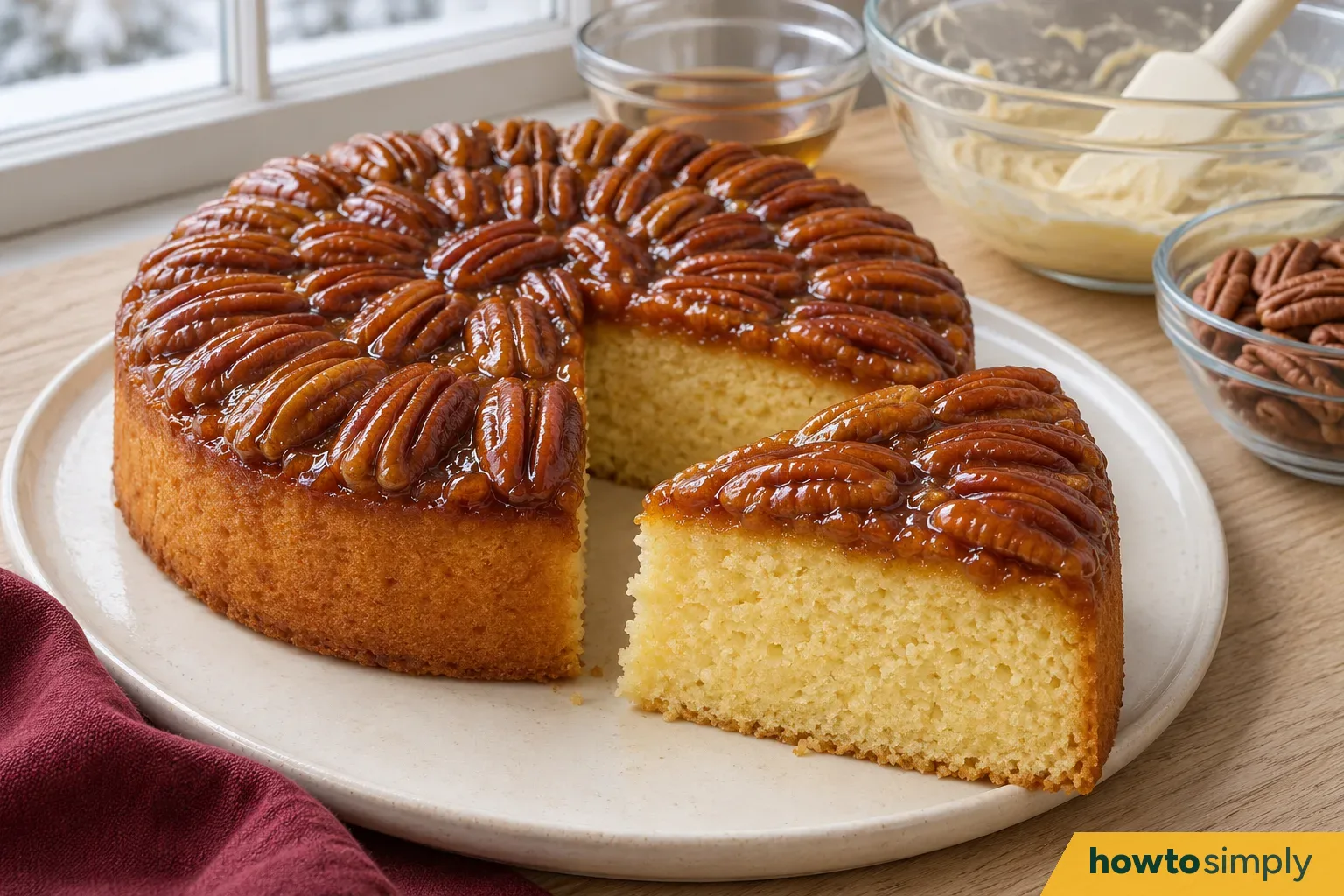
An upside-down cake where the decoration goes in first. Pecan halves sit in rings in a buttery maple and brown sugar syrup, a simple vanilla batter goes over them, and when you turn the baked cake onto a plate the nuts come out on top with a shiny glaze.
| What | This recipe |
|---|---|
| Makes | One 20 cm (8 inch) round cake, 8 slices |
| Oven | 175°C conventional, 155°C fan (about 350°F), middle shelf |
| Prep | 25 minutes, including the maple topping |
| Baking | 35–45 minutes |
| Resting and cooling | 10 minutes in the tin, then 40 minutes on the plate |
| Total | About 1 hour 50 minutes to 2 hours |
| Allergens | Contains tree nuts (pecans), egg, milk (butter, yogurt) and wheat (gluten) |
Before you start
- You'll need: a 20 cm (8 inch) round metal cake tin at least 5 cm (2 inches) deep with a fixed base, baking parchment, a small saucepan, two mixing bowls, kitchen scales, a measuring jug, a whisk, a flexible spatula, a tablespoon, a wooden skewer, a wire rack, a table knife, oven mitts and a heatproof serving plate wider than the tin.
- Use a tin with a fixed base, not a loose-bottomed or springform one. The hot syrup can leak out through the gap.
- Use pure maple syrup, not "pancake syrup", which is mostly flavoured sugar syrup.
- Each step picture below shows four moments of its step. Read it from top left to bottom right.
Ingredients
- 45 g (about 3 tablespoons) unsalted butter, split into 5 g (1 teaspoon) for the tin and 40 g for the topping
- 50 ml (about 3½ tablespoons) pure maple syrup
- 50 g soft light brown sugar
- 100 g (about 3½ oz) pecan halves
- 2 large eggs, about 100 g without their shells
- 130 g (about ⅔ cup) fine granulated sugar
- 125 g plain whole-milk yogurt
- 80 ml (about ⅓ cup) mild vegetable oil
- 5 ml (1 teaspoon) vanilla extract
- 175 g (about 1½ cups) plain flour (all-purpose flour)
- 7 g (about 1¾ teaspoons) baking powder
- 2 g (about ⅓ teaspoon) fine salt
Steps
Make the maple topping and lay the pecans
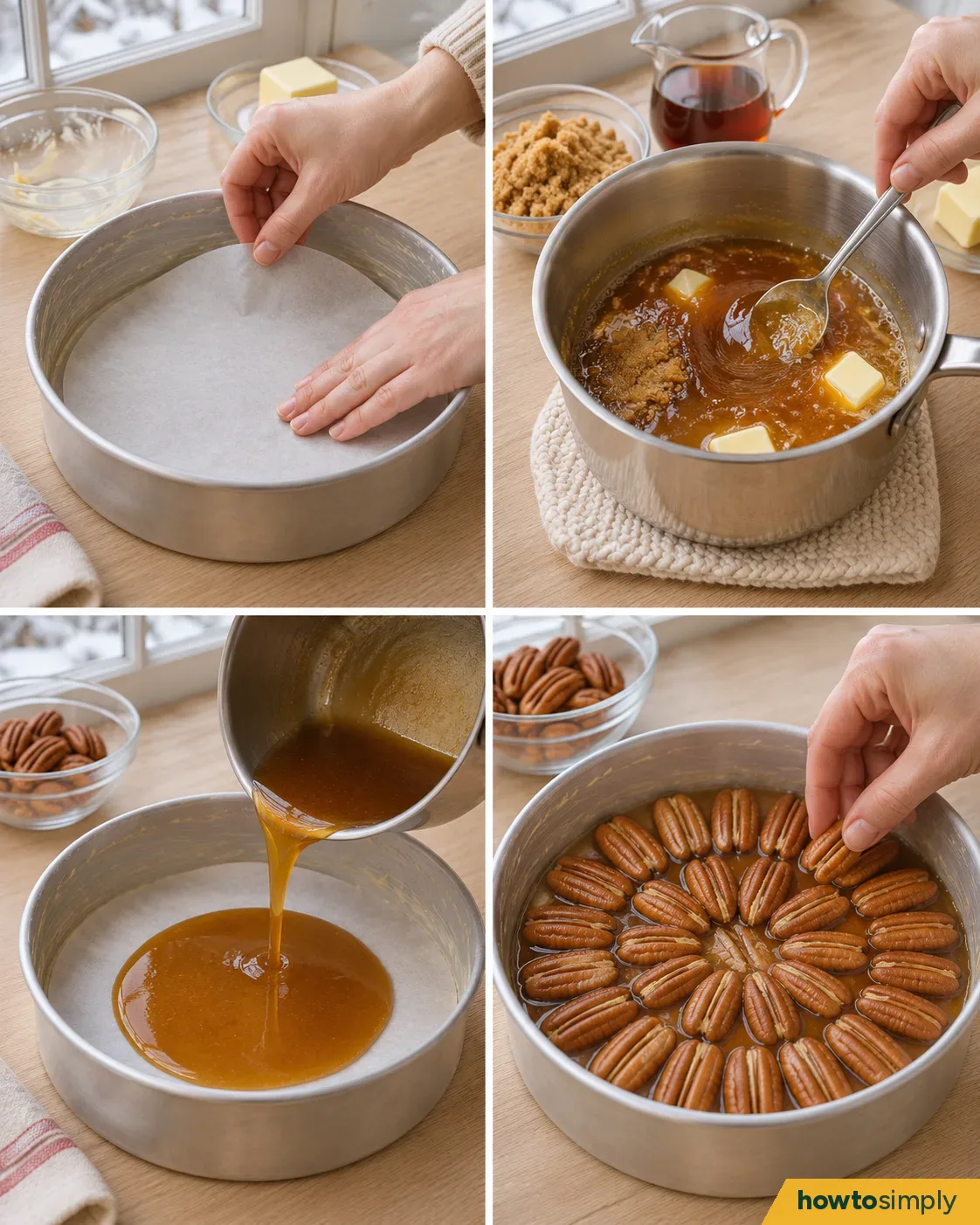
Heat the oven to 175°C conventional or 155°C fan (about 350°F), with a shelf in the middle. Rub 5 g of the butter inside the tin and press a circle of parchment onto the base.
Put the other 40 g of butter, the maple syrup and the brown sugar in the saucepan over medium-low heat. Stir for 2–3 minutes, until the butter has melted and the mixture looks glossy. Pour it into the tin and tilt the tin so the syrup covers the base.
Starting at the outside edge, lay the pecans side by side in rings, with the side you want to show facing down onto the paper. It ends up on top. Nudge them into place with a spoon, as the syrup is hot, and tuck smaller pieces into the middle.
Mix the vanilla batter and spoon it over the nuts
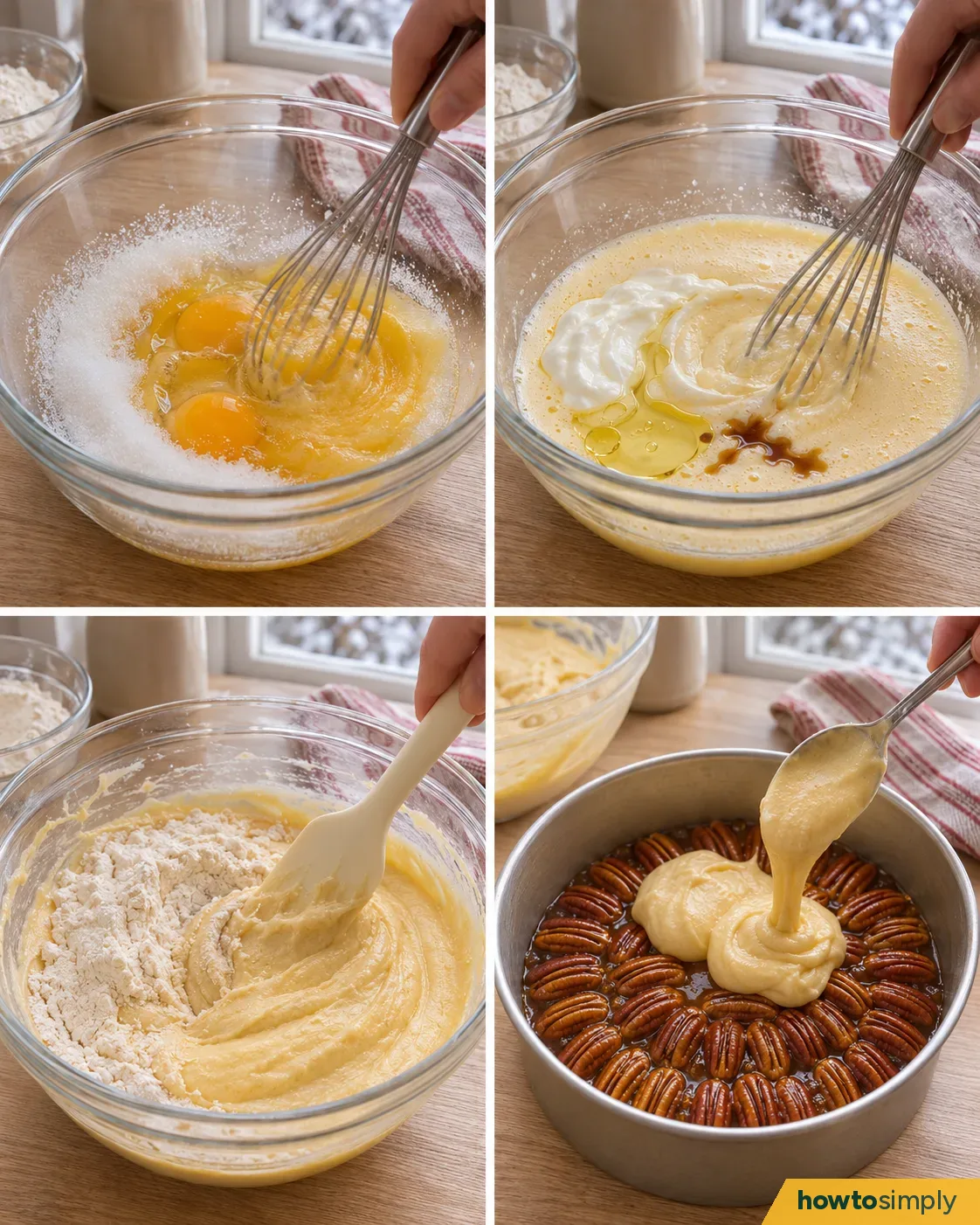
Whisk the eggs and granulated sugar for 1–2 minutes, until pale and full of small bubbles. Whisk in the yogurt, oil and vanilla until smooth.
In the second bowl, stir the flour, baking powder and salt together, then tip them into the wet mixture. Switch to the spatula and fold: scrape down the side, lift batter from the bottom over the flour, and repeat for 30–60 seconds, stopping as soon as the last dry streak disappears. Spoon the batter over the pecans in small mounds, so you don't push them out of their rings.
Bake, then turn the cake out while it's warm
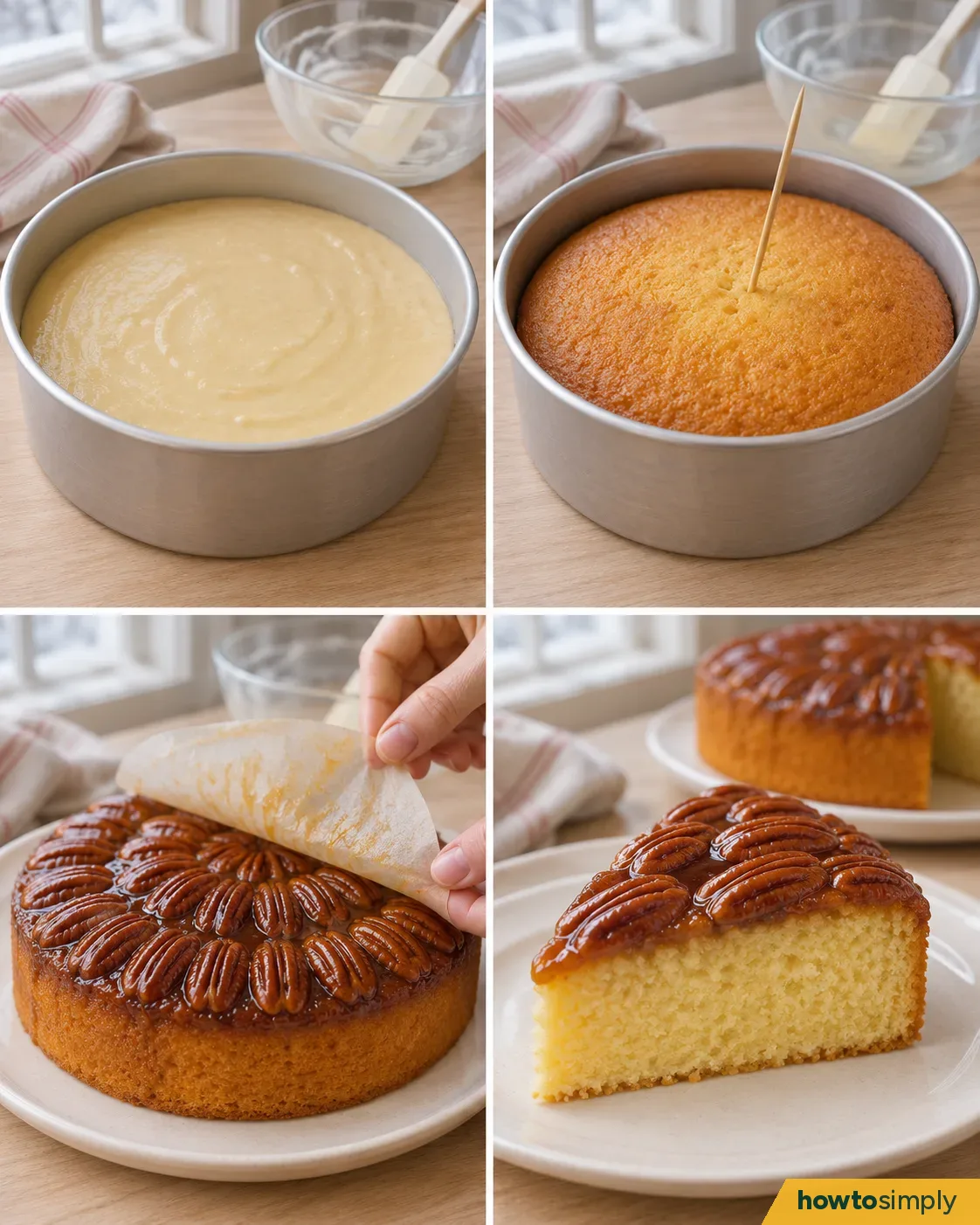
Gently join the mounds with the back of the spoon so the nuts are covered. Bake for 35–45 minutes, checking from 35 minutes. The middle should spring back when you press it lightly. Push the skewer into the middle, stopping before it reaches the syrup at the bottom. A few moist crumbs mean it's done. If you see wet batter, bake for 3 more minutes and check again.
Stand the tin on the rack for 10 minutes. Run the table knife around the inside edge. Put the serving plate upside down on top of the tin. Wearing oven mitts, hold the tin and plate together, flip them over in one go and set the plate down. Lift the tin straight up and slowly peel off the paper. Leave the cake for 40 minutes so the glaze can settle before you slice it.
If this doesn't work
- Some pecans stuck to the paper: while the glaze is still warm, lift them off with a spoon and press them back into their gaps. The glaze holds them as it cools.
- The cake won't come out of the tin: it has probably cooled too long and the syrup has set. Put the tin back in the warm oven (switched off) for a few minutes to soften it, run the knife around again and turn it out.
- Syrup leaked onto the oven floor: the tin had a loose base or wasn't deep enough. Next time use a fixed-base tin at least 5 cm deep, and put a baking tray on the shelf below to catch drips.
Serving and storing
Serve slightly warm or at room temperature. For neat slices, start the knife between two pecans and use short sawing strokes. Once the cake is completely cool, cover it and keep it somewhere cool.
Related
- How to make cranberry and orange olive oil cake
- How to make gingerbread snacking cake
- How to make date and walnut loaf cake
The pictures in this recipe are illustrations.
Sources and method
- Researched by
- Abu Bakar Saadat
- Pictures
- 4 illustrations drawn for this article: drawings, not photos.
Did this solve the problem?
Where did you get stuck?
Get new guides by email
Our newest guides, sent to your inbox. Free, and you can unsubscribe in one click.
We'll email you to confirm. How we use your email
Follow howtosimply on Facebook
We share every new article on our Facebook page, so the next fix turns up in your feed.
Follow on FacebookWhat did you think?
Reaction counts are loading.