How to make lemon and poppy seed madeleines
Researched by Abu Bakar Saadat4 min read
Last updated: 21 November 2026References
 Illustration
On this page 7 sections
In short
Rub lemon zest into sugar, whisk in eggs, fold in flour, poppy seeds and melted butter, chill the batter for 45 minutes, then bake in a buttered madeleine tin at 200°C (180°C fan) for 9–12 minutes. Makes 12.
Overview
Madeleines are small French butter cakes baked in a shell-shaped tin, with a soft hump on one side and crisp golden ridges on the other. Lemon zest rubbed into the sugar gives these a bright smell, poppy seeds add a light crunch, and a dusting of icing sugar sits in the ridges like snow. The batter needs 45 minutes in the fridge, so start an hour and a half before you want them.

| What | This recipe |
|---|---|
| Makes | 12 madeleines |
| Oven | 200°C conventional, 180°C fan (about 400°F), middle shelf |
| Prep | 20 minutes |
| Chilling | 45 minutes |
| Baking | 9–12 minutes |
| Cooling | 12 minutes |
| Total | About 1 hour 30 minutes |
| Allergens | Contains egg, milk (butter) and wheat (gluten) |
Before you start
- You'll need: a metal 12-hole madeleine tin (each shell about 7 cm long), kitchen scales, a small saucepan, a pastry brush, a fine grater, a large mixing bowl, a whisk, a sieve, a flexible spatula, two teaspoons and a wire rack.
- Use an unwaxed lemon if you can, because you're eating the skin. Wash and dry it either way.
- Don't skip the chill. Cold, thick batter in a cold tin is what gives madeleines their raised middle.
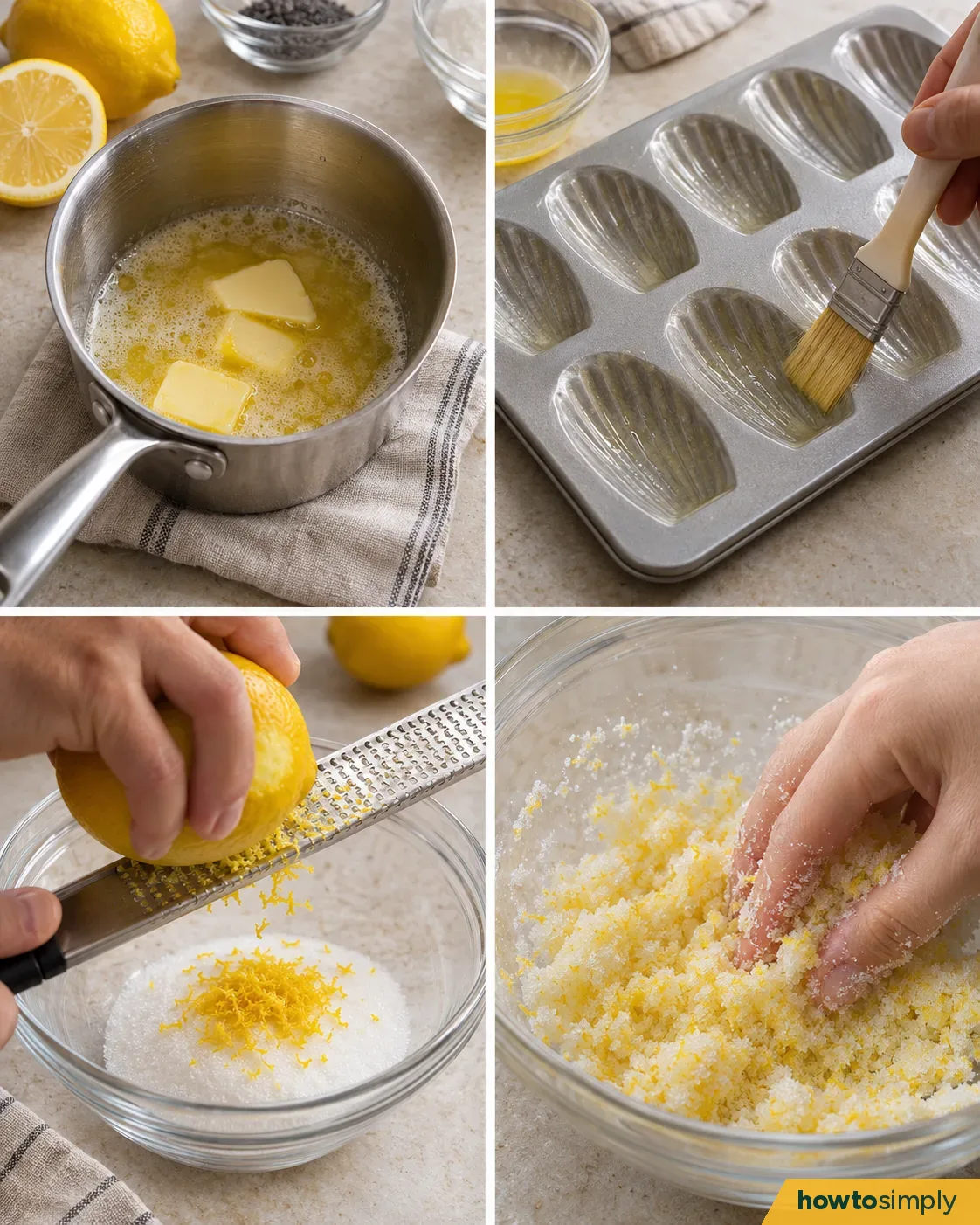
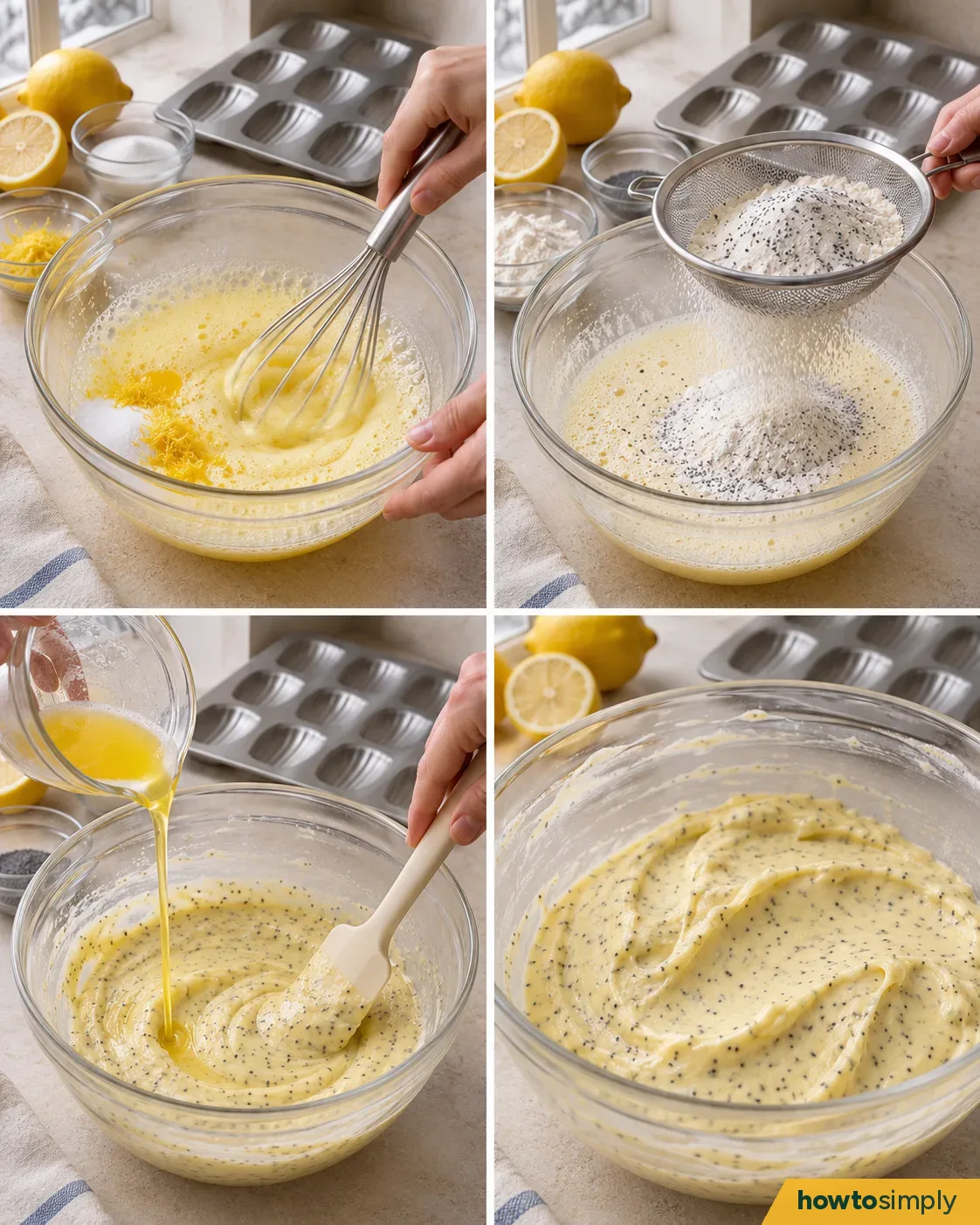
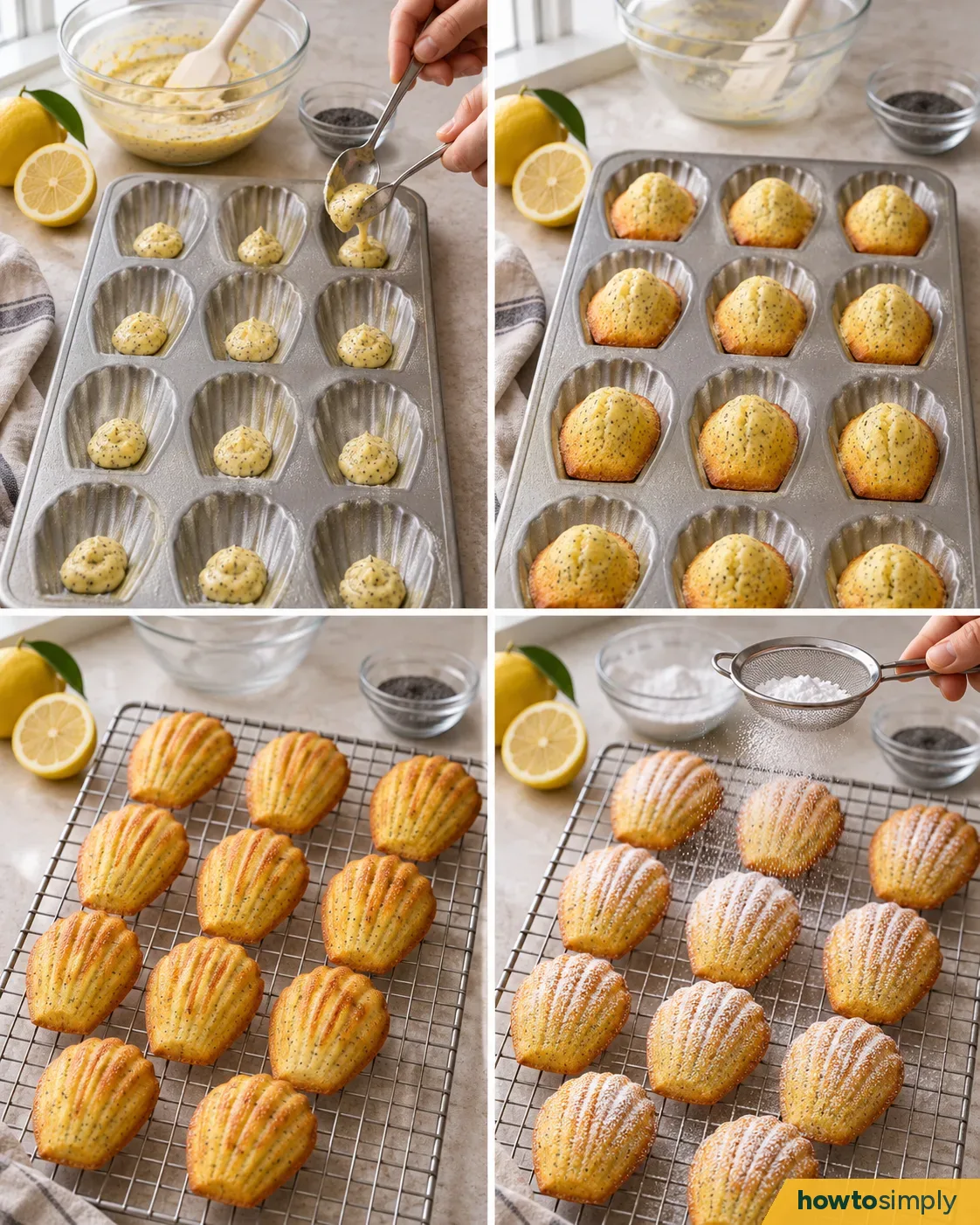
- Each step picture below shows four moments of its step. Read it from top left to bottom right.
Ingredients
- 75 g (about 5 tablespoons) unsalted butter, split into 10 g for the tin and 65 g for the batter
- 70 g (about ⅓ cup) caster sugar or fine granulated sugar
- 1 unwaxed lemon, for about 2 teaspoons finely grated zest
- 2 medium eggs, about 90 g without their shells
- 80 g (about ⅔ cup) plain flour (all-purpose flour)
- 3 g (about ¾ teaspoon) baking powder
- 1 g (a generous pinch) fine salt
- 6 g (about 2 teaspoons) poppy seeds
- 5 g icing sugar (powdered sugar), for dusting
Steps
Butter the tin and rub the lemon into the sugar
Melt all the butter in the saucepan over low heat for 2–3 minutes. Spoon about 10 g into a small dish and brush a thin layer into every groove of the tin, then put the tin in the fridge. Leave the other 65 g of butter to cool until it's lukewarm but still liquid.
Put the sugar in the mixing bowl. Grate the yellow lemon skin over it, turning the lemon as soon as you see white underneath (the white part tastes bitter). Rub the zest into the sugar with your fingertips for 30 seconds, until it feels damp and smells of lemon.
Make the batter and chill it
Add the eggs to the lemon sugar and whisk for 3–4 minutes, until pale and foamy. Sift the flour, baking powder, salt and poppy seeds over the bowl, and tip in any seeds left in the sieve. With the spatula, scoop under the mixture and turn it gently over the flour, repeating until there are no dry streaks.
Keep folding while you trickle in the 65 g of lukewarm butter. Stop when the batter looks smooth with no oily streaks. Cover the bowl and put it in the fridge for 45 minutes. It's ready when a spoon pulled through it leaves a track. Turn the oven on to 200°C conventional or 180°C fan (about 400°F) for the last 15 minutes of chilling.
Fill, bake and dust
Take the cold tin out of the fridge. Use one teaspoon to scoop the batter and the other to push it into the middle of each shell, about 26 g each. Leave the mounds as they are; they spread into the grooves in the oven.
Bake for 9–12 minutes, checking from 9 minutes. They're done when the edges are golden and the raised middles spring back when you touch them lightly. Leave them in the tin for 2 minutes, then tip them out onto the rack, ridges facing up, and cool for 10 minutes. Sift the icing sugar lightly over them just before serving.
If this doesn't work
- A cake is stuck in the tin: slide the rounded tip of a teaspoon under its wide end and ease it forward along the grooves. If several stick, stand the warm tin on a damp tea towel for 1 minute and try again.
- No hump in the middle: the batter or the tin was probably too warm. Chill both for the full time, and don't spread the batter out in the shells.
- The edges are dark but the middles are pale: your tin may be dark-coloured, which browns faster. Check from 8 minutes next time.
Serving and storing
Madeleines are best on the day, with tea, while the edges are still crisp. If you make them ahead, keep them airtight once completely cool and leave off the icing sugar. To crisp them up again, warm the undusted cakes for 3 minutes at 160°C conventional or 140°C fan, let them cool a little, then dust.
Related
- How to make cinnamon shortbread fingers
- How to make coconut macaroons
- How to make raspberry almond thumbprint cookies
The pictures in this recipe are illustrations.
Sources and method
- Researched by
- Abu Bakar Saadat
- Pictures
- 4 illustrations drawn for this article: drawings, not photos.
Did this solve the problem?
Where did you get stuck?
Get new guides by email
Our newest guides, sent to your inbox. Free, and you can unsubscribe in one click.
We'll email you to confirm. How we use your email
Follow howtosimply on Facebook
We share every new article on our Facebook page, so the next fix turns up in your feed.
Follow on FacebookWhat did you think?
Reaction counts are loading.