Why some countries still have kings
3 min read · 3 steps · Updated 2 October 2026
In short: not all crowns are equal, they were pushed, then there are the kingdoms where the king still rules.

In a world of elections and presidents, more than 40 countries still have a king, a queen, an emperor, a sultan or a prince as head of state. Fifteen of them even share the same king. Charles the Third is head of state of Britain, Canada, Australia, Jamaica, and eleven others.
This is Countries Compared. Today: why do so many countries still have kings and queens, and what do they actually do?
Step by step
Not all crowns are equal
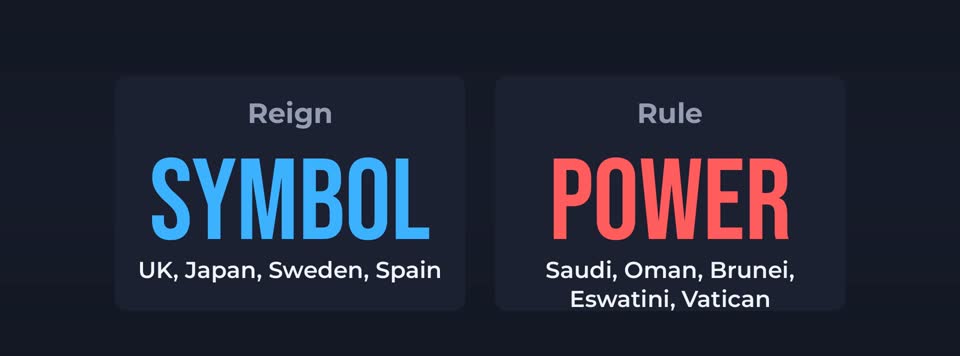
Most modern monarchs reign, but don't rule. In Britain, Japan, Sweden or Spain, the king or emperor is a symbol. Elected governments make the decisions. But in a handful of countries, the monarch really rules. Saudi Arabia, Oman, Brunei, Eswatini, and the Vatican, where the Pope is an absolute monarch.
Europe still has about a dozen monarchies. Britain, Norway, Sweden, Denmark, the Netherlands, Belgium, Spain and Luxembourg. And tiny ones: Liechtenstein, Monaco, and Andorra, which strangely has two princes. The President of France, and a Spanish bishop.
They were pushed
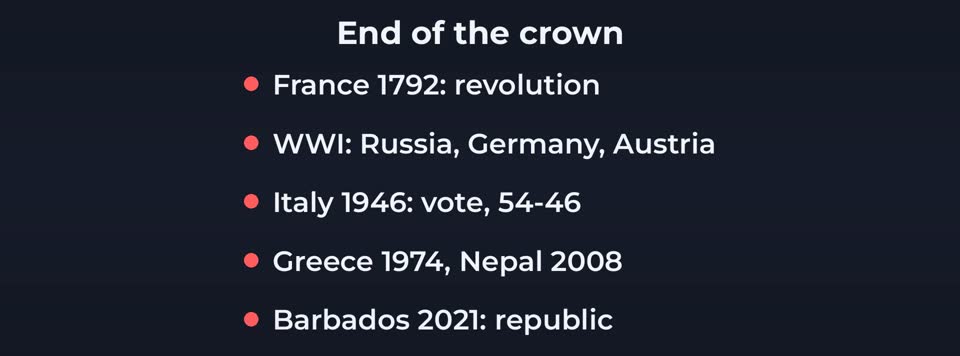
France abolished its monarchy in a revolution in 1792. The First World War swept away the emperors of Russia, Germany and Austria. Italy voted its king out in a referendum in 1946, 54 to 46. Greece did the same in 1974. Nepal's parliament abolished the monarchy in 2008. And in 2021, Barbados replaced the Queen with a president and became a republic.
So what does a modern king or queen actually do? They sign laws, open parliament, and formally appoint the prime minister, almost always the leader who won the election. They host state visits and represent the country abroad. The power is real on paper, but by custom it's used only on the government's advice.
So why did the others survive?
Supporters give a few reasons. A monarch is above party politics. A head of state nobody voted against. A living symbol of the nation and of continuity, and sometimes a referee in a crisis. In 1981, Spain's King Juan Carlos helped stop an attempted military coup, just six years after the monarchy returned.
And when people are asked, they often vote to keep the crown. In 1999, Australians rejected becoming a republic, 55 to 45. But it works both ways. In 1993, Brazilians were asked if they wanted their monarchy back. Only about 13 percent said yes. And Norway chose its king by vote. When it became independent in 1905, a Danish prince agreed to take the throne only if the people approved. Almost four in five voted yes.
The British monarchy is the most famous test case. Taxpayers fund the royal household through the Sovereign Grant, about 132 million pounds in 2025 to 26. Most Britons want to keep the monarchy. But among young adults, support is much weaker.

Then there are the kingdoms where the king still rules
In 2011, the Arab Spring toppled leaders in Tunisia, Egypt, Libya and Yemen. All eight Arab monarchies survived. Researchers point to oil wealth, powerful foreign allies, and broad networks of support. It wasn't just tradition.
Good to know
Some monarchies are protected by law. In Thailand, insulting the king can mean up to 15 years in prison per offense, and some people have been sentenced to decades. And Malaysia has a unique system. Its king is chosen every five years, from among nine hereditary sultans.
And the oldest of them all? Japan. By tradition, its imperial line goes back to 660 BC, though historians only have firm evidence for about 1,500 years. Today's Emperor Naruhito is counted as the 126th.
In short: Kings and queens survive for very different reasons. Some because they have real power. Most because their people still find them useful, or simply familiar. A crown lasts only as long as people want it to.
- The Royal Household (Sovereign Grant report 2025-26)
- Australian Electoral Commission 1999 referendum
- Italian referendum 1946
- Brazil plebiscite 1993
- Norway 1905 referendum
- Barbados 2021
- Imperial Household Agency (Japan)
- YouGov monarchy tracker
Rules and prices change. Check the official source before you act.