Why Iceland is green and Greenland is ice
3 min read · 3 steps · Updated 2 October 2026
In short: let's start with Iceland, greenland's story is about marketing, but the joke isn't quite true either.
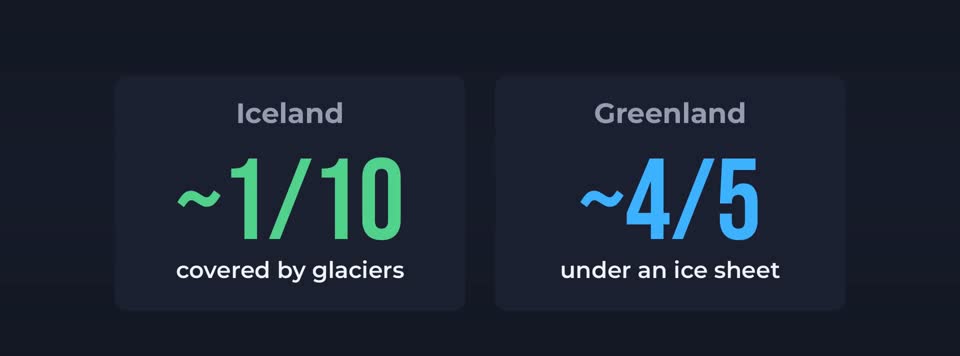
Here's one of geography's favourite jokes. Iceland is mostly green. Greenland is mostly ice. Only about a tenth of Iceland is covered by glaciers. About four fifths of Greenland is buried under an ice sheet.
This is Countries Compared. Today: who named these islands, why, and what really makes them so different?
Step by step

Let's start with Iceland
According to the old Norse Book of Settlements, a Viking sailor called Floki reached the island in the 860s. He's remembered as Raven Floki, because he used ravens to find land. After a hard winter, he climbed a mountain, saw a fjord full of drift ice, and named the place Iceland. Before him, another visitor had called it Snowland. So the cold name stuck early.

Greenland's story is about marketing
Around 982, a man called Erik the Red was exiled from Iceland for killing people. He sailed west and explored a huge land. When he came back, he called it Greenland. As the Icelandic historian Ari wrote, Erik said people would be more eager to go there if the land had a good name. It worked. Around 985, settlers followed him. Greenlanders themselves use a different name: Kalaallit Nunaat, the land of the Greenlandic people.
The Norse settlements lasted more than 400 years, with perhaps a few thousand people on hundreds of farms. The last written record is a wedding at Hvalsey Church, in 1408. After that, the settlements vanished. A colder climate, collapsing trade, or people simply leaving? Historians still debate why.
But names aside, why are they actually so different?
It's not latitude. Reykjavik and Nuuk, the two capitals, sit almost exactly as far north as each other. The difference is the ocean.
A branch of the warm North Atlantic Current, which comes from the Gulf Stream, flows along Iceland's south and west coasts. It keeps winters surprisingly mild, around freezing in Reykjavik in January. Greenland's east coast gets the opposite, a cold current carrying ice down from the Arctic. And Nuuk's January average is about minus seven. On top of the ice sheet, it's far colder. In 1991, a weather station there recorded minus 69.6 degrees, the coldest temperature ever measured in the Northern Hemisphere.
And Greenland is huge. Its ice sheet covers 1.7 million square kilometers, and in places it's more than three kilometers thick. If it all melted, sea levels around the world would rise by about seven meters.
And it is melting. Satellites show Greenland losing more than 250 billion tons of ice a year, on average, since 2002.
Iceland has another advantage. It sits right on the Mid Atlantic Ridge, where two tectonic plates pull apart. It has around 30 active volcanic systems. And that heat is useful. About nine in ten Icelandic homes are heated by geothermal water.

But the joke isn't quite true either
Iceland isn't that green. When the Vikings arrived, forests may have covered a quarter of the island. Today, only a tiny share. And in winter, much of it is white or brown. Meanwhile, Greenland's southern fjords turn genuinely green in summer. Farms there are part of a UNESCO World Heritage site. So Erik the Red wasn't lying completely.
Good to know
Today, Iceland is an independent country of around 400,000 people. Greenland has about 57,000, most of them Inuit. It governs itself, but it's still part of the Kingdom of Denmark.
In short: One island was named by a man who saw ice on a bad day, the other by a man who needed settlers. More than a thousand years later, both names are still doing their job.
- Landnamabok
- Ari Thorgilsson's Islendingabok
- Danish Meteorological Institute
- NASA GRACE/GRACE-FO (Greenland ice mass)
- World Meteorological Organization (-69.6 C
- Klinck 1991)
- Statistics Iceland
- Statistics Greenland
Rules and prices change. Check the official source before you act.